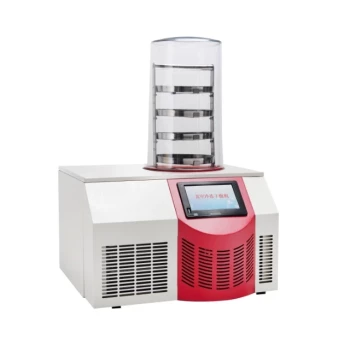
A laboratory vacuum drying oven is the definitive tool for preserving the structural integrity of N/TiO2-x mesocrystal nanocubes during synthesis. Used specifically after washing cycles involving deionized water and ethanol, this equipment lowers the system pressure to rapidly evaporate solvents at a gentle 60°C. This specific environment is non-negotiable because it prevents the collapse of the material's delicate nanoporous structure, which would otherwise occur under high heat or prolonged exposure to surface tension.
Core Takeaway: The vacuum drying process decouples evaporation speed from high temperature. By lowering the boiling point of residual solvents, you protect the unique hierarchical porous structure of the N/TiO2-x mesocrystals, ensuring they retain the high specific surface area required for peak performance.
Preserving the Nanoporous Architecture
The primary value of the vacuum drying oven lies in its ability to protect the physical geometry of the nanocubes.
Preventing Structural Collapse
The N/TiO2-x mesocrystals possess a unique hierarchical porous structure. If these materials are exposed to high temperatures typical of standard drying, the thermal stress can cause this delicate framework to crumble or fuse.
Mitigating Surface Tension Effects
When water or ethanol evaporates slowly from inside a nanopore, surface tension can exert tremendous force on the pore walls. Rapid evaporation under vacuum reduces the duration and impact of these forces, preventing the pores from closing up.
Maintaining Specific Surface Area
The utility of N/TiO2-x mesocrystals is often directly tied to their specific surface area. By ensuring the pores remain open and uncollapsed, the vacuum oven guarantees the material retains its maximum reactive surface.
The Mechanics of Vacuum Drying
Understanding how the oven operates clarifies why it is superior to standard convection ovens for this specific application.
Lowering Solvent Boiling Points
By reducing the internal pressure of the chamber, the vacuum oven significantly lowers the boiling points of solvents like water and ethanol. This allows these liquids to turn to vapor vigorously even at a mild 60°C.
Gentle Thermal Treatment
Because evaporation occurs at 60°C rather than 100°C (for water), the nanocubes are spared from thermal shock. This "soft" drying approach is critical for materials that are chemically or physically sensitive to heat.
Rapid Solvent Removal
Despite the lower temperature, the vacuum environment accelerates the drying process. It effectively pulls volatile substances out of the deep pores of the material more efficiently than air drying or standard heating could achieve.
Understanding the Risks and Trade-offs
While vacuum drying is essential for quality, it introduces specific constraints compared to standard laboratory ovens.
Batch Size Limitations
Vacuum ovens typically have smaller chambers than standard convection ovens to maintain pressure integrity. This limits the volume of N/TiO2-x precursor you can process in a single batch.
Equipment Complexity
Operating under vacuum requires precise control of seals, pumps, and pressure valves. Leaks or pump failures can lead to incomplete drying or pressure fluctuations that may disrupt the synthesis consistency.
Monitoring Challenges
Unlike standard ovens where you might easily open a door to check progress, interrupting a vacuum cycle breaks the pressure seal. This requires the user to rely heavily on preset timing and external gauges rather than visual inspection.
Making the Right Choice for Your Goal
When preparing N/TiO2-x mesocrystals, your drying method dictates the final quality of the material.
- If your primary focus is Structural Integrity: Use a vacuum drying oven at 60°C to ensure the nanoporous framework remains intact and free from collapse.
- If your primary focus is High Surface Area: Rely on vacuum drying to prevent pore blockage or agglomeration, maximizing the material's reactive potential.
The vacuum drying oven transforms a potentially destructive drying phase into a precision step that locks in the material's critical properties.
Summary Table:
| Feature | Vacuum Drying (60°C) | Standard Convection Drying | Impact on N/TiO2-x |
|---|---|---|---|
| Temperature | Low/Gentle (60°C) | High (>100°C) | Prevents thermal shock and framework fusion |
| Solvent Removal | Rapid via low pressure | Slow via evaporation | Minimizes surface tension and pore collapse |
| Pore Integrity | Preserved | High risk of collapse | Maintains high specific surface area |
| Structure | Hierarchical porous intact | Agglomerated/Closed pores | Ensures peak material performance |
Elevate Your Nanomaterial Synthesis with KINTEK Precision
Don't let improper drying compromise your research. KINTEK specializes in high-performance laboratory equipment designed to protect your most delicate samples. Whether you are synthesizing N/TiO2-x mesocrystals or advanced battery materials, our vacuum drying ovens and cooling solutions provide the precise thermal control you need to prevent structural collapse.
Our value to your lab:
- Comprehensive Range: From high-temperature furnaces and vacuum ovens to hydraulic presses and essential ceramics.
- Tailored Solutions: Specialized tools for battery research, crushing, milling, and high-pressure reactions.
- Reliability: Equipment engineered for consistent, repeatable results in demanding research environments.
Ready to optimize your material performance? Contact our technical experts today to find the perfect drying solution for your specific application!
References
- Xiaolan Kang, Zhenquan Tan. <i>In situ</i> formation of defect-engineered N-doped TiO<sub>2</sub> porous mesocrystals for enhanced photo-degradation and PEC performance. DOI: 10.1039/c8na00193f
This article is also based on technical information from Kintek Solution Knowledge Base .
Related Products
- 56L Vertical Laboratory Vacuum Drying Oven
- 23L Laboratory Vacuum Drying Oven
- Laboratory Scientific Electric Heating Blast Drying Oven
- Benchtop Laboratory Vacuum Freeze Dryer
- Dental Porcelain Zirconia Sintering Ceramic Vacuum Press Furnace
People Also Ask
- Why is a laboratory vacuum drying oven recommended for rice straw residues? Protect Your Biomass Integrity
- What role does a laboratory vacuum drying oven play in the preparation of modified multi-walled carbon nanotubes?
- What is the importance of using a laboratory vacuum drying oven? Preserving Slow-Release Microcapsule Integrity
- Why is a Laboratory Vacuum Drying Oven recommended for PBAT microspheres? Protect Sensitive Polymer Integrity
- What role does a laboratory vacuum drying oven play in processing nanoparticle powder samples? Protect Sample Integrity