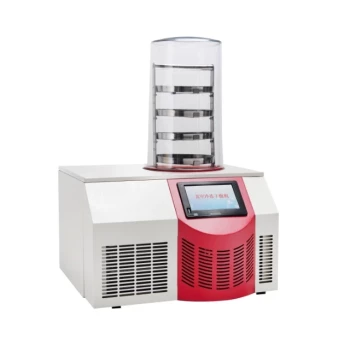
The final treatment of recovered monomers and catalysts relies on the ability of laboratory vacuum drying ovens or high-vacuum manifolds to establish a constant negative pressure environment. This process is essential for the "deep drying" of isolated crystals, ensuring the complete removal of trace vapors—specifically water, methanol, or ethylene glycol—until the material reaches a constant weight.
Core Takeaway Achieving a true "constant weight" via negative pressure is the only definitive way to validate purity and calculate accurate yields. Without this deep drying step, residual solvents will inflate mass measurements and compromise the chemical integrity required for successful re-polymerization or catalyst reuse.
The Critical Role of Negative Pressure
Deep Drying and Trace Impurity Removal
Standard drying methods often leave behind microscopic amounts of solvent trapped within the crystal lattice or pore structure.
Vacuum drying ovens and high-vacuum manifolds utilize constant negative pressure to lower the boiling point of trapped liquids.
This allows for the thorough removal of stubborn solvents like methanol and ethylene glycol, as well as water, which might otherwise remain physically adsorbed to the material.
Achieving Constant Weight
The primary indicator of a successful treatment is achieving constant weight.
This means the material is dried until its mass stops decreasing, confirming that all volatile components have evaporated.
Reaching this state is the only way to ensure that subsequent measurements reflect the actual mass of the monomer or catalyst, rather than the weight of retained moisture.
Implications for Data and Process Integrity
Accurate Yield Calculation
Precise yield calculations are impossible if the recovered material contains residual solvent.
By ensuring the thorough removal of vapors, you eliminate the variable of "solvent weight" from your data.
This provides a true baseline for assessing the efficiency of your recovery process and the actual quantity of isolated monomer crystals.
Catalyst Mass Balance Assessment
For recovered catalysts, understanding the exact mass balance is vital for evaluating process economics and chemical efficiency.
Any retained moisture or solvent distorts the mass balance calculation, leading to incorrect assumptions about catalyst recovery rates.
Vacuum drying ensures the mass measured corresponds strictly to the solid catalyst material.
Purity for Re-polymerization
Meeting Reuse Requirements
Recovered monomers are only valuable if they are pure enough to be used again.
The presence of trace water or alcohols can inhibit reaction kinetics or act as chain terminators during re-polymerization.
Deep drying ensures these materials meet stringent purity standards, allowing them to be reintroduced into the production cycle without degrading final product quality.
Avoiding Structural Damage (Common Pitfalls)
Preventing Agglomeration
Proper drying is not just about chemical purity; it is about physical structure.
If moisture is not removed gently before high-temperature steps (like calcination), the remaining liquid can undergo violent evaporation.
This rapid expansion can cause severe particle agglomeration, ruining the uniformity of the powder.
Preserving Pore Structure
Catalysts often rely on a specific pore structure to function effectively.
Violent evaporation of trapped solvents can cause the collapse of the pore structure, rendering the catalyst less effective or entirely inert.
Using a vacuum oven allows for drying at safer temperatures, preserving the critical physical architecture of the catalyst.
Making the Right Choice for Your Goal
To maximize the value of your recovered materials, prioritize the drying metric that aligns with your downstream application.
- If your primary focus is Process Economics: Prioritize drying to constant weight to ensure your yield calculations and mass balance assessments are statistically accurate.
- If your primary focus is Material Reuse: Prioritize the removal of specific solvents (methanol/ethylene glycol) to prevent chemical interference during re-polymerization.
- If your primary focus is Catalyst Performance: Focus on controlled, gentle drying to prevent pore collapse and agglomeration, ensuring a uniform particle size distribution.
Deep drying under vacuum is the bridge between a recovered raw material and a viable, high-quality chemical resource.
Summary Table:
| Feature | Benefit for Monomers/Catalysts | Impact on Quality |
|---|---|---|
| Negative Pressure | Lowers solvent boiling points | Removes trace water, methanol, and ethylene glycol |
| Deep Drying | Reaches "Constant Weight" | Enables accurate yield calculations and mass balance |
| Gentle Evaporation | Prevents rapid gas expansion | Preserves pore structure and prevents particle agglomeration |
| Thermal Control | Drying at lower temperatures | Maintains chemical integrity and avoids thermal degradation |
Elevate Your Recovery Yields with KINTEK Precision
Ensure the absolute purity and structural integrity of your recovered materials with KINTEK’s advanced laboratory solutions. From high-performance vacuum drying ovens and high-vacuum manifolds to our specialized crushing and milling systems, we provide the tools necessary to achieve constant weight and optimal particle distribution.
Why choose KINTEK?
- Comprehensive Equipment: Explore our range of high-temperature furnaces, hydraulic presses, and autoclaves designed for rigorous research.
- Process Integrity: Protect your catalysts from pore collapse and ensure monomers are ready for re-polymerization.
- Expert Support: Our team helps you select the right consumables, from PTFE products to high-purity ceramics.
Contact KINTEK today to optimize your laboratory workflow!
References
- Emma McCrea, Małgorzata Swadźba‐Kwaśny. Methanolysis of polyethylene terephthalate (PET) using non-stoichiometric protic ionic liquids. DOI: 10.1039/d5su00316d
This article is also based on technical information from Kintek Solution Knowledge Base .
Related Products
- 56L Vertical Laboratory Vacuum Drying Oven
- 23L Laboratory Vacuum Drying Oven
- Laboratory Scientific Electric Heating Blast Drying Oven
- Benchtop Laboratory Vacuum Freeze Dryer
- Dental Porcelain Zirconia Sintering Ceramic Vacuum Press Furnace
People Also Ask
- Why is a laboratory vacuum drying oven recommended for rice straw residues? Protect Your Biomass Integrity
- What role does a laboratory vacuum drying oven play in the preparation of modified multi-walled carbon nanotubes?
- What is the importance of using a laboratory vacuum drying oven? Preserving Slow-Release Microcapsule Integrity
- Why is a Laboratory Vacuum Drying Oven recommended for PBAT microspheres? Protect Sensitive Polymer Integrity
- What role does a laboratory vacuum drying oven play in processing nanoparticle powder samples? Protect Sample Integrity