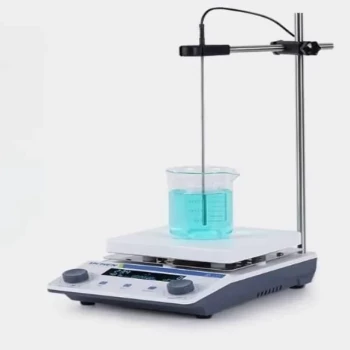
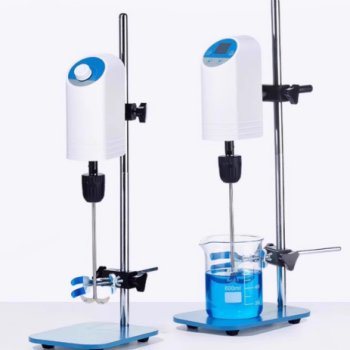
Continuous kinetic perturbation is the defining requirement. A magnetic stirrer is considered essential because it ensures that the sodium borohydride reducing agent and the metal precursor solution come into full, consistent contact. Without this constant agitation, you cannot maintain the uniform reaction environment necessary to synthesize a high-quality PdLa/ATO catalyst.
Core Insight The magnetic stirrer acts as a regulator for the catalyst's microstructure, not just a mixing tool. By maintaining a uniform concentration throughout the solution, it controls the nucleation and growth rates of palladium and lanthanum nanoparticles, preventing them from clumping together on the carrier surface.
Establishing the Reaction Environment
Achieving Kinetic Perturbation
The chemical reduction phase relies on the interaction between the metal precursor and the reducing agent (sodium borohydride).
A magnetic stirrer provides continuous kinetic perturbation. This mechanical force is necessary to break the static nature of the fluid, forcing the reactants to interact dynamically rather than diffusing passively.
Ensuring Full Contact
Passive diffusion is insufficient for this type of catalyst preparation.
The stirrer ensures that the reducing agent makes full contact with the metal precursor solution immediately upon introduction. This eliminates gradients where reactants might otherwise remain separated, ensuring the reaction initiates simultaneously across the entire volume.
Creating Uniform Concentration
The quality of the final catalyst depends heavily on the consistency of the liquid phase.
Stirring maintains a uniform reaction concentration environment. This homogeneity is critical because it ensures that every part of the carrier material is exposed to the same ratio of reactants, preventing inconsistent chemical deposition.
Controlling Nanoparticle Formation
Regulating Nucleation and Growth
The formation of nanoparticles occurs in two stages: nucleation (birth) and growth (enlargement).
The magnetic stirrer effectively controls these rates for both palladium and lanthanum nanoparticles. By keeping the reactant concentration uniform, the stirrer ensures that nucleation happens in a controlled burst rather than sporadically, which is key to achieving specific particle sizes.
Preventing Component Accumulation
Without adequate stirring, active components tend to aggregate.
The kinetic energy provided by the stirrer prevents the active components from accumulating excessively in specific areas on the carrier surface. This dispersion is vital for maximizing the surface area of the catalyst and ensuring the active sites are accessible.
Understanding the Trade-offs
The Risk of Inadequate Mixing
If the stirring speed is insufficient or the mechanism fails, the reaction environment becomes heterogeneous.
This leads to uncontrolled growth, where nanoparticles clump together (agglomerate) rather than spreading out. These "dead zones" or areas of high concentration result in a catalyst with poor dispersion and significantly reduced efficiency.
Mechanical Shear Considerations
While vigorous stirring is necessary, it applies mechanical shear force to the fluid.
In similar chemical synthesis processes, this force aids in molecular-level mixing. However, one must ensure the agitation is consistent; erratic stirring can lead to unpredictable nucleation rates and uneven particle size distribution.
Optimizing Catalyst Preparation
How to Apply This to Your Project
To ensure the highest quality PdLa/ATO catalyst, you must view the magnetic stirrer as a control variable, not just lab equipment.
- If your primary focus is Uniformity: Ensure continuous, steady kinetic perturbation to prevent active components from accumulating in specific spots on the carrier.
- If your primary focus is Particle Size: Use the stirrer to maintain a strictly uniform concentration, which directly regulates the nucleation and growth rates of the nanoparticles.
Consistency in agitation is the key to transforming raw chemical precursors into a highly dispersed, active catalyst.
Summary Table:
| Feature | Role in Catalyst Preparation | Impact on PdLa/ATO Quality |
|---|---|---|
| Kinetic Perturbation | Breaks fluid stasis for dynamic interaction | Ensures simultaneous reaction across volume |
| Concentration Control | Maintains uniform reactant distribution | Regulates nucleation and growth rates |
| Component Dispersion | Prevents active component accumulation | Maximizes surface area and active sites |
| Mechanical Shear | Provides molecular-level mixing | Eliminates "dead zones" and agglomeration |
Elevate Your Catalyst Research with KINTEK Precision
Achieving the perfect nanoparticle distribution requires more than just chemistry—it requires reliable, high-performance laboratory equipment. KINTEK specializes in providing researchers with the tools needed for sophisticated material synthesis, including advanced magnetic stirrers, homogenizers, and shakers designed for consistent kinetic perturbation.
Whether you are developing PdLa/ATO catalysts or working on advanced battery research, our comprehensive portfolio—ranging from crushing and milling systems to high-temperature reactors and specialized electrolytic cells—ensures your lab is equipped for excellence.
Ready to optimize your synthesis process? Contact us today to find the perfect equipment for your lab and experience the KINTEK advantage in precision and durability.
References
- Paulo V. R. Gomes, Almir Oliveira Neto. Synergistic Pd-La Catalysts on ATO for Clean Conversion of Methane into Methanol and Electricity. DOI: 10.3390/reactions6010002
This article is also based on technical information from Kintek Solution Knowledge Base .
Related Products
- Laboratory Small Constant Temperature Heated Magnetic Stirrer Heater and Stirrer
- Custom PTFE Teflon Parts Manufacturer for Magnetic Stirring Bar
- High Performance Laboratory Stirrers for Diverse Applications
- Three-dimensional electromagnetic sieving instrument
- Custom PTFE Teflon Parts Manufacturer for PTFE Stirring Bar Recovery Rod
People Also Ask
- What role does a magnetic stirrer with heating play in ZnO nanoparticle synthesis? Precision Control for Quality Results
- What role does a constant temperature heating magnetic stirrer play in MFC-HAp synthesis? Achieve Material Homogeneity
- What is the function of a laboratory magnetic stirrer in Ni–Cr–P electrodeposition? Optimize Ion Transport & Coating
- Why is a laboratory magnetic stirrer required for benzoic acid esters? Boost Reaction Speed & Yield with High RPM
- What role does a laboratory magnetic stirrer play in TiO2 and TiO2-Ag sol preparation? Master Chemical Kinetics