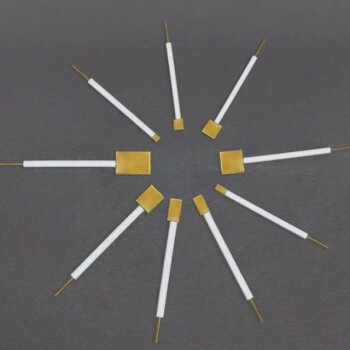
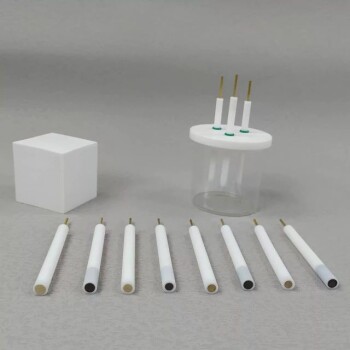
Platinum wire is the standard choice for a counter electrode because of its exceptional chemical inertness and high electrical conductivity. It serves a critical function by completing the electrical circuit in a three-electrode system, ensuring that current flows efficiently without participating in the redox reactions you are trying to measure or dissolving into the electrolyte.
The Core Takeaway The platinum wire acts as a chemically "invisible" charge carrier. Its primary value lies in its ability to facilitate the necessary current loop for electrochemical measurements while ensuring the data reflects only the behavior of your working electrode, not artifacts from the counter electrode itself.
The Role of the Counter Electrode
Completing the Current Loop
In electrochemical characterization, such as cyclic voltammetry, you typically use a three-electrode setup.
The counter electrode (CE) is the essential partner to the working electrode (WE). While the WE is where the reaction of interest occurs, the CE provides the necessary circuit for current to flow.
Balancing the Charge
For every oxidation reaction occurring at the working electrode, a reduction reaction must occur at the counter electrode (and vice versa).
The platinum wire facilitates these balancing reactions—often hydrogen or oxygen evolution—to maintain electrical neutrality in the system without interfering with the target study.
Why Platinum is the Material of Choice
Unmatched Chemical Inertness
The defining characteristic of platinum is its resistance to chemical attack.
Unlike other metals, platinum does not undergo self-dissolution or corrode easily. This is vital because a dissolving electrode would release metal ions into the solution, fundamentally altering the electrolyte composition.
Stability in Aggressive Environments
This inertness holds true even in harsh experimental conditions.
Platinum remains stable in highly acidic solutions (like 1.0 M HCl) or chloride-rich environments (like NaCl). It prevents the counter electrode from becoming a variable in your experiment.
Preventing Signal Interference
Because platinum is chemically stable, it ensures that the current measured is strictly a result of the reactions at the working electrode.
If the counter electrode were to oxidize or react, those parasitic currents would be indistinguishable from the data you are trying to capture, leading to flawed conclusions about the material you are characterizing.
Understanding the Trade-offs: Surface Area and Geometry
The Limitation of Simple Wire
While platinum wire is excellent for general use, it has a relatively small geometric surface area.
In experiments requiring high currents, a simple wire may experience high current density. This can lead to polarization of the counter electrode, where the reaction at the counter electrode becomes the rate-limiting step of the entire system.
Mitigating Polarization
To combat polarization, the effective surface area of the counter electrode generally needs to be larger than that of the working electrode.
For high-current applications, researchers often switch from simple wire to platinum mesh or platinum sheet.
The Role of Platinized Platinum
Another solution found in advanced setups is platinized platinum wire.
This wire is coated with "platinum black," a porous layer that drastically increases the microscopic surface area. This lowers the current density and polarization potential, ensuring precise potential control even during rigorous redox reactions.
Making the Right Choice for Your Goal
When selecting your specific platinum counter electrode configuration, consider the intensity of your electrochemical reaction:
- If your primary focus is standard cyclic voltammetry with low currents: A standard platinum wire is sufficient, offering a cost-effective balance of inertness and conductivity.
- If your primary focus is high-current experiments or large working electrodes: Choose a platinum mesh or platinized wire to maximize surface area and prevent counter electrode polarization from bottlenecking your data.
Ultimately, the platinum electrode is not just a wire; it is the guarantor of purity in your electrochemical system.
Summary Table:
| Feature | Benefit for Electrochemical Characterization |
|---|---|
| Chemical Inertness | Prevents self-dissolution and metal ion contamination of the electrolyte. |
| High Conductivity | Facilitates efficient current flow and completes the electrical circuit. |
| Electrochemical Stability | Ensures measured current reflects only the working electrode's behavior. |
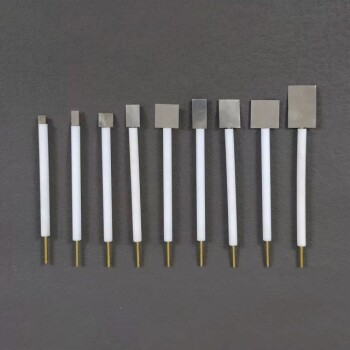
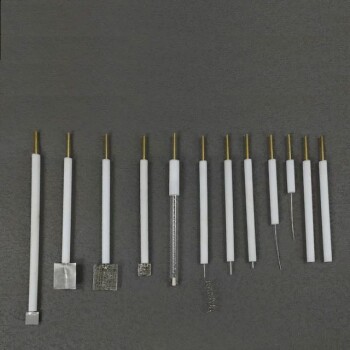
| Versatile Geometries | Available in wire, mesh, or sheet to manage current density and polarization. |
Elevate Your Electrochemical Accuracy with KINTEK
Don't let counter electrode artifacts compromise your research data. KINTEK provides high-purity platinum wire, mesh, and sheet electrodes designed for maximum stability and performance in diverse electrolytic environments.
Beyond electrodes, KINTEK specializes in a comprehensive range of laboratory solutions, including:
- Electrolytic cells and high-performance electrodes
- Advanced battery research tools and consumables
- Precision high-temperature furnaces and reactors
- Hydraulic presses and sample preparation equipment
Ready to optimize your lab's performance? Contact our technical experts today to find the perfect electrochemical consumables for your specific application.
References
- Thiery Auguste Foffié Appia, Lassiné Ouattara. Electrooxidation of simulated wastewater containing pharmaceutical amoxicillin on thermally prepared IrO2/Ti. DOI: 10.13171/mjc02104071566ftaa
This article is also based on technical information from Kintek Solution Knowledge Base .
Related Products
- Platinum Sheet Electrode for Laboratory and Industrial Applications
- Rotating Platinum Disk Electrode for Electrochemical Applications
- Platinum Sheet Electrode for Battery Lab Applications
- Platinum Auxiliary Electrode for Laboratory Use
- High Purity Gold Platinum Copper Iron Metal Sheets
People Also Ask
- What is a common use for a platinum sheet electrode? As a Reliable Counter Electrode in Electrochemical Cells
- What is the most critical guideline for immersing a platinum sheet electrode in an electrolyte? Ensure Accurate Electrochemical Measurements
- What is the purity of the platinum sheet in a platinum sheet electrode? The Key to Reliable Electrochemical Data
- What is the expected lifespan of a platinum sheet electrode? Maximize Your Electrode's Service Life
- What are the available specifications for platinum sheet electrodes? Find the Perfect Fit for Your Electrochemical Needs