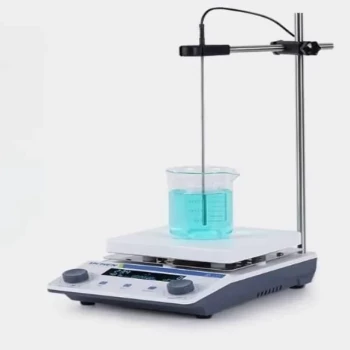
A powerful magnetic stirrer serves as the critical mechanical driver that maintains the homogeneity of your photocatalytic system. Its primary function is to keep catalyst particles, such as titanium dioxide, physically suspended in the solution to prevent sedimentation. Without this constant agitation, gravity would force the catalyst to the bottom of the reactor, effectively halting the reaction in the upper layers of the fluid.
Core Insight: The magnetic stirrer does not just mix fluids; it eliminates mass transfer resistance. By ensuring the reaction is limited only by the chemistry of the catalyst and not by the physics of transport, it allows your data to reflect the catalyst's intrinsic activity rather than experimental flaws.
The Mechanics of Particle Suspension
Preventing Sedimentation
In a static or weakly stirred solution, solid catalyst particles will naturally settle due to gravity.
Titanium dioxide and similar semiconductors are relatively heavy compared to the solvent. A powerful stirrer counters this gravitational force, keeping the particles distributed evenly throughout the entire volume of the reactor.
Maximizing the "Reaction Trinity"
For photocatalysis to occur, three distinct elements must occupy the same space simultaneously: the catalyst particle, the pollutant molecule (e.g., methylene blue), and the UV photon.
The stirrer acts as the facilitator for this meeting. By keeping the solution dynamic, it statistically maximizes the frequency of collision between these three components.
Uniform Photon Exposure
If the catalyst settles, it forms a dense layer at the bottom of the vessel.
This layer blocks UV light from penetrating, meaning only the top layer of the sediment is active. Vigorous stirring ensures that every catalyst particle has an equal opportunity to intercept UV photons necessary for activation.
Validating Experimental Integrity
Eliminating Mass Transfer Resistance
"Mass transfer resistance" refers to the difficulty reactant molecules have in traveling to the catalyst surface.
If the fluid is stagnant, pollutants must rely on slow diffusion to reach the catalyst. Powerful stirring creates convective currents that force pollutants against the catalyst surface, ensuring the reaction speed is determined by the chemistry, not the travel time.
Measuring Intrinsic Activity
The ultimate goal of characterizing a photocatalyst is to determine its intrinsic activity—its true potential.
If your stirring is inadequate, your results will show a lower degradation efficiency than what is actually possible. High-speed stirring removes physical variables, ensuring your measured efficiency is an accurate representation of the catalyst's capabilities.
The Risks of Inadequate Agitation
False Data Interpretation
The most dangerous pitfall of weak stirring is generating false negatives.
You may discard a highly effective catalyst simply because it settled out of suspension during the test. The failure in this scenario is mechanical, not chemical.
Inconsistent Light Scattering
A well-stirred solution creates a "cloud" of particles that scatters light internally.
This scattering increases the path length of the photons, giving them more chances to be absorbed. A settled solution loses this optical advantage, leading to wasted light energy.
Making the Right Choice for Your Experiment
If your primary focus is determining True Reaction Kinetics: Ensure the stirring speed is high enough that further increases do not change the degradation rate (the "plateau" of mass transfer).
If your primary focus is Process Efficiency: Verify that the catalyst remains visibly suspended in the upper third of the reactor throughout the entire duration of the experiment.
Powerful agitation is not a variable to be minimized; it is the baseline requirement for accurate photocatalytic data.
Summary Table:
| Feature | Impact on Photocatalytic Process | Scientific Benefit |
|---|---|---|
| Particle Suspension | Prevents catalyst sedimentation (e.g., TiO2) | Maintains active surface area across the reactor |
| Mass Transfer | Eliminates physical transport resistance | Ensures data reflects intrinsic chemical activity |
| Reaction Trinity | Facilitates collision of catalyst, pollutant, and photon | Maximizes degradation efficiency and reaction rates |
| Light Distribution | Promotes uniform internal light scattering | Increases photon path length and absorption probability |
| Data Validation | Removes mechanical variables from kinetics | Prevents false negatives and ensures reproducibility |
Elevate Your Research Precision with KINTEK
Don't let mechanical limitations skew your experimental data. At KINTEK, we specialize in high-performance laboratory equipment designed to meet the rigorous demands of advanced research. Whether you are analyzing reaction kinetics or scaling up process efficiency, our comprehensive range of magnetic stirrers, high-temperature reactors, and crushing and milling systems ensures your catalyst performance is never compromised by poor agitation.
From PTFE consumables to advanced photocatalytic reactor components, KINTEK provides the tools needed for consistent, reproducible results in battery research, material science, and chemical engineering.
Ready to optimize your lab's workflow? Contact our technical experts today to find the perfect solution for your specific application.
References
- H.R. Khan. Sol-Gel Synthesis of TiO2 from TiOSO4 (Part 2): Kinetics and Photocatalytic Efficiency of Methylene Blue Degradation Under UV Irradiation. DOI: 10.3390/catal15010064
This article is also based on technical information from Kintek Solution Knowledge Base .
Related Products
- Laboratory Small Constant Temperature Heated Magnetic Stirrer Heater and Stirrer
- Custom PTFE Teflon Parts Manufacturer for Magnetic Stirring Bar
- Three-dimensional electromagnetic sieving instrument
- High Performance Laboratory Stirrers for Diverse Applications
- Custom PTFE Teflon Parts Manufacturer for PTFE Stirring Bar Recovery Rod
People Also Ask
- What role does a magnetic stirrer with heating play in ZnO nanoparticle synthesis? Precision Control for Quality Results
- What role does a constant temperature heating magnetic stirrer play in MFC-HAp synthesis? Achieve Material Homogeneity
- What is the function of a laboratory magnetic stirrer in Ni–Cr–P electrodeposition? Optimize Ion Transport & Coating
- Why is a laboratory magnetic stirrer required for benzoic acid esters? Boost Reaction Speed & Yield with High RPM
- What role does a laboratory magnetic stirrer play in TiO2 and TiO2-Ag sol preparation? Master Chemical Kinetics