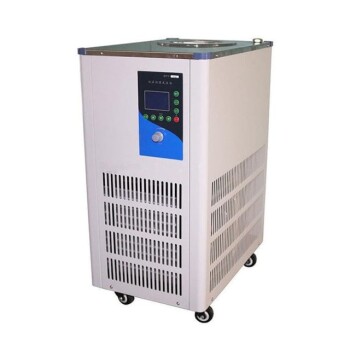
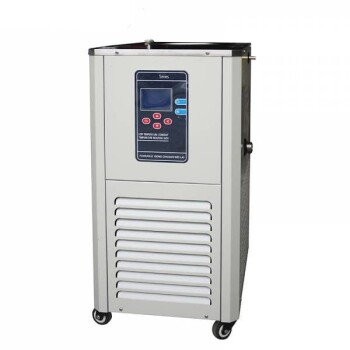
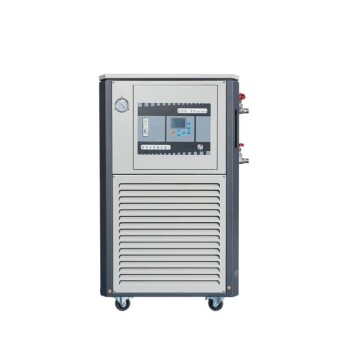
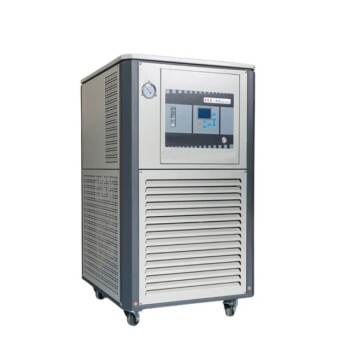
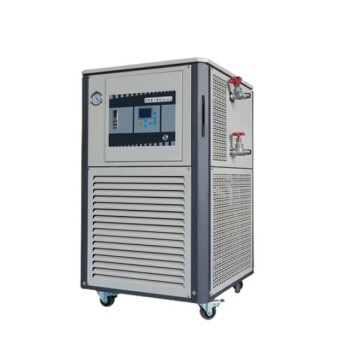
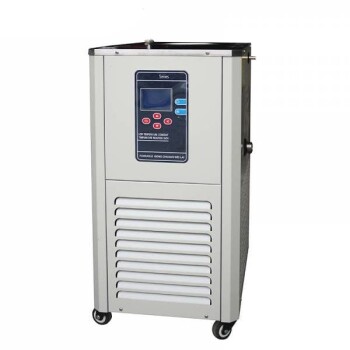
A precision cooling circulation system is the primary control mechanism for determining the physical structure of Polyaniline (PANI). It ensures the oxidative polymerization of aniline monomers and ammonium persulfate occurs strictly at 0 °C. This thermal clamp slows the reaction kinetics, preventing the formation of irregular clusters and favoring the growth of high-performance nanofibers.
The Core Insight
The difference between a high-conductive nanofiber and a standard polymer clump is thermal control. By maintaining a strict 0 °C environment, you suppress chaotic side reactions and dictate a polymerization pathway that favors ordered, linear growth over random aggregation.
The Mechanics of Nanofiber Growth
Regulating Reaction Kinetics
In chemical synthesis, temperature is often a proxy for speed. Precision cooling acts as a brake on the polymerization process.
By holding the environment at 0 °C, the system significantly slows the reaction rate between the aniline monomers and the oxidant (ammonium persulfate). This controlled pace allows the molecules to arrange themselves methodically rather than reacting instantaneously and chaotically.
Suppressing Side Reactions
Chemical reactions often have "competitors"—secondary pathways that create impurities or unwanted structures.
High temperatures fuel these chaotic side reactions. A precision cooling system effectively freezes out these competitive pathways, ensuring that the chemical energy is directed solely toward the desired polymerization chain.
Guiding Morphology
The ultimate goal of this synthesis is specific geometry: high-aspect-ratio nanofibers.
Without cooling, the polymer tends to crash out of the solution as irregular, granular clusters. The constant low-temperature environment forces the polymer chains to elongate, resulting in the distinct nanofiber shape required for advanced applications.
The Impact on Material Performance
Structural Integrity and Conductivity
There is a direct link between the shape of the polymer and its utility.
Irregular clusters disrupt the flow of electrons, resulting in poor performance. In contrast, the high-aspect-ratio nanofibers produced at 0 °C create long, continuous pathways for electron transport. This specific morphology is vital for significantly enhancing the electrical conductivity of the final material.
The Cost of Thermal Fluctuation
While precision cooling is critical, it introduces strict operational requirements. Understanding the risks of failure is essential.
Sensitivity to Temperature Spikes
The reaction is highly sensitive. Even minor deviations above 0 °C can re-trigger side reactions.
If the cooling system cannot maintain the set point against the heat generated by the reaction (exotherm), the synthesis will revert to producing irregular clusters. Consistency is just as important as the target temperature.
Yield vs. Quality
Operating at 0 °C slows the process down.
This creates a necessary trade-off: you are sacrificing the speed of production to guarantee the quality and conductivity of the output. Attempting to rush the process by raising the temperature will destroy the nanofiber morphology.
Optimizing Your Synthesis Strategy
To ensure high-quality PANI synthesis, align your equipment capabilities with your material goals:
- If your primary focus is Electrical Conductivity: Ensure your cooling system has the capacity to hold 0 °C strictly, as this maximizes nanofiber aspect ratio and electron flow.
- If your primary focus is Structural Uniformity: Prioritize circulation capability to eliminate "hot spots" in the reaction vessel that could lead to irregular clusters.
Success in PANI synthesis is not just about mixing chemicals; it is about strictly enforcing the thermal discipline required to grow nanofibers.
Summary Table:
| Feature | Impact of Precision Cooling (0 °C) | Risk of Thermal Fluctuation (> 0 °C) |
|---|---|---|
| Reaction Kinetics | Controlled, methodical polymerization | Rapid, chaotic side reactions |
| Morphology | High-aspect-ratio linear nanofibers | Irregular, granular clusters |
| Conductivity | Enhanced electron transport pathways | Poor electrical performance |
| Structural Integrity | High uniformity and ordered growth | Random aggregation and impurities |
| Process Goal | High-quality material performance | Increased yield at cost of quality |
Elevate Your Material Science with KINTEK Precision Solutions
Success in PANI synthesis and advanced polymer research demands strict thermal discipline. KINTEK specializes in high-performance laboratory equipment designed to maintain the exact environments your research requires. From precision cooling solutions (ULT freezers, cold traps, and chillers) to our comprehensive range of chemical reactors, magnetic shakers, and high-temperature furnaces, we provide the tools necessary to ensure structural integrity and superior conductivity in your materials.
Ready to optimize your synthesis workflow? Contact KINTEK today to find the perfect thermal control system for your lab!
References
- Abdolreza Mirmohseni, Ali Olad. Preparation of PANI–CuZnO ternary nanocomposite and investigation of its effects on polyurethane coatings antibacterial, antistatic, and mechanical properties. DOI: 10.1007/s40097-018-0290-5
This article is also based on technical information from Kintek Solution Knowledge Base .
Related Products
- 100L Chilling Circulator Cooling Water Circulator for Low Temperature Constant Temperature Reaction Bath Water Bath Cooling
- 80L Chilling Circulator Cooling Water Circulator for Water Bath Cooling and Low Temperature Constant Temperature Reaction Bath
- 10L Chilling Circulator Cooling Water Bath Low Temperature Constant Temperature Reaction Bath
- 5L Chilling Circulator Cooling Water Bath Circulator for Low Temperature Constant Temperature Reaction Bath
- 20L Chiller Water Bath Cooling Circulator Low Temperature Constant Temperature Reaction Bath
People Also Ask
- What function does a circulating cooling chiller perform during the gas adsorption isotherm testing of nanoporous carbon?
- Why is a circulating water chiller required for Prussian Blue nanoparticles? Ensure Stability & Batch Reproducibility
- What is the purpose of a cooling circulation water bath system in electrochemical experiments? Enhance Lab Precision
- How does a constant temperature circulator support the leaching reaction of gold scrap? Optimize Gold Recovery Results
- How do constant temperature circulators impact weight-loss immersion tests? Ensure Precision in Corrosion Analysis