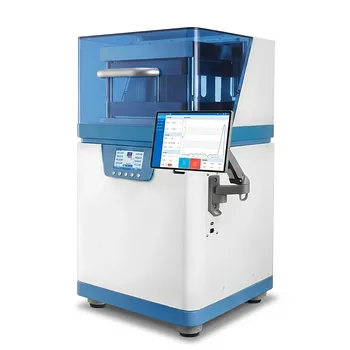
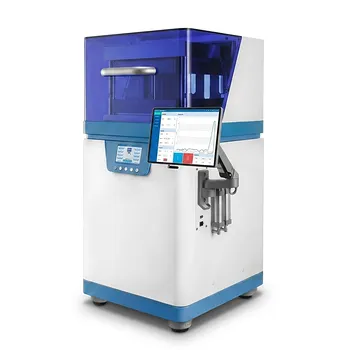
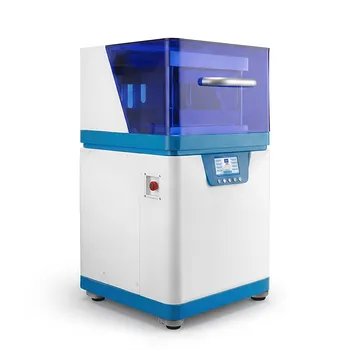
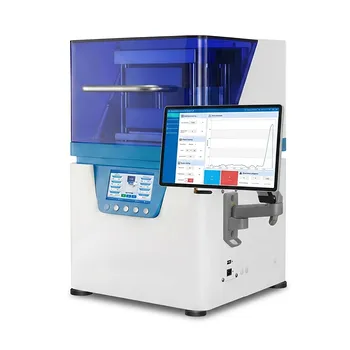
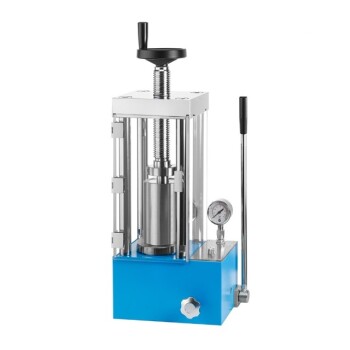
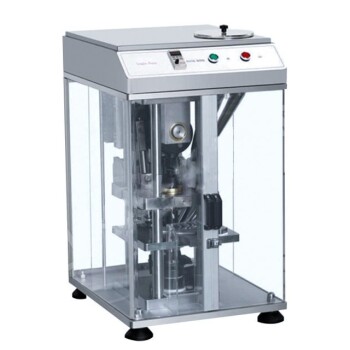
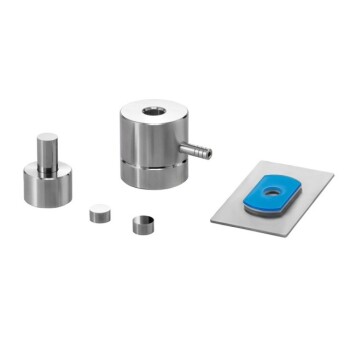
The precision press is the critical tool for establishing the physical and electrochemical integrity of a Membrane Electrode Assembly (MEA). In the fabrication of hydroxide exchange membrane (HEM) systems, it provides the exact, synchronized pressure needed to fuse the catalyst layer, membrane, and gas diffusion layer into a single cohesive unit, which is essential for minimizing ohmic resistance and preventing component delamination during operation.
A precision press ensures high-performance MEA fabrication by creating a seamless interface and strong mechanical bond through controlled force and temperature. This process is the foundation for efficient ion transport and the long-term structural stability of the electrochemical cell.
Achieving Interfacial Integrity and Bonding
Minimizing Interfacial Contact Resistance
A precision press applies constant, uniform pressure to eliminate microscopic gaps between the catalyst layer, the ion exchange membrane, and the gas diffusion layer (GDL). By creating tight physical contact, the press significantly reduces interfacial contact resistance, which is a primary driver of efficiency loss in HEM cells.
Enhancing Ion and Electron Transport
The pressing process establishes effective ion transport channels across the interface of the polymer electrolyte and the catalyst. By inducing micro-melting or thermoplastic softening at the interface, the press ensures that the hydroxide ions can move freely between the membrane and the active sites of the catalyst.
Facilitating Decal Transfer
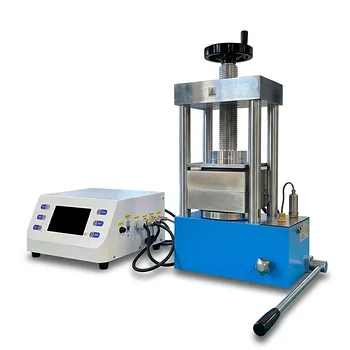
In many fabrication workflows, the catalyst is first coated onto a supporting film rather than the membrane itself. A precision hot press provides the specific temperature and pressure required to transfer the catalyst layer perfectly onto the membrane surface, ensuring a high-quality electrochemical interface.
Mechanical Stability and Component Protection
Preventing Catalyst Delamination
Strong interfacial bonding created by the press prevents the catalyst layer from peeling off or "delaminating" during cell operation. This mechanical lock is vital for maintaining performance over thousands of hours of cycling, especially when the cell is subjected to pressure differentials or fluid flow.
Avoiding Structural Damage to Fragile Layers
While high pressure is needed for bonding, excessive or uneven force can puncture the thin hydroxide exchange membrane or crush the carbon fibers in the gas diffusion layer. A precision hydraulic press allows for "dwelling" control and accurate pressure settings (such as 140 psi) to bond the materials without compromising their structural integrity.
Ensuring Tolerance Against Pressure Differentials
A well-pressed MEA can better withstand the internal mechanical stresses of a full cell stack. Precision lamination enhances the assembly's ability to resist deformation when operating under high-pressure differentials, which is often required in industrial electrolysis or fuel cell applications.
Understanding the Trade-offs
The Risk of Over-compression
Applying too much pressure can lead to the "thinning" of the membrane, which increases the risk of gas crossover and short-circuiting. Over-compression can also reduce the porosity of the GDL, hindering the transport of reactants and products (like water and oxygen) to and from the catalyst sites.
Thermal Sensitivity of HEM Materials
Unlike standard proton exchange membranes, some hydroxide exchange membranes are highly sensitive to thermal degradation. If the precision press is not accurately calibrated, the heat required for bonding can inadvertently break down the polymer backbone or the functional groups of the HEM, leading to a rapid loss in ionic conductivity.
Making the Right Choice for Your Goal
To achieve the best results in HEM fabrication, your pressing parameters must be tailored to your specific material set and performance targets.
- If your primary focus is Peak Efficiency: Use a precision hot press to induce micro-melting at the interface, which maximizes ion transport and minimizes ohmic losses.
- If your primary focus is Long-Term Durability: Prioritize a press with high dwelling-time accuracy to ensure a deep mechanical interlock that prevents catalyst delamination.
- If your primary focus is High-Volume Production: Utilize a precision hydraulic press with programmable cycles to ensure repeatable interfacial quality across multiple MEA batches.
By mastering the balance of pressure, temperature, and time, you transform a stack of separate materials into a high-performance electrochemical engine.
Summary Table:
| Key Benefit | Mechanism | Impact on Performance |
|---|---|---|
| Interfacial Integrity | Eliminates microscopic gaps | Minimizes contact resistance and ohmic loss |
| Ion Transport | Induces micro-melting | Maximizes hydroxide ion mobility |
| Mechanical Stability | Creates deep structural bond | Prevents catalyst delamination during cycling |
| Component Safety | Accurate dwell & force control | Prevents membrane punctures and GDL crushing |
Elevate Your Electrochemical Research with KINTEK
Precision is the heartbeat of high-performance MEA fabrication. KINTEK specializes in advanced laboratory equipment designed to meet the rigorous demands of battery research and green energy development. Our range of precision hydraulic presses (including hot, pellet, and isostatic systems) provides the exact pressure and temperature control necessary to bond sensitive hydroxide exchange membranes without compromising their structural integrity.
Beyond pressing solutions, our portfolio includes high-temperature high-pressure reactors, electrolytic cells, and specialized battery research tools to streamline your entire workflow. Don't let interfacial resistance or component damage hinder your results—contact KINTEK today to discover how our high-precision systems can enhance your lab's efficiency and ensure repeatable, top-tier results.
References
- Rituja Patil, James R. McKone. Reversible alkaline hydrogen evolution and oxidation reactions using Ni–Mo catalysts supported on carbon. DOI: 10.1039/d3ya00140g
This article is also based on technical information from Kintek Solution Knowledge Base .
Related Products
- Automatic Laboratory Heat Press Machine
- Automatic Laboratory Hot Press 400x400 mm with Programmable High Temperature and Hydraulic Force Control
- Large Format Automatic Laboratory Hot Press 400x400 Plate for Industrial Material Sintering and Polymer Lamination
- Automatic Hydraulic Hot Press with 500x500mm Heating Plates and Multi Stage PLC Control for Material Sintering
- Fully Automatic Heated Hydraulic Lab Press for Materials Sintering and Sample Preparation
People Also Ask
- What are the core advantages of using a laboratory hot press to produce Bi2Se3? Achieve 93% Density & High Conductivity
- Why is a laboratory hot press necessary for all-solid-state battery assembly? Reduce Impedance and Enhance Performance
- How does a three-stage pressure program affect rice husk particleboards? Optimize Bond Strength & Stability
- What is the primary function of a laboratory hot press in MEA assembly? Optimize Fuel Cell Bonding & Performance
- How does a laboratory hot press improve alloy performance? Optimize Liquid Phase Sintering for High-Strength Materials