Optimizing structural integrity through pressure control. A three-stage pressure program significantly improves the quality of rice husk particleboards by synchronizing physical compression with resin curing. By initiating a high-pressure phase (e.g., 3.5 MPa) followed by a controlled reduction (to 1.0 MPa), the process eliminates trapped steam, thereby increasing internal bond strength and ensuring dimensional stability.
The core advantage of this method is the mitigation of internal stress. By relieving pressure as the resin cures, the system prevents steam-induced ruptures that otherwise compromise the board's core.
The Mechanics of the Three-Stage Program
Rapid Densification
The first stage of the program utilizes high pressure (specifically cited as 3.5 MPa in laboratory settings). This serves to instantly compress the loose rice husk mat to its target thickness.
This rapid compression is vital for establishing the board's density profile. It forces the particles together immediately, ensuring the mat reaches the desired geometry before the resin begins to cure and harden.
Synchronized Steam Exhaustion
Following the initial compression, the program initiates a pressure reduction phase (dropping to 1.0 MPa) while maintaining constant temperature. This step is engineered to manage the byproducts of the chemical reaction.
As the resin cures and the husks heat up, steam and gases are generated inside the mat. Lowering the pressure creates a pathway for this steam to escape, rather than trapping it inside the compressing material.
Impact on Physical Properties
Enhancing Internal Bond Strength
The primary performance benefit of this technique is a significant increase in Internal Bond (IB) strength.
When steam is allowed to vent during the holding and reduction stages, it does not disrupt the adhesive bonds forming between the rice husks. This results in a cohesive core where the resin cures without interference from high-pressure gas pockets.
Improving Dimensional Stability
Boards produced with this method exhibit superior dimensional stability. The process ensures that the board is formed with minimal residual internal stress.
By avoiding the "springback" effect caused by trapped pressure, the finished particleboard is less prone to warping or swelling after it is removed from the press.
Common Pitfalls to Avoid
The Risk of Constant High Pressure
It is a common error to assume that maintaining maximum pressure throughout the cycle yields a stronger board.
If pressure is not reduced, steam generated during the reaction remains trapped within the mat. This builds up internal stress that often exceeds the strength of the uncured resin.
Preventing "Blowouts"
The immediate consequence of failing to use a multi-stage reduction is often structural failure.
When the press is opened after a single-stage high-pressure cycle, the trapped steam expands violently. This causes the board to delaminate, blister, or suffer a complete "blowout," rendering the material useless.
Making the Right Choice for Your Goal
To maximize the utility of rice husk particleboards, you must tailor the pressure profile to the material's behavior.
- If your primary focus is Structural Integrity: Ensure the initial pressure stage is high enough (e.g., 3.5 MPa) to achieve full densification before the resin sets.
- If your primary focus is Defect Reduction: Strictly monitor the pressure reduction ramp to 1.0 MPa to ensure adequate steam venting and prevent internal blisters.
A properly executed three-stage pressure program is the difference between a usable structural panel and a defective, delaminated board.
Summary Table:
| Stage | Pressure Level | Primary Function | Performance Impact |
|---|---|---|---|
| Stage 1 | High (e.g., 3.5 MPa) | Rapid Densification | Establishes density profile and target thickness |
| Stage 2 | Reduced (to 1.0 MPa) | Steam Exhaustion | Prevents internal stress and steam-induced ruptures |
| Stage 3 | Holding / Release | Resin Curing | Maximizes Internal Bond (IB) strength and stability |
Elevate Your Material Research with KINTEK Precision
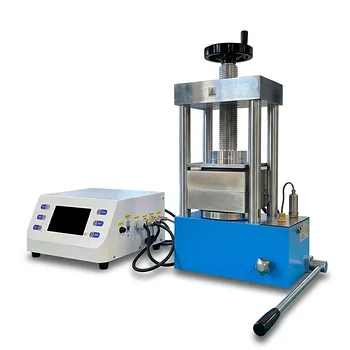
Achieving the perfect pressure profile is critical for developing high-performance composites. KINTEK specializes in advanced laboratory equipment, offering high-precision hydraulic presses (pellet, hot, isostatic) designed to handle complex multi-stage programs for particleboard and resin research.
Whether you are optimizing rice husk panels or exploring new sustainable materials, our comprehensive range—including high-temperature furnaces, crushing systems, and specialized consumables—provides the reliability your lab demands.
Ready to eliminate structural defects and enhance your bond strength? Contact our technical experts today to find the ideal hot press solution for your research goals!
References
- Peng Luo, Yueqi Wang. Effect of liquid hot water pretreatment on selected properties of rice husk and its particleboard. DOI: 10.15376/biores.15.3.6714-6723
This article is also based on technical information from Kintek Solution Knowledge Base .
Related Products
- 30T 40T Split Automatic Heated Hydraulic Press Machine with Heated Plates for Laboratory Hot Press
- Automatic Heated Hydraulic Press Machine with Heated Plates for Laboratory Hot Press
- Heated Hydraulic Press Machine with Heated Plates Split Manual Laboratory Hot Press
- Automatic Laboratory Heat Press Machine
- 24T 30T 60T Heated Hydraulic Press Machine with Heated Plates for Laboratory Hot Press
People Also Ask
- What are the advantages of using a laboratory hydraulic press for hot pressing? Achieve Peak Nano-Composite Density
- What are the core advantages of using a laboratory hot press to produce Bi2Se3? Achieve 93% Density & High Conductivity
- Why is a laboratory hydraulic hot press essential for high-density, additive-free Silicon Carbide? Unlock Pure SiC.
- How does a laboratory hydraulic hot press ensure the quality of PHBV/natural fiber composites? Expert Guide
- What is the function of a laboratory hydraulic hot press in the assembly of solid-state photoelectrochemical cells?