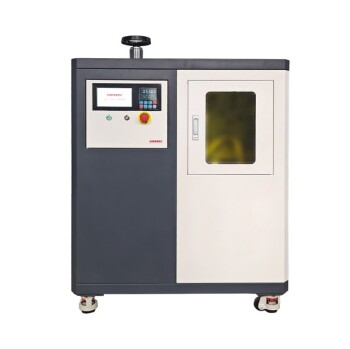
The primary function of a laboratory hot press during the molding of an Oxygen Depolarized Cathode (ODC) is to mechanically fuse the active catalytic layer with the conductive support structure. By applying precise pressure—typically around 15 MPa—at controlled temperatures near 130°C, the press transforms loose components into a unified, conductive electrode.
The hot press serves as the critical compaction step that eliminates structural voids and ensures a tight bond between the catalyst and the current collector, establishing the necessary physical density for electron transport.
The Critical Functions of Hot Pressing
Bonding the Conductive Support
The ODC relies on a nickel mesh to act as a conductive skeleton.
The hot press forces the active catalytic material into the interstices of this mesh. This creates a robust mechanical interface, ensuring the catalyst layer does not delaminate from the support during operation.
Establishing Electron Pathways
For an electrode to function, electrons must move freely between the reaction sites and the external circuit.
Hot pressing compresses the electrode materials, bringing particles into intimate contact. This "continuity of electron transport paths" minimizes internal resistance and maximizes the efficiency of the electrochemical reaction.
Eliminating Structural Defects
Loose packing of materials leads to large, uncontrolled pores that can compromise stability.
By applying significant pressure (15 MPa), the hot press eliminates these large pores. This compaction creates a dense, uniform structure that serves as the foundation for the electrode's long-term mechanical stability.
Distinguishing Compaction from Sintering
The Role of Temperature Control
It is vital to distinguish the hot press step (approx. 130°C) from the subsequent high-temperature sintering step (approx. 330°C).
The hot press uses moderate heat to soften the binder and facilitate compaction. It is not responsible for the chemical decomposition or hydrophobic network formation found in the later stages.
Pore Management vs. Pore Creation
While the hot press removes unwanted large pores through compression, it does not create the essential "reaction micropores."
Those specific micropores are formed later in a high-temperature furnace, where additives like methylcellulose are burned off and PTFE forms a web-like skeleton. The hot press sets the stage; the furnace activates the structure.
Optimizing the Fabrication Process
To ensure high-performance electrode fabrication, consider the following parameters based on your specific objectives:
- If your primary focus is mechanical durability: Ensure the hot press pressure reaches 15 MPa to fully embed the nickel mesh within the catalytic layer.
- If your primary focus is electrical efficiency: Verify that the pressing temperature (130°C) is maintained uniformly to maximize particle contact and electron path continuity.
- If your primary focus is final pore structure: Recognize that the hot press is for densification; rely on the subsequent furnace sintering step to establish hydrophobicity and microporosity.
The hot press is the definitive step that turns a mixture of powders and mesh into a singular, conductive, and mechanically sound component.
Summary Table:
| Process Step | Pressure (MPa) | Temperature (°C) | Primary Function |
|---|---|---|---|
| Hot Pressing | ~15 MPa | ~130°C | Mechanical bonding & electron pathway formation |
| Sintering | N/A | ~330°C | Hydrophobic network formation & pore creation |
| Goal | Compaction | Softening | Creating a unified, conductive electrode structure |
Elevate Your ODC Fabrication with KINTEK Precision
Maximize the efficiency and durability of your electrode production with KINTEK’s industry-leading laboratory equipment. Whether you require precise hydraulic hot presses for critical compaction or high-temperature furnaces for advanced sintering, our solutions are engineered for excellence.
Why Choose KINTEK?
- Comprehensive Range: From high-pressure reactors and pellet presses to specialized furnace systems (tube, vacuum, and atmosphere).
- Tailored Solutions: Specialized tools for battery research, material science, and electrochemical cell development.
- Unmatched Quality: Ensure your catalytic layers never delaminate and maintain optimal electron transport paths.
Ready to optimize your lab's workflow and achieve superior material density? Contact us today to find the perfect equipment for your research!
References
- Marcus Gebhard, Christina Roth. Design of an In-Operando Cell for X-Ray and Neutron Imaging of Oxygen-Depolarized Cathodes in Chlor-Alkali Electrolysis. DOI: 10.3390/ma12081275
This article is also based on technical information from Kintek Solution Knowledge Base .
Related Products
- Automatic Heated Hydraulic Press Machine with Heated Plates for Laboratory Hot Press 25T 30T 50T
- Manual High Temperature Heated Hydraulic Press Machine with Heated Plates for Lab
- Touchscreen Automatic Vacuum Heat Press
- 30T 40T Split Automatic Heated Hydraulic Press Machine with Heated Plates for Laboratory Hot Press
- Vacuum Hot Press Furnace Machine Heated Vacuum Press
People Also Ask
- Why is the heating function of a laboratory hydraulic press essential for MEA assembly in DEFC? Optimize Cell Bonding
- What technical conditions does a heated hydraulic press provide for PEO batteries? Optimize Solid-State Interfaces
- How is a heated hydraulic press used for Li-LLZO batteries? Optimize Interfacial Bonding with Thermal-Pressure
- What role does a heated hydraulic press play in Cold Sintering (CSP)? Enhancing LATP-Halide Densification
- What are heated hydraulic presses used for? Molding Composites, Vulcanizing Rubber, and More