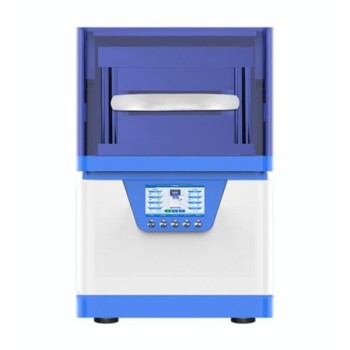
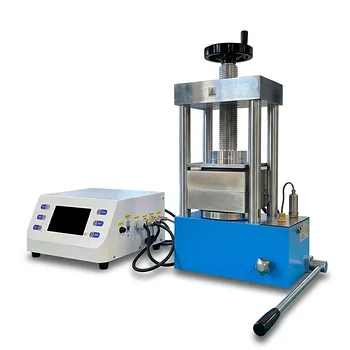
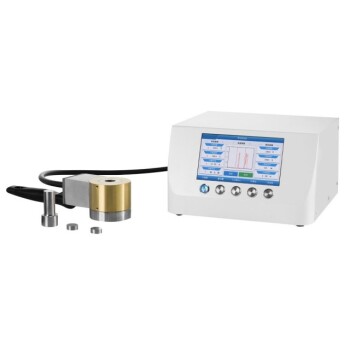
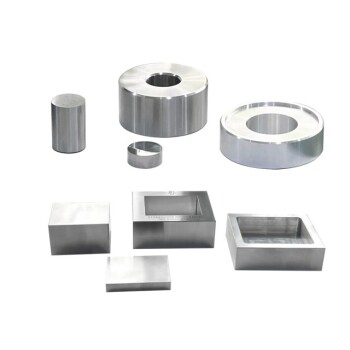
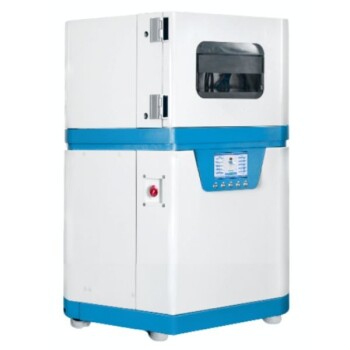
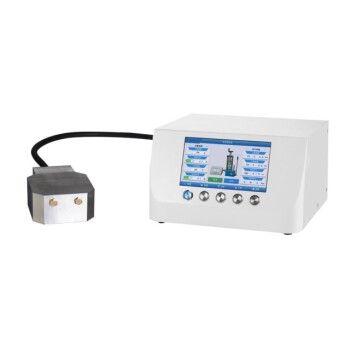
The use of a laboratory hot press is fundamental to the assembly of all-solid-state lithium batteries because it resolves the critical issue of poor physical contact between rigid layers. By applying simultaneous heat and pressure, the hot press eliminates microscopic voids, forcing the cathode and electrolyte into intimate contact at the atomic or molecular level without damaging their internal structures.
The primary value of this process is a drastic reduction in solid-solid interface impedance—often decreasing resistance by approximately 75%—which is the single most significant factor in securing long-term cycle stability and high rate performance.
Overcoming the Solid-Solid Interface Barrier
Eliminating Physical Gaps
In solid-state batteries, the interface between the cathode and electrolyte is naturally prone to voids and gaps.
Unlike liquid electrolytes that flow into pores, solid layers remain rigid and disconnected.
A laboratory hot press applies mechanical force to physically close these gaps, ensuring the active materials touch the electrolyte surface completely.
Drastically Reducing Impedance
The presence of voids creates high resistance to ion flow.
By integrating the layers via hot pressing, you significantly lower the solid-solid interface impedance.
Data indicates this process can reduce impedance from approximately 248 Ω·cm² to ~62 Ω·cm², a reduction that directly translates to better battery efficiency.
Mechanisms of Structural Integration
Achieving Atomic-Level Contact
The combination of heat and pressure does more than just push layers together; it promotes bonding.
This process facilitates intimate contact at the atomic or molecular scale.
This level of integration is necessary to ensure that lithium ions can traverse the boundary between the cathode and electrolyte without obstruction.
Preserving Material Integrity
While the pressure must be significant, the process is designed to be non-destructive.
The hot press achieves integration without damaging the material structure of the battery components.
This balance ensures that while the interface is improved, the intrinsic electrochemical properties of the cathode and electrolyte remain intact.
Mechanical Reinforcement and Safety
Preventing Delamination
Beyond electrochemical performance, the hot press ensures mechanical durability.
The heat treatment enhances interlayer adhesion, which prevents the layers from separating (delamination) when the battery undergoes bending or mechanical stress.
Inhibiting Dendrite Growth
Proper integration establishes a robust buffer structure at the interface.
This unified structure helps inhibit crack propagation within the electrolyte.
Furthermore, a well-bonded interface suppresses the growth of lithium dendrites, which are a primary cause of short circuits and battery failure.
Understanding the Trade-offs
Precision vs. Material Damage
While pressure is necessary, excessive force or temperature can degrade sensitive materials like polymer electrolytes.
You must utilize precise controls (e.g., specific temperatures around 150 °C and pressures like 0.5 bar for certain polymers) to bond the layers without inducing thermal degradation or crushing the porous structures required for ion transport.
Integration vs. Densification
It is important to distinguish the hot press integration step from the initial powder densification.
While a hydraulic press is used to densify powders into pellets, the hot press is specifically required for the interfacial bonding of the layers.
Skipping the hot press in favor of cold pressing alone will likely result in a mechanically weak interface with high resistance.
Making the Right Choice for Your Goal
To maximize the effectiveness of your battery assembly process, apply these principles based on your specific objectives:
- If your primary focus is maximizing power output: Prioritize hot pressing to reduce interface impedance to the ~62 Ω·cm² range, enabling faster ion transport.
- If your primary focus is mechanical longevity: Use the hot press to maximize interlayer adhesion, preventing delamination during physical handling or expansion.
Ultimately, the laboratory hot press transforms a stack of loose components into a single, cohesive electrochemical system capable of high performance.
Summary Table:
| Feature | Impact on Battery Performance | Improvement Metric |
|---|---|---|
| Interface Gaps | Eliminates microscopic voids/gaps | Atomic-level contact |
| Ion Resistance | Lowers solid-solid interface impedance | ~248 Ω·cm² to ~62 Ω·cm² |
| Mechanical Bond | Enhances interlayer adhesion | Prevents delamination |
| Safety | Robust buffer structure | Inhibits lithium dendrite growth |
Elevate Your Battery Research with KINTEK Precision
To transform separate cathode and electrolyte layers into a high-performance electrochemical system, precision is non-negotiable. KINTEK specializes in advanced laboratory hot presses, hydraulic pellet presses, and isostatic systems designed specifically for the rigorous demands of all-solid-state lithium battery assembly.
Our equipment provides the exact temperature and pressure control needed to reduce interface impedance and inhibit dendrite growth without compromising material integrity. Beyond pressing solutions, we offer a comprehensive suite of battery research tools, high-temperature furnaces, and specialized consumables (PTFE, ceramics, and crucibles) to support every stage of your material development.
Ready to optimize your solid-state battery performance? Contact KINTEK today to consult with our experts on the ideal equipment for your lab.
Related Products
- 30T 40T Split Automatic Heated Hydraulic Press Machine with Heated Plates for Laboratory Hot Press
- Automatic Heated Hydraulic Press Machine with Heated Plates for Laboratory Hot Press
- Heated Hydraulic Press Machine with Heated Plates Split Manual Laboratory Hot Press
- Automatic Laboratory Heat Press Machine
- Automatic Heated Hydraulic Press Machine with Heated Plates for Laboratory Hot Press 25T 30T 50T
People Also Ask
- What are the advantages of using a laboratory hydraulic press for hot pressing? Achieve Peak Nano-Composite Density
- What are the core advantages of using a laboratory hot press to produce Bi2Se3? Achieve 93% Density & High Conductivity
- Why is a laboratory hydraulic hot press essential for high-density, additive-free Silicon Carbide? Unlock Pure SiC.
- How does a laboratory hydraulic hot press ensure the quality of PHBV/natural fiber composites? Expert Guide
- What is the function of a laboratory hydraulic hot press in the assembly of solid-state photoelectrochemical cells?