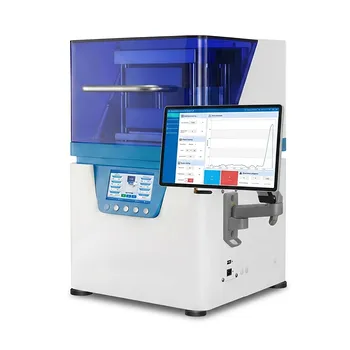
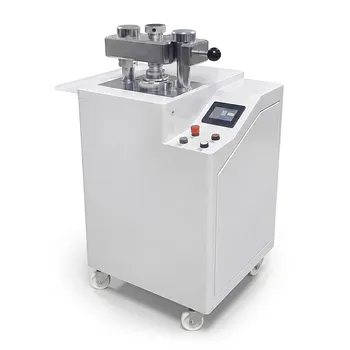
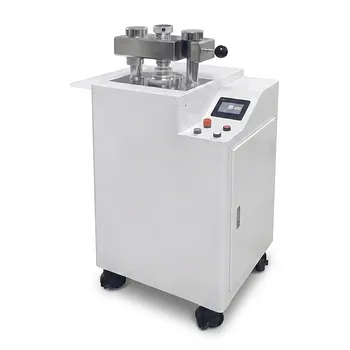
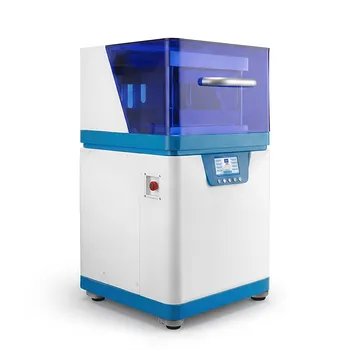
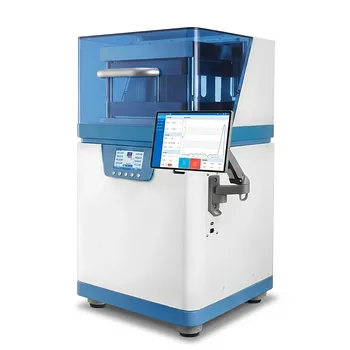
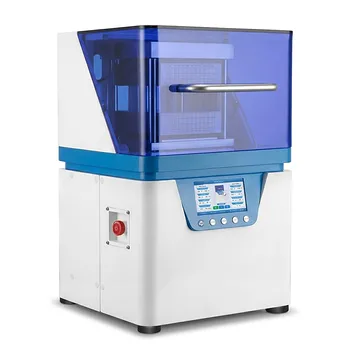
A uniaxial hydraulic press is the foundational tool for PLD target fabrication. It is required to compress loose ceramic powders into a dense, structurally sound "green body" by applying extreme mechanical pressure, typically ranging from 150 MPa to 200 MPa. This process eliminates internal voids and ensures the target can survive high-temperature sintering and the subsequent high-energy laser ablation required for thin-film growth.
A uniaxial hydraulic press transforms loose ceramic powder into a stable, uniform green body through mechanical interlocking and plastic deformation. This pre-forming step is essential to achieve the high density and crack resistance needed for consistent material ablation during the Pulsed Laser Deposition process.
Eliminating Voids and Increasing Density
Particle Rearrangement and Deformation
The primary role of the press is to force individual ceramic particles to overcome internal friction and move closer together. Under extreme pressure, these particles undergo plastic deformation, filling the gaps between them more effectively than gravity or manual packing ever could.
Eliminating Internal Porosity
By applying high mechanical force within a precision mold, the press eliminates large internal pores that would otherwise remain in the material. This ensures a uniform initial density, which is a critical prerequisite for the final sintering stage.
Structural Integrity for Sintering and Ablation
Creating Green Body Strength
The compression process creates a "green body," a temporary state where the powder is held together by mechanical interlocking. This provides the target with enough structural strength to be handled and placed into a high-temperature furnace without crumbling.
Resistance to Laser Bombardment
PLD targets must withstand intense, localized heating from high-energy laser pulses. A hydraulic press ensures the target is free of micro-cracks and density gradients, preventing the target from fracturing or "pitting" unevenly during the deposition process.
Impact on Film Quality
A well-pressed target provides a stable and consistent particle source during ablation. This stability directly impacts the quality of the epitaxial layers, ensuring that the resulting thin films have the desired stoichiometry and structural perfection.
Understanding the Trade-offs and Pitfalls
Pressure Limits and Cracking
While high pressure is necessary, exceeding the material's limits can lead to "lamination" or internal stress cracks when the pressure is released. Finding the optimal pressure—such as the 150-196 MPa range mentioned in technical standards—is vital for target longevity.
Friction and Density Gradients
In uniaxial pressing, friction between the powder and the mold walls can cause the density to be higher at the top than at the bottom. This non-uniformity can lead to warping during sintering if the pressing process is not carefully controlled or if the mold is not properly lubricated.
Optimizing the Pressing Process for Your Project
How to Apply This to Your Target Preparation
The success of your Pulsed Laser Deposition depends heavily on the physical characteristics of your starting ceramic target.
- If your primary focus is High-Density Targets: Use a press capable of reaching at least 150-200 MPa to ensure maximum particle packing and minimal porosity before sintering.
- If your primary focus is Thin-Film Uniformity: Ensure the powder is distributed evenly in the mold before pressing to prevent density gradients that cause uneven laser ablation.
- If your primary focus is Mechanical Stability: Focus on the "dwell time" (the time pressure is held) to allow particles to fully rearrange and mechanically interlock into a robust green body.
A precise pressing stage is the only way to guarantee a ceramic target capable of producing high-quality electronic and optical thin films.
Summary Table:
| Key Feature | Benefit for PLD Target Fabrication | Recommended Specification |
|---|---|---|
| Particle Compaction | Eliminates internal voids and increases green body density | 150 - 200 MPa |
| Structural Strength | Prevents crumbling during handling and high-temp sintering | High Mechanical Interlocking |
| Ablation Stability | Resists laser pitting and ensures uniform material removal | Crack-free Microstructure |
| Stoichiometry | Maintains consistent material ratios in resulting thin films | Uniform Density Distribution |
Precision Tools for Superior Thin-Film Research
Achieving the perfect epitaxial layer starts with a flawlessly prepared target. KINTEK specializes in high-performance laboratory equipment designed to meet the rigorous demands of material science.
Whether you need a uniaxial hydraulic press (pellet, hot, or isostatic) to create high-density green bodies or high-temperature furnaces (muffle, vacuum, or tube) for precision sintering, KINTEK provides the reliability and accuracy your research deserves. Our comprehensive range also includes crushing systems, milling equipment, and specialized consumables like crucibles and ceramics.
Ready to optimize your PLD target fabrication? Contact our experts today to find the ideal pressing and heating solution for your laboratory!
References
- Harald Summerer, Alexander Karl Opitz. Exsolved catalyst particles as a plaything of atmosphere and electrochemistry. DOI: 10.1039/d2ey00036a
This article is also based on technical information from Kintek Solution Knowledge Base .
Related Products
- Fully Automatic Heated Hydraulic Lab Press for Materials Sintering and Sample Preparation
- Automatic XRF Pellet Press 40 Ton Hydraulic Sample Preparation Press for Fluorescent Spectroscopy Analysis
- Automatic Fluorescent Pellet Press for XRF Sample Preparation
- Automatic Hydraulic Hot Press with 500x500mm Heating Plates and Multi Stage PLC Control for Material Sintering
- Automatic Laboratory Hydraulic Pellet Press Machine for Lab Use
People Also Ask
- How is a laboratory hydraulic press used in the preparation of modified biochar samples for FTIR analysis? Expert Guide
- How does a laboratory heating hydraulic press contribute to the preparation of recycled graphite green bodies? - Optimize Density.
- How does the laboratory hydraulic press contribute to the preparation of solid targets for laser ablation?
- What role does a laboratory hydraulic press play in perovskite-MOF glass fabrication? Master Material Densification
- Why use a laboratory hydraulic press for Fe2O3-CoP conductivity? Achieve Precise Material Characterization