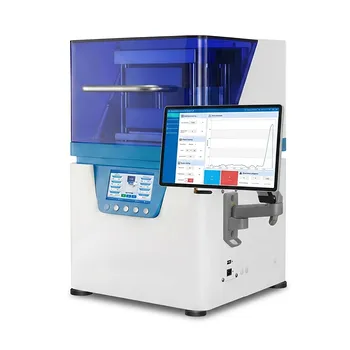
The laboratory hydraulic press is the critical tool for transforming loose precursor powders into high-density "green bodies" necessary for Bi-2223 superconductivity. It applies precise uniaxial pressure to compress Bi-2223 precursor powders (often mixed with additives like graphene) into a solid cylindrical or disk-shaped form. This physical compaction is the prerequisite for the chemical diffusion and phase formation that occur during the subsequent sintering process.
By applying high-precision pressure, the laboratory hydraulic press minimizes particle gaps and maximizes contact area in the powder matrix. This creates the optimal physical environment for element diffusion and the formation of the superconducting phase, directly determining the final material's electrical performance.
Enhancing the Physical Properties of the Green Body
Increasing Particle Contact and Density
The primary function of the press is to apply precise pressure (frequently up to 5 tons) to the precursor powder. This force causes particle rearrangement and mechanical interlocking, which effectively eliminates air gaps and reduces porosity.
A high-density green body ensures that individual powder particles are in intimate contact. This physical proximity is vital because it establishes the initial geometric shape and establishes the necessary density required for high-quality ceramic superconductors.
Establishing Geometric Integrity and Green Strength
Beyond density, the press provides the sample with green strength, which is the mechanical integrity needed for handling. This allows the sample to be moved from the mold to the sintering furnace without crumbling or losing its shape.
By using precision metal molds, the press ensures the green body has a defined and uniform dimension. This uniformity is essential for consistent heat distribution and structural integrity during the high-temperature consolidation phase.
Driving Chemical and Phase Transformations
Facilitating Solid-State Diffusion
The formation of the Bi-2223 phase is a diffusion-controlled solid-state reaction. By reducing the physical distance between particles, the hydraulic press significantly enhances element diffusion across grain boundaries.
Without this high-pressure compaction, the gaps between particles would act as barriers to atomic movement. The press ensures that the precursors are close enough to react chemically when heat is applied in the furnace.
Optimizing the Superconducting Phase Formation
The quality of the Bi-2223 superconducting phase is directly linked to the compaction quality of the green body. Increased contact area promotes a more complete transition into the superconducting phase during sintering.
Ultimately, this process improves the superconducting performance of the material, such as its critical current density. A well-pressed green body leads to a more continuous superconducting path throughout the final ceramic.
Integration of Composite Materials
Securing Silver Wire Reinforcements
In many Bi-2223 applications, the powder is pressed in conjunction with silver wires or metal matrices. The laboratory press facilitates the coaxial pressing of these materials, ensuring the wires are securely fixed and uniformly distributed.
This layer-by-layer alternating stacking and compression establishes a composite structure. The press ensures that the silver wires maintain their position within the powder matrix, providing a stable physical foundation for the final superconducting wire or tape.
Understanding the Trade-offs and Pitfalls
Pressure Uniformity and Internal Stress
While high pressure is beneficial, non-uniform pressure distribution can lead to internal stresses within the green body. If the pressure is not applied evenly, the sample may suffer from "capping" or laminating, where layers of the pellet peel apart.
Managing Excessive Shrinkage and Cracking
If the green density is too low due to insufficient pressure, the sample may undergo excessive volume shrinkage during sintering. This often results in macro-cracks or warping, which destroys the structural integrity and electrical connectivity of the Bi-2223 sample.
How to Apply This to Your Sample Preparation
Making the Right Choice for Your Goal
- If your primary focus is maximizing superconducting phase purity: Ensure you use a press capable of maintaining precise, high-pressure loads (e.g., 5-10 tons) to maximize particle contact for diffusion.
- If your primary focus is composite stability (e.g., adding silver wires): Utilize high-precision, wear-resistant metal molds to ensure the uniform distribution and fixation of the metal reinforcements during the compaction cycle.
- If your primary focus is preventing sample failure: Monitor the compaction rate carefully to achieve optimal green density, which prevents cracking and excessive shrinkage during the subsequent tube furnace firing.
The laboratory hydraulic press is not merely a molding tool, but a fundamental instrument that dictates the chemical viability and physical success of Bi-2223 superconducting materials.
Summary Table:
| Process Stage | Function of Hydraulic Press | Impact on Bi-2223 Sample |
|---|---|---|
| Compaction | Eliminates air gaps & reduces porosity | Increases particle contact for optimal density |
| Structural | Provides green strength & geometry | Ensures integrity during handling & sintering |
| Chemical | Facilitates solid-state diffusion | Accelerates phase transformation & element movement |
| Composite | Coaxial pressing with silver wires | Secures reinforcements for stable composite structures |
| Quality | Uniform pressure application | Prevents cracking, capping, and excessive shrinkage |
Elevate Your Superconductivity Research with KINTEK
Precision is paramount when preparing high-performance Bi-2223 superconducting samples. KINTEK provides industry-leading laboratory solutions designed to ensure your materials meet the highest standards of density and phase purity.
Our comprehensive portfolio includes:
- High-Precision Hydraulic Presses: Manual, electric, and isostatic presses for perfect pellet formation.
- Advanced Thermal Processing: High-temperature tube and muffle furnaces for controlled sintering and diffusion.
- Specialized Accessories: Wear-resistant metal molds and essential consumables like crucibles and ceramics.
Whether you are a researcher focused on phase purity or a developer working on composite silver-wire reinforcements, KINTEK’s expertise in laboratory equipment ensures consistent, repeatable results.
Ready to optimize your sample preparation? Contact our specialists today to find the perfect equipment for your laboratory.
References
- Siti Nabilah Abdullah, M. Muralidhar. Microstructure and Superconducting Properties of Bi-2223 Synthesized via Co-Precipitation Method: Effects of Graphene Nanoparticle Addition. DOI: 10.3390/nano13152197
This article is also based on technical information from Kintek Solution Knowledge Base .
Related Products
- Laboratory Hydraulic Press Split Electric Lab Pellet Press
- Laboratory Hydraulic Press Lab Pellet Press Machine for Glove Box
- Laboratory Hydraulic Press Lab Pellet Press for Button Battery
- Automatic Laboratory Hydraulic Pellet Press Machine for Lab Use
- Fully Automatic Heated Hydraulic Lab Press for Materials Sintering and Sample Preparation
People Also Ask
- What role does a laboratory hydraulic press play in platinum recovery research? Enhancing Sample Precision
- What are the specific applications of a lab hydraulic press in biochar evaluation? Optimize density and data accuracy.
- What are the roles of a laboratory hydraulic press and stainless steel molds in the preparation of graphite samples?
- What is the role of a laboratory hydraulic press in electrode prep? Maximize Energy Density & Sealing Precision
- Why must a laboratory hydraulic press equipped with cylindrical molds be used when preparing BZY green bodies? High Density