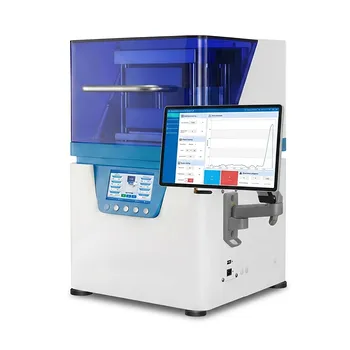
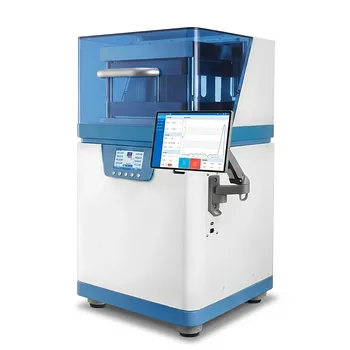
To measure the electronic conductivity of $Fe_2O_3–CoP$ heterostructure nanosheets accurately, a laboratory hydraulic press is required to compress loose nanopowders into dense, uniform pellets. By applying high pressure—typically around 30 MPa—the press eliminates inter-particle voids and forces the nanosheets into intimate physical contact. This transformation from a loose powder to a solid pellet is essential to establish stable electrical pathways and ensure that the resulting data reflects the material's intrinsic bulk conductivity rather than the resistance of trapped air.
Core Takeaway: The laboratory hydraulic press standardizes the physical state of $Fe_2O_3–CoP$ nanopowders by removing air gaps and ensuring uniform density. This process is the only way to obtain repeatable, accurate resistance measurements that are not skewed by inconsistent packing or high contact resistance.
Eliminating Inter-Particle Resistance
Overcoming the Insulating Effect of Voids
In their natural powder state, $Fe_2O_3–CoP$ nanosheets are separated by microscopic air gaps that act as insulators. A hydraulic press applies sufficient force to collapse these voids, bringing the individual particles into close proximity.
Establishing Robust Electrical Channels
Electronic conductivity requires a continuous path for charge carriers to travel through the sample. High-pressure compaction creates interconnected networks between the heterostructure nanosheets, allowing for the measurement of effective electron transport.
Reducing Surface Contact Resistance
Loose powders provide poor contact surfaces for measurement probes, leading to high "noise" in the data. The press creates a smooth, dense surface that ensures low-resistance contact between the sample and the testing electrodes.
Standardizing Sample Geometry and Density
Achieving Precise Pellet Thickness
For conductivity calculations, the thickness of the sample must be known and uniform. A hydraulic press typically produces pellets with a specific thickness, such as 0.4 mm, which allows for highly accurate sheet resistance calculations.
Ensuring Repeatable Packing Density
Conductivity is highly sensitive to how tightly a powder is packed. By using a controlled pressure (e.g., 30 MPa), researchers ensure that every sample has the same relative density, making comparisons between different material batches scientifically valid.
Eliminating Influence of Manual Preparation
Without a hydraulic press, sample density would depend on the manual force used to fill a container. The press removes this human error, providing a constant and repeatable environment for every conductivity test.
Understanding the Trade-offs and Pitfalls
The Risk of Morphology Damage
While high pressure is necessary for contact, excessive force can physically crush the delicate nanosheet structures. If the heterostructure morphology is destroyed, the measured conductivity may no longer represent the original $Fe_2O_3–CoP$ material properties.
Pressure-Induced Phase Changes
In some semiconductor materials, extreme compaction can induce localized heating or mechanical stress that alters the crystal lattice. It is critical to use the minimum pressure required to achieve a stable reading without compromising the material's integrity.
Impact of Residual Stresses
Rapidly releasing the hydraulic pressure can cause the pellet to crack or "cap" due to internal stresses. Controlled, slow decompression is often necessary to maintain the mechanical strength of the pellet during the measurement phase.
Making the Right Choice for Your Goal
To achieve the most reliable conductivity data, your use of the hydraulic press should align with your specific research objectives.
- If your primary focus is measuring intrinsic material property: Apply consistent high pressure (e.g., 30 MPa) to ensure the elimination of all inter-particle voids and air gaps.
- If your primary focus is electrode performance in a battery: Use the press to densify the material onto a current collector (like nickel foam) to enhance bonding strength and current collection efficiency.
- If your primary focus is semiconductor band gap analysis: Ensure the pellet is sufficiently dense to eliminate contact resistance, allowing for accurate resistance-temperature data used in the Arrhenius equation.
By transforming loose nanosheets into a standardized solid form, the laboratory hydraulic press bridges the gap between raw material synthesis and precise electrochemical characterization.
Summary Table:
| Factor | Role in Conductivity Testing | Resulting Benefit |
|---|---|---|
| Void Elimination | Collapses air gaps between particles | Establishes robust electrical pathways |
| Controlled Pressure | Standardizes density (e.g., 30 MPa) | Ensures data repeatability across batches |
| Geometry Control | Produces uniform thickness (e.g., 0.4 mm) | Enables precise resistivity calculations |
| Surface Quality | Creates a smooth, dense interface | Minimizes contact resistance with probes |
Optimize Your Material Analysis with KINTEK
Precision in sample preparation is the foundation of reliable data. KINTEK specializes in high-performance laboratory hydraulic presses—including pellet, hot, and isostatic models—designed to help you achieve the perfect pellet density for Fe2O3–CoP nanosheet characterization and beyond.
Our extensive portfolio supports your entire research workflow, featuring high-temperature furnaces (muffle, tube, vacuum), high-pressure reactors, and advanced crushing and milling systems. Whether you are focused on battery research, semiconductor analysis, or material synthesis, KINTEK provides the professional-grade equipment and consumables (like PTFE and ceramics) required for excellence.
Ready to enhance your lab's accuracy and efficiency? Contact our technical experts today to find the ideal equipment tailored to your specific application requirements!
References
- Jun Pu, Yagang Yao. Efficient Catalysis of Ultrathin Two‐Dimensional Fe<sub>2</sub>O<sub>3</sub>–CoP Heterostructure Nanosheets for Polysulfide Redox Reactions. DOI: 10.1002/smll.202304847
This article is also based on technical information from Kintek Solution Knowledge Base .
Related Products
- Laboratory Hydraulic Press Split Electric Lab Pellet Press
- Laboratory Hydraulic Press Lab Pellet Press Machine for Glove Box
- Laboratory Hydraulic Press Lab Pellet Press for Button Battery
- Automatic Laboratory Hydraulic Pellet Press Machine for Lab Use
- Fully Automatic Heated Hydraulic Lab Press for Materials Sintering and Sample Preparation
People Also Ask
- What are the roles of a laboratory hydraulic press and stainless steel molds in the preparation of graphite samples?
- What is the role of a laboratory hydraulic press in electrode prep? Maximize Energy Density & Sealing Precision
- How does a laboratory hydraulic press ensure the quality of alumina-forming alloy green bodies? Optimize CSP Research
- How is a laboratory hydraulic press used to evaluate the mechanical performance of nano-modified concrete? Expert Guide
- Why is a laboratory hydraulic press used for ASSB assembly? Achieving 392 MPa for Optimal Solid-State Battery Density