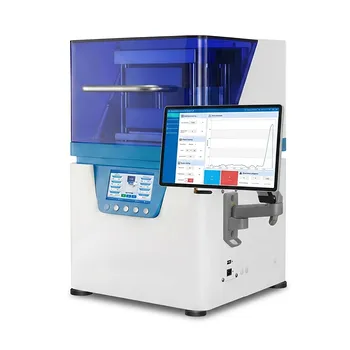
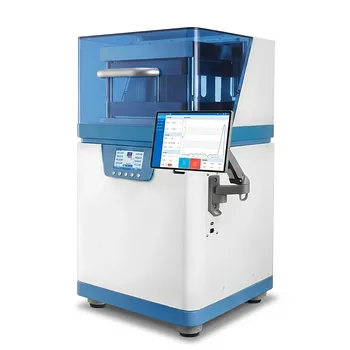
The laboratory hydraulic press is the critical tool for transforming powdered modified biochar into a solid, semi-transparent pellet suitable for infrared light penetration. By applying approximately 20 MPa of uniform pressure to a mixture of biochar and potassium bromide (KBr), the press creates a dense medium that allows for the precise detection of chemical bond vibrations. This process ensures the sample is thin and uniform enough to yield high-quality spectroscopic data while minimizing light scattering.
The hydraulic press facilitates Fourier-Transform Infrared (FTIR) analysis by compressing a diluted biochar-KBr mixture into a semi-transparent disk. This transformation is essential to eliminate trapped air and ensure high light transmittance, enabling the clear identification of functional groups and chemical interactions within the modified biochar.
The Role of Compression in FTIR Preparation
Dilution and Homogenization
Before pressing, a small amount of the modified biochar is ground and mixed with potassium bromide (KBr) powder. This dilution, often at a ratio of 1 part sample to 100 parts KBr, is necessary because pure biochar is too opaque for infrared radiation to pass through.
Eliminating Air and Voids
The primary function of the hydraulic press is to apply mechanical force to remove air trapped between powder particles. By rearranging the particles into a solid matrix, the press creates a transparent or semi-transparent medium that allows infrared light to reach the detector with high signal contrast.
Achieving Optical Transparency
Under high pressure, typically around 20 MPa, the KBr mixture flows and fuses into a thin disk. This "pellet" must be largely transparent to infrared light so that the resulting spectra represent the molecular structure of the biochar rather than physical interference from the powder.
Impact on Spectroscopic Data Quality
Ensuring Uniform Thickness
A laboratory press, used in conjunction with precision dies, ensures the pellet has a consistent density and thickness. This uniformity is vital for minimizing scattering interference, which can distort characteristic absorption peaks during testing.
Identifying Specific Functional Groups
Properly pressed samples allow for the accurate identification of critical chemical bond signals, such as Mg-O, Mg-OH, and phosphate groups. Clear peaks are necessary to determine if the biochar modification resulted in physical encapsulation or specific chemical interactions.
Enhancing Detection Sensitivity
By creating a light-transmitting disk without air bubbles, the press places the sample within the optimal detection range of the FTIR instrument. This enables the observer to see surface functional groups like Fe-O, C=O, and O-H with high clarity.
Understanding the Trade-offs and Pitfalls
Pressure Calibration Risks
Applying insufficient pressure results in an opaque pellet that scatters light, leading to a "noisy" spectrum. Conversely, excessive pressure can occasionally cause the pellet to crack or lead to unwanted chemical phase changes in sensitive modified samples.
Moisture Sensitivity
KBr is highly hygroscopic, meaning it absorbs moisture from the air rapidly. If the pressing process is too slow or conducted in a humid environment, water vapor can be trapped in the pellet, creating large O-H broad peaks that may mask the actual functional groups of the biochar.
Sample Concentration Issues
If the ratio of biochar to KBr is too high, the pellet will be too dark for the IR beam to penetrate, resulting in "flat-lining" of the peaks. If it is too low, the absorption signals may be too weak to distinguish from background noise.
How to Optimize Your Sample Preparation
To achieve the best results when preparing modified biochar for FTIR analysis, consider your specific analytical goals:
- If your primary focus is quantitative accuracy: Ensure a precise 1:100 sample-to-KBr ratio and use a digital hydraulic press to maintain exact pressure consistency across all samples.
- If your primary focus is identifying trace surface groups: Prioritize the grinding stage to ensure the biochar is extremely fine, as this improves the homogeneity of the pellet and the clarity of weak signals.
- If your primary focus is preventing contamination: Use a vacuum-capable pellet die with the hydraulic press to remove air and moisture during the compression cycle.
Mastering the use of the hydraulic press ensures that your biochar samples provide the clear, reproducible data necessary for advanced chemical characterization.
Summary Table:
| Parameter | Specification/Ratio | Benefit for FTIR Analysis |
|---|---|---|
| Compression Pressure | Approximately 20 MPa | Eliminates trapped air and creates a solid, transparent matrix |
| Dilution Ratio | 1:100 (Biochar to KBr) | Ensures the sample is thin enough for infrared light penetration |
| Sample Form | Semi-transparent Pellet | Minimizes light scattering and enhances signal-to-noise ratio |
| Key Observations | Functional Groups (C=O, Mg-O) | Enables clear identification of chemical modifications |
| Optimal Equipment | Vacuum-capable Pellet Die | Prevents moisture absorption and O-H peak interference |
Achieve Superior Spectroscopic Clarity with KINTEK
Precise sample preparation is the foundation of breakthrough biochar research. KINTEK provides high-precision laboratory hydraulic presses (manual, digital, and isostatic) and vacuum-capable pellet dies specifically designed to produce the uniform, air-free pellets required for high-quality FTIR analysis.
Beyond pelleting, our comprehensive portfolio supports your entire workflow—from crushing and milling systems for sample homogenization to high-temperature furnaces (muffle, tube, vacuum) and ceramic crucibles for biochar modification.
Unlock the full potential of your analytical data.
Contact our laboratory specialists today to find the ideal equipment for your research!
References
- Panfeng Tu, Haoran Yuan. Enhanced phosphate adsorption and desorption characteristics of MgO-modified biochars prepared via direct co-pyrolysis of MgO and raw materials. DOI: 10.1186/s40643-023-00670-3
This article is also based on technical information from Kintek Solution Knowledge Base .
Related Products
- Fully Automatic Heated Hydraulic Lab Press for Materials Sintering and Sample Preparation
- Laboratory Hydraulic Press Split Electric Lab Pellet Press
- Laboratory Hydraulic Press Lab Pellet Press Machine for Glove Box
- Laboratory Hydraulic Press Lab Pellet Press for Button Battery
- Hydraulic Diaphragm Lab Filter Press for Laboratory Filtration
People Also Ask
- How does a laboratory heating hydraulic press contribute to the preparation of recycled graphite green bodies? - Optimize Density.
- How does the laboratory hydraulic press contribute to the preparation of solid targets for laser ablation?
- What role does a laboratory hydraulic press play in perovskite-MOF glass fabrication? Master Material Densification
- Why use a laboratory hydraulic press for Fe2O3-CoP conductivity? Achieve Precise Material Characterization
- How can a laboratory hydraulic press be applied in thin-film heterojunction synthesis? Achieve High-Density Pellets