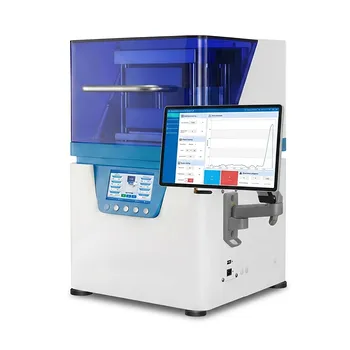
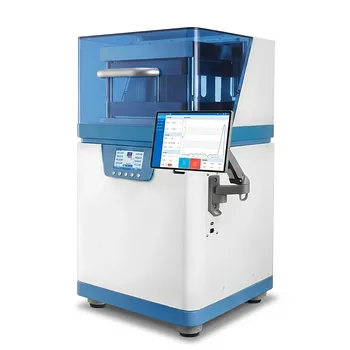
The laboratory hydraulic press acts as the primary mechanical catalyst for densification in the fabrication of perovskite-MOF glass composites. By applying intense uniaxial pressure, the press transforms loose, mixed powders—specifically perovskite particles and a glass-forming MOF matrix like agZIF-62—into a cohesive, high-density "green body." This physical compaction is the essential precursor to liquid-phase sintering, ensuring the final composite achieves structural integrity and optimized electronic properties.
Core Takeaway: A laboratory hydraulic press is used to eliminate voids and maximize the contact area between perovskite particles and the MOF matrix. This densification is critical for achieving tight interfacial bonding and effective surface passivation during the subsequent liquid-phase sintering process.
Achieving Structural Densification
Minimizing Voids and Porosity
The primary role of the press is to compress mixed powders into dense, disk-shaped samples. By applying high pressure, the machine forces air out and significantly reduces the voids between particles.
Reducing internal porosity is vital because air pockets act as insulators or structural weak points. A dense pellet ensures that the material responds predictably to heat during the next stages of fabrication.
Increasing Particle Contact Area
The hydraulic press increases the contact area between the perovskite particles and the metal-organic framework (MOF) matrix. This physical proximity is required for the two distinct phases to interact effectively at their boundaries.
High-pressure molding ensures that the particles are packed tightly enough to allow for solid-phase reactions and diffusion. Without this initial mechanical force, the particles would remain isolated, leading to a brittle and poorly performing composite.
Facilitating the Sintering Process
Formation of the "Green Body"
The press creates what is known as a "green body," a pellet that possesses a specific geometric shape and sufficient initial strength for handling. This stability is necessary to prevent the sample from crumbling before it reaches the furnace.
Achieving a high-density green body serves as a foundation for obtaining samples with low grain boundary resistance. Proper compaction minimizes shrinkage and prevents the formation of micro-cracks during high-temperature treatments.
Enhancing Melt Flow and Encapsulation
During the subsequent liquid-phase sintering, the MOF matrix softens or melts to form a glass phase. The initial pressure applied by the hydraulic press facilitates melt flow by ensuring the glass-forming MOF is already in tight contact with the perovskite.
This proximity allows the glass phase to effectively encapsulate the crystalline perovskite. This encapsulation is critical for surface passivation, protecting the perovskite from environmental degradation while maintaining its functional properties.
Impact on Material Performance
Reduction of Grain Boundary Resistance
In energy materials, the hydraulic press is often used to reduce grain boundary impedance. By forcing particles into intimate contact, the press establishes efficient ion transport channels within the material.
In some composite systems, applying specific pressures (often between 1 and 4 tons) can increase ionic conductivity by several orders of magnitude. This can sometimes achieve functional performance levels even before or without the need for high-temperature sintering.
Controlling Diffusion and Reaction Rates
The press allows for the regulation of reaction rates by adjusting the internal packing density. By controlling the pressure (e.g., 9000 PSI or specific MPa targets), researchers can influence how deeply the matrix penetrates the perovskite structure.
This level of control is essential for tailoring the mechanical strength and the electronic or chemical release rates of the final pellet. Precise pressure-holding control ensures that the resulting composite is uniform in both density and performance.
Understanding the Trade-offs
Pressure Limits and Material Deformation
While high pressure is beneficial for density, exceeding a material's tolerance can lead to structural deformation or the introduction of internal stresses. If the pressure is too high, it may cause the perovskite crystals to fracture, degrading the material's performance.
Uniformity and Stress Distribution
Uniaxial pressing can sometimes lead to non-uniform density distributions within the pellet. The edges of the disk may experience different stress levels than the center, which can result in warping or uneven sintering during the heating phase.
Making the Right Choice for Your Goal
- If your primary focus is maximizing ionic conductivity: Use precise pressure-holding control to minimize grain boundary resistance and establish clear transport channels.
- If your primary focus is environmental stability: Prioritize high-pressure compaction to ensure the MOF matrix provides total encapsulation and surface passivation during sintering.
- If your primary focus is structural integrity: Ensure the formation of a high-density green body to prevent micro-cracking and shrinkage during the final heat treatment.
The laboratory hydraulic press is the foundational tool that converts a simple powder mixture into a high-performance, dense composite ready for advanced sintering and application.
Summary Table:
| Key Role | Physical Benefit | Impact on Performance |
|---|---|---|
| Powder Densification | Eliminates air voids & porosity | Ensures structural integrity and uniform heating |
| Interfacial Contact | Maximizes particle-to-matrix area | Facilitates effective liquid-phase sintering |
| Green Body Creation | Forms stable geometric shape | Prevents micro-cracking and crumbling during handling |
| Impedance Control | Reduces grain boundary resistance | Significantly boosts ionic conductivity and transport |
Elevate Your Material Research with KINTEK Precision
Achieving the perfect densification for perovskite-MOF glass composites requires precision and reliability. KINTEK specializes in high-performance laboratory equipment designed to streamline your fabrication workflow. Our comprehensive range of hydraulic presses (pellet, hot, and isostatic) ensures optimal green body formation, while our crushing and milling systems provide the perfect powder precursors.
From initial compaction to final heat treatment in our advanced high-temperature furnaces (muffle, vacuum, or CVD), KINTEK provides the tools you need for low grain boundary resistance and superior encapsulation.
Ready to optimize your composite performance? Contact our technical experts today to find the ideal pressing and sintering solution for your laboratory.
References
- Mehri Ghasemi, Xiaoming Wen. Effective Suppressing Phase Segregation of Mixed‐Halide Perovskite by Glassy Metal‐Organic Frameworks. DOI: 10.1002/smll.202304236
This article is also based on technical information from Kintek Solution Knowledge Base .
Related Products
- Laboratory Hydraulic Press Split Electric Lab Pellet Press
- Laboratory Hydraulic Press Lab Pellet Press Machine for Glove Box
- Laboratory Hydraulic Press Lab Pellet Press for Button Battery
- Automatic Laboratory Hydraulic Pellet Press Machine for Lab Use
- Fully Automatic Heated Hydraulic Lab Press for Materials Sintering and Sample Preparation
People Also Ask
- What are the roles of a laboratory hydraulic press and stainless steel molds in the preparation of graphite samples?
- What is the role of a laboratory hydraulic press in electrode prep? Maximize Energy Density & Sealing Precision
- How does a laboratory hydraulic press ensure the quality of alumina-forming alloy green bodies? Optimize CSP Research
- How is a laboratory hydraulic press used to evaluate the mechanical performance of nano-modified concrete? Expert Guide
- Why is a laboratory hydraulic press used for ASSB assembly? Achieving 392 MPa for Optimal Solid-State Battery Density