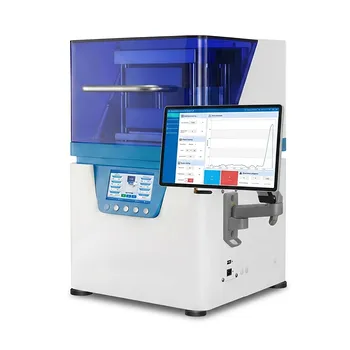
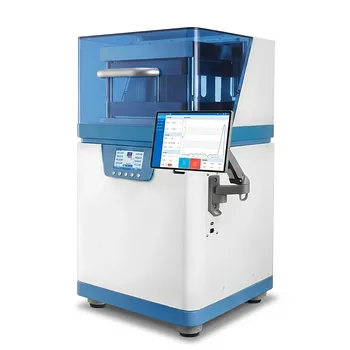
The laboratory hydraulic press is the foundational tool for transforming loose precursor powders into high-density, uniform solid targets essential for thin-film heterojunction synthesis. It achieves this by applying precise axial pressure to raw materials—such as Tungsten Trioxide (WO3) or composite powders—compacting them into pellets or "green bodies." This process ensures a stable source material for subsequent deposition or thermal treatments, directly influencing the quality and homogeneity of the final heterojunction interface.
By providing precise pressure control and eliminating internal voids, a laboratory hydraulic press ensures that precursor materials possess the uniform density and structural integrity required for stable evaporation and high-quality film growth.
Achieving Material Uniformity and Density
Standardizing Evaporation Rates in CVD
For thin-film synthesis via Chemical Vapor Deposition (CVD), the precursor must provide a consistent flux of atoms. A hydraulic press compresses raw powders into high-density pellets, ensuring a uniform distribution of material. This consistency is vital for maintaining a stable evaporation rate, which directly prevents thickness variations across the heterojunction.
Eliminating Internal Voids and Defects
Applying high-precision vertical pressure forces powder particles to pack tightly and rearrange within a mold. This process effectively eliminates internal voids and air pockets that could otherwise cause structural defects or layer separation. In complex precursors, such as coal-based waste and polymer mixtures, this step is critical for preventing delamination during high-temperature treatments.
Enhancing Structural and Electrical Properties
Pre-forming Green Bodies for Sintering
The press is used to create a "green body" target with specific mechanical strength. This pre-forming step ensures the resulting ceramic target remains free of micro-cracks after high-temperature sintering. Maintaining the integrity of these targets is essential for providing a stable particle source during the growth of epitaxial layers.
Optimizing Electrical Connectivity
In cases where precursors are pressed directly onto conductive substrates like FTO glass, the hydraulic press ensures optimal physical contact. This reduces contact resistance and improves the collection efficiency of charge carriers. Such precision is vital for the accurate electrochemical analysis of the resulting thin-film heterojunctions.
Preparing for Multi-Stage Processing
Integration with Cold Isostatic Pressing (CIP)
A hydraulic press is often the first step in a multi-stage densification process, creating disk-shaped green bodies for Cold Isostatic Pressing (CIP). By establishing a stable initial form, the press ensures that force is distributed uniformly during subsequent high-pressure reinforcement. This prevents sample deformation or damage that might occur if loose powder were treated directly.
Pre-processing for Dealloying and Metallurgy
In powder metallurgy, the press is used for high-pressure molding prior to dealloying. Achieving a uniform internal composition and low porosity during the pressing phase is a prerequisite for producing homogeneous nanoporous structures. These structures often serve as the scaffold for sophisticated thin-film heterojunctions.
Understanding Technical Trade-offs
Pressure Limits and Material Integrity
While higher pressure increases density, exceeding the material's elastic limit can lead to capping or lamination (internal cracking). Different materials, such as MXenes versus coal-based precursors, require specific pressure ranges (e.g., 8 to 10 kilonewtons) to achieve the desired density without compromising structural integrity.
The Risk of Surface Contamination
The use of steel dies and lubricants can introduce impurities into the precursor pellet. Even trace amounts of foreign matter can disrupt the electronic properties of a heterojunction. To mitigate this, dies must be meticulously cleaned or lined with inert materials to maintain the purity required for semiconductor-grade thin films.
How to Apply This to Your Project
Recommendations for Success
- If your primary focus is CVD or PVD target preparation: Use the press to achieve maximum density and surface uniformity to ensure a predictable and repeatable evaporation rate.
- If your primary focus is electrode characterization: Apply controlled pressure to catalysts on conductive substrates to minimize contact resistance and improve signal-to-noise ratios in testing.
- If your primary focus is multi-stage material synthesis: Utilize the press to create a stable green body that can withstand the intense, multi-directional forces of Isostatic Pressing or sintering without cracking.
By mastering the precise application of pressure, you ensure that the foundational precursors of your thin-film heterojunctions are structurally sound and chemically consistent.
Summary Table:
| Application Stage | Key Benefit of Pressing | Critical Consideration |
|---|---|---|
| CVD Target Preparation | Standardized evaporation rates & flux | Uniform particle distribution |
| Sintering Pre-form | Prevents micro-cracks in green bodies | Material elastic limits |
| Electrical Testing | Reduced contact resistance on substrates | Surface purity & contamination |
| Multi-stage (CIP) | Stable initial form for reinforcement | Elimination of internal voids |
Elevate Your Material Synthesis with KINTEK
Precision is paramount in thin-film heterojunction research. KINTEK specializes in high-performance laboratory equipment designed to ensure your precursors meet the highest standards of density and uniformity. Our comprehensive range includes:
- Hydraulic Presses: Pellet, hot, and isostatic presses for perfect sample preparation.
- Thermal Solutions: Muffle, tube, vacuum, and CVD/PECVD furnaces for advanced material deposition.
- Sample Processing: Crushing and milling systems, high-temperature high-pressure reactors, and autoclaves.
Whether you are optimizing evaporation rates or enhancing electrical connectivity, KINTEK provides the reliable tools and consumables (like PTFE products, ceramics, and crucibles) you need for breakthrough results.
Ready to upgrade your lab's capabilities and ensure repeatable research outcomes? Contact our technical experts today!
References
- Tianyi Zhang, Mauricio Terrones. Effects of post-transfer annealing and substrate interactions on the photoluminescence of 2D/3D monolayer WS<sub>2</sub>/Ge heterostructures. DOI: 10.1039/d3nr00961k
This article is also based on technical information from Kintek Solution Knowledge Base .
Related Products
- Laboratory Hydraulic Press Split Electric Lab Pellet Press
- Laboratory Hydraulic Press Lab Pellet Press Machine for Glove Box
- Laboratory Hydraulic Press Lab Pellet Press for Button Battery
- Automatic Laboratory Hydraulic Pellet Press Machine for Lab Use
- Fully Automatic Heated Hydraulic Lab Press for Materials Sintering and Sample Preparation
People Also Ask
- What are the roles of a laboratory hydraulic press and stainless steel molds in the preparation of graphite samples?
- What is the role of a laboratory hydraulic press in electrode prep? Maximize Energy Density & Sealing Precision
- How does a laboratory hydraulic press ensure the quality of alumina-forming alloy green bodies? Optimize CSP Research
- How is a laboratory hydraulic press used to evaluate the mechanical performance of nano-modified concrete? Expert Guide
- Why is a laboratory hydraulic press used for ASSB assembly? Achieving 392 MPa for Optimal Solid-State Battery Density