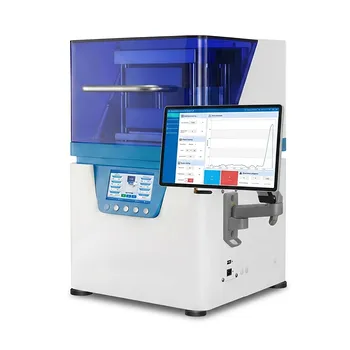
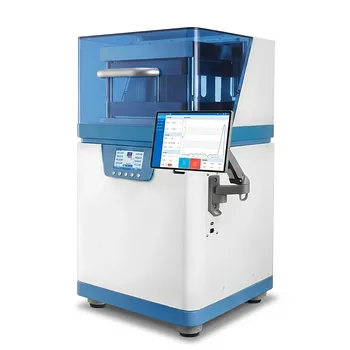
The laboratory hydraulic press serves as the primary instrument for consolidating SiOC/ZrB2 powder mixtures into dense, geometrically precise green bodies. By applying controlled axial pressure through high-precision molds, the equipment overcomes inter-particle forces to eliminate voids and establish a uniform internal density. This initial compaction is critical, as it directly dictates the final microstructure, mechanical strength, and electromagnetic wave absorption properties of the sintered ceramic composite.
Core Takeaway: The laboratory hydraulic press transforms loose ceramic powders into a structurally sound "green body," providing the necessary particle contact and density distribution to ensure successful solid-state reactions and predictable electromagnetic performance during high-temperature sintering.
Establishing Structural and Chemical Foundations
Compression and Particle Rearrangement
The hydraulic press applies significant axial pressure—often reaching levels such as 10 MPa or 1 ton/cm²—to overcome Van der Waals and electrostatic forces between particles. This physical force causes loose powders to rearrange and deform, effectively eliminating macro-voids and establishing a stable geometric profile.
Enhancing Solid-State Diffusion
By reducing the physical distance between ZrB2 and SiOC precursors, the press maximizes particle-to-particle contact. This close proximity is essential for diffusion-controlled solid-state chemical reactions that occur later during the firing process in a tube furnace.
Controlling Internal Porosity
Precise pressure control ensures a uniform density distribution throughout the green body. Minimizing internal porosity at this stage is a prerequisite for controlling the final microstructure, which ultimately determines the material's structural integrity.
Impact on Final Material Performance
Optimizing Electromagnetic Wave Absorption
For SiOC/ZrB2 composites, the green body's density is a primary lever for tuning electromagnetic wave absorption properties. A consistent initial density ensures that the final pyrolyzed ceramic interacts with electromagnetic fields in a predictable, high-performance manner.
Ensuring Stability During Sintering
Green bodies formed under high pressure possess the mechanical strength required for handling and subsequent processing. This structural stability prevents cracking or severe deformation when the material is subjected to extreme temperatures, such as 1600°C, during the final densification phase.
Geometric Precision with Specialized Tooling
The use of precision-machined molds, such as those made from hardened steel or cemented carbide, ensures the green body meets exact dimensional requirements. This accuracy is vital when the ceramic is intended for use as a functional component or a stable substrate for high-pressure processing.
Understanding the Trade-offs and Limitations
The Risk of Density Gradients
Uniaxial pressing can lead to non-uniform pressure distribution, where the density at the center of the green body differs from the edges. This gradient can cause internal stresses that manifest as warping or "hourglassing" during the sintering process.
Mold Wear and Contamination
High-pressure cycles eventually cause wear on precision dies, which can alter the dimensions of the green body over time. Furthermore, friction between the ceramic powder and the mold walls can introduce trace metallic contaminants if proper lubricants or liners are not utilized.
Limits of Mechanical Consolidation
While hydraulic pressing creates a functional prototype, it may not eliminate the finest micropores. In many high-performance applications, uniaxial pressing is only the initial stage, requiring subsequent cold isostatic pressing (CIP) to achieve the ultimate theoretical density.
Maximizing Success in Ceramic Green Body Fabrication
To achieve the best results when fabricating SiOC/ZrB2 composites, consider your primary experimental objectives:
- If your primary focus is electromagnetic tuning: Prioritize precise, repeatable pressure settings to ensure consistent porosity levels across all test samples.
- If your primary focus is geometric accuracy: Utilize high-precision cemented carbide molds and ensure the powder is granulated uniformly to prevent uneven filling.
- If your primary focus is preventing sintering defects: Incorporate a dwell time at peak pressure to allow for maximum particle de-airing and rearrangement before decompression.
The precision of the laboratory press at the green body stage is the single most influential factor in determining the reliability and performance of the final ceramic composite.
Summary Table:
| Feature | Mechanism | Impact on SiOC/ZrB2 Performance |
|---|---|---|
| Axial Compression | Overcomes inter-particle forces (10 MPa+) | Eliminates voids; establishes uniform internal density |
| Particle Contact | Reduces distance between precursors | Enhances solid-state diffusion during sintering |
| Porosity Control | Precise pressure regulation | Tunes electromagnetic (EM) wave absorption properties |
| Precision Tooling | Hardened steel/carbide molds | Ensures geometric accuracy and structural stability |
| Mechanical Strength | Particle rearrangement & deformation | Prevents cracking and warping at high temperatures (1600°C) |
Elevate Your Material Research with KINTEK Precision
Achieving the perfect green body is the foundation of high-performance ceramic engineering. KINTEK specializes in laboratory equipment designed for extreme precision. Whether you are fabricating SiOC/ZrB2 composites or advanced battery materials, our comprehensive range of hydraulic presses (pellet, hot, and isostatic), high-temperature furnaces (tube, muffle, vacuum), and precision crushing/milling systems ensures repeatable, high-quality results.
From specialized ceramic crucibles to high-pressure reactors, KINTEK provides the integrated solutions your lab needs to bridge the gap between powder and high-performance functional components.
Ready to optimize your ceramic fabrication process? Contact KINTEK today for expert consultation and industry-leading equipment.
References
- Yujun Jia, Chengying Xu. Polymer-derived SiOC reinforced with core–shell nanophase structure of ZrB2/ZrO2 for excellent and stable high-temperature microwave absorption (up to 900 °C). DOI: 10.1038/s41598-023-27541-3
This article is also based on technical information from Kintek Solution Knowledge Base .
Related Products
- Laboratory Hydraulic Press Split Electric Lab Pellet Press
- Laboratory Hydraulic Press Lab Pellet Press Machine for Glove Box
- Laboratory Hydraulic Press Lab Pellet Press for Button Battery
- Automatic Laboratory Hydraulic Pellet Press Machine for Lab Use
- Fully Automatic Heated Hydraulic Lab Press for Materials Sintering and Sample Preparation
People Also Ask
- What role does a laboratory hydraulic press play in platinum recovery research? Enhancing Sample Precision
- What are the specific applications of a lab hydraulic press in biochar evaluation? Optimize density and data accuracy.
- What are the roles of a laboratory hydraulic press and stainless steel molds in the preparation of graphite samples?
- What is the role of a laboratory hydraulic press in electrode prep? Maximize Energy Density & Sealing Precision
- Why must a laboratory hydraulic press equipped with cylindrical molds be used when preparing BZY green bodies? High Density