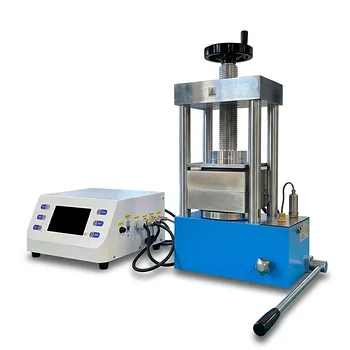
The uniaxial hydraulic press serves as the critical bridge between raw material synthesis and accurate performance testing. Before analyzing the ionic conductivity of Li2O–LiI–MoO3 solid electrolytes, this equipment is used to cold-press loose powder into a dense, solid pellet, typically under pressures around 360 MPa. This step is mandatory to mechanically eliminate air voids and force the particles into a cohesive unit without altering their chemical composition.
The Core Takeaway You cannot accurately measure the conductivity of a loose powder because the air gaps act as insulators. The hydraulic press transforms the sample into a dense solid, ensuring that test results reflect the intrinsic properties of the material rather than the poor connectivity of the powder.
The Physics of Densification
Eliminating Microscopic Voids
Loose powders consist of individual particles separated by air pockets (pores). In an ionic conductivity test, ions cannot travel through these air gaps. By applying significant force via a uniaxial press, these pores are collapsed, creating a continuous physical medium for ion transport.
Leveraging Amorphous Ductility
Li2O–LiI–MoO3 electrolytes often possess an amorphous (glass-like) structure. The primary reference highlights that this material exhibits ductility. High-pressure cold pressing utilizes this ductility to deform the particles, allowing them to flow into one another and bond tightly without the need for high-temperature melting.
Ensuring Accurate Data Collection
Reducing Grain Boundary Resistance
The resistance encountered where two particles meet is called grain boundary resistance. If particles are merely touching loosely, this resistance is artificially high. The hydraulic press forces particles into intimate contact, significantly lowering this resistance so it does not overshadow the actual conductivity of the electrolyte grains.
Enabling AC Impedance Spectroscopy
The standard test method, Alternating Current (AC) impedance spectroscopy, relies on passing an electrical signal through the bulk material. For the signal to propagate correctly and provide interpretable data (specifically Nyquist plots), the sample must act as a single, dense geometric body rather than a pile of disconnected dust.
Ensuring Electrode Contact
For a conductivity test, blocking electrodes must be attached to the sample surfaces. A pressed pellet provides flat, parallel surfaces. This ensures intimate contact between the electrolyte and the electrodes, preventing contact resistance from skewing the measurement data.
Common Pitfalls to Avoid
Inconsistent Pressure Application
Applying insufficient pressure results in a "green body" with low packing density. This leads to data that incorrectly suggests the material has low conductivity, when in reality, the material is conductive but the pathway is broken.
Over-Reliance on Powder Data
It is a critical error to assume the properties of the powder represent the final application. The performance of a solid-state battery depends on the dense pellet or film form, making the pressing stage not just a preparation step, but a simulation of the material's state in a real-world device.
Making the Right Choice for Your Goal
- If your primary focus is determining maximum conductivity: Ensure the pressure applied (e.g., 360 MPa) is sufficient to maximize density, as higher density generally correlates with higher measured ionic conductivity.
- If your primary focus is material characterization: Use consistent pressure across all samples to ensure that variations in data are caused by chemical differences, not variations in pellet density.
Ultimately, the hydraulic press removes the variable of "geometry" so you can isolate and measure the variable of "chemistry."
Summary Table:
| Factor | Impact on Conductivity Testing | Role of Hydraulic Press |
|---|---|---|
| Air Voids | Act as insulators, blocking ion transport | Collapses pores to create a continuous medium |
| Particle Contact | High grain boundary resistance if loose | Forces intimate contact to lower resistance |
| Sample Shape | Irregular powder prevents electrode bonding | Creates flat, parallel surfaces for electrodes |
| Material State | Ductility must be leveraged for bonding | Applies high pressure to deform and bond particles |
| Data Accuracy | Loose powder skews AC impedance results | Ensures results reflect intrinsic material chemistry |
Maximize Your Research Precision with KINTEK
Don't let inconsistent sample preparation skew your electrolyte performance data. KINTEK specializes in precision laboratory equipment designed for advanced materials science. Our robust hydraulic presses (pellet, hot, isostatic) ensure uniform density and repeatable results for your Li2O–LiI–MoO3 and battery research.
Beyond sample preparation, we offer a comprehensive range of high-temperature furnaces, crushing and milling systems, and specialized electrolytic cells, supporting your workflow from raw synthesis to final characterization.
Ready to elevate your lab's efficiency and data accuracy? Contact us today to discover how KINTEK’s high-performance tools can empower your next breakthrough!
Related Products
- Laboratory Hydraulic Press Split Electric Lab Pellet Press
- Automatic Laboratory Hydraulic Press for XRF & KBR Pellet Press
- Laboratory Hydraulic Pellet Press for XRF KBR FTIR Lab Applications
- 24T 30T 60T Heated Hydraulic Press Machine with Heated Plates for Laboratory Hot Press
- Laboratory Manual Hydraulic Pellet Press for Lab Use
People Also Ask
- What role does a laboratory hydraulic press play in platinum recovery research? Enhancing Sample Precision
- What are the specific applications of a lab hydraulic press in biochar evaluation? Optimize density and data accuracy.
- What are the roles of a laboratory hydraulic press and stainless steel molds in the preparation of graphite samples?
- What is the role of a laboratory hydraulic press in electrode prep? Maximize Energy Density & Sealing Precision
- Why must a laboratory hydraulic press equipped with cylindrical molds be used when preparing BZY green bodies? High Density