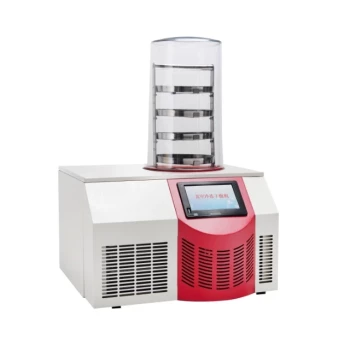
Knowledge Why is a vacuum drying oven preferred for drying ceramic slurries? Prevent Oxidation & Ensure Chemical Purity
Author avatar

Tech Team · Kintek Solution

Updated 1 day ago

Why is a vacuum drying oven preferred for drying ceramic slurries? Prevent Oxidation & Ensure Chemical Purity


The preference for using a vacuum drying oven to process ceramic slurries containing metal binders and carbides is driven by the critical need to prevent chemical degradation. These ovens allow for the efficient removal of ball-milling solvents at significantly lower temperatures while maintaining an oxygen-free environment. This dual capability is essential for preserving the purity and stability of reactive components like Molybdenum (Mo), Nickel (Ni), and Titanium Carbide (TiC).

Core Takeaway: Vacuum drying decouples temperature from evaporation rates, allowing you to remove solvents rapidly without thermal stress or oxygen exposure. This is the only reliable method to prevent the oxidation of ultrafine metal powders and carbides, ensuring the structural integrity of the final high-performance ceramic.

Preserving Chemical Purity

The Challenge of Reactive Components

Ceramic slurries often contain highly active metal binders (such as Mo and Ni) and carbides (like TiC). These materials are frequently processed as ultrafine powders to ensure better sintering.

However, the high surface area of these ultrafine powders makes them extremely susceptible to oxidation. If exposed to oxygen during a standard heating process, these components will degrade, compromising the quality of the laminated ceramic raw materials.

Creating an Oxygen-Free Environment

The primary advantage of a vacuum oven is the physical removal of air from the drying chamber. By eliminating oxygen, the system creates a protective inert environment.

This prevents the chemical reaction between oxygen and the metallic or carbide components. Consequently, the final product maintains high chemical stability and purity, which is impossible to achieve in a standard atmospheric oven.

Optimizing the Drying Physics

Reducing the Solvent Boiling Point

In a vacuum environment, the atmospheric pressure surrounding the slurry is drastically reduced. This physics principle lowers the boiling point of the solvents used in ball milling, such as ethanol.

This allows the liquid to evaporate rapidly without requiring high heat. You can achieve effective drying at temperatures that are safe for the sensitive components involved.

Preventing Thermal Degradation

Because the solvents boil off at lower temperatures, the thermal stress on the ceramic mixture is minimized. High temperatures can sometimes alter the microstructure of the slurry or accelerate unwanted reactions.

Vacuum drying ensures the ball-milling media is removed completely while the powder mixture remains at a moderate temperature. This preserves the "activity" of the metal powders without triggering premature sintering or oxidation.

Understanding the Trade-offs

Batch Processing Limitations

While vacuum drying is superior for quality, it is typically a batch process rather than a continuous one. This can limit throughput speed compared to conveyor-belt style air dryers used for less sensitive materials.

Equipment Complexity and Cost

Vacuum systems require robust seals, pumps, and maintenance that standard ovens do not. The operational cost per batch is generally higher due to energy consumption by the vacuum pump and the complexity of the equipment.

Solvent Trapping

If the vacuum pressure is dropped too quickly, solvents may "flash" boil, potentially causing splattering or uneven crusts on the slurry. Precise control of the pressure curve is required to ensure smooth, uniform drying.

Making the Right Choice for Your Project

When handling high-performance ceramics, the drying method is a quality control gate, not just a moisture removal step.

  • If your primary focus is Chemical Purity: Prioritize vacuum drying to ensure zero oxidation of reactive binders like Nickel (Ni) and Cobalt (Co).
  • If your primary focus is Structural Homogeneity: Use vacuum drying to remove solvents at low temperatures, preventing crust formation and thermal stress cracks.

Summary: For slurries containing metal binders and carbides, the vacuum oven is not an option but a necessity to guarantee the material remains unoxidized and chemically stable for sintering.

Summary Table:

Feature Vacuum Drying Oven Standard Atmospheric Oven
Oxygen Levels Near-zero (Oxygen-free) High (Ambient air)
Oxidation Risk Minimal (Protects Mo, Ni, TiC) High (Degrades reactive components)
Boiling Point Significantly lowered Standard at 1 atm
Thermal Stress Low (Low-temperature drying) High (Requires more heat)
Suited For Reactive binders & carbides Non-reactive, bulk materials

Elevate Your Material Purity with KINTEK

Don't compromise the integrity of your high-performance ceramics. KINTEK specializes in advanced laboratory solutions designed to handle your most sensitive research. Whether you need precise vacuum ovens for oxygen-free drying, high-temperature furnaces (muffle, tube, or CVD) for sintering, or ball milling systems for slurry preparation, we provide the tools to ensure chemical stability.

From high-pressure reactors to PTFE consumables and ceramic crucibles, our portfolio supports your entire workflow. Contact our technical experts today to find the perfect vacuum drying solution and prevent oxidation in your metal binder and carbide slurries!

Related Products

People Also Ask

Related Products

Laboratory Scientific Electric Heating Blast Drying Oven

Laboratory Scientific Electric Heating Blast Drying Oven

The desktop fast autoclave sterilizer is a compact and reliable device used for rapid sterilization of medical, pharmaceutical, and research items.

Small Vacuum Heat Treat and Tungsten Wire Sintering Furnace

Small Vacuum Heat Treat and Tungsten Wire Sintering Furnace

The small vacuum tungsten wire sintering furnace is a compact experimental vacuum furnace specially designed for universities and scientific research institutes. The furnace features a CNC welded shell and vacuum piping to ensure leak-free operation. Quick-connect electrical connections facilitate relocation and debugging, and the standard electrical control cabinet is safe and convenient to operate.

Vacuum Heat Treat Sintering Brazing Furnace

Vacuum Heat Treat Sintering Brazing Furnace

A vacuum brazing furnace is a type of industrial furnace used for brazing, a metalworking process that joins two pieces of metal using a filler metal that melts at a lower temperature than the base metals. Vacuum brazing furnaces are typically used for high-quality applications where a strong, clean joint is required.

Lab-Scale Vacuum Induction Melting Furnace

Lab-Scale Vacuum Induction Melting Furnace

Get precise alloy composition with our Vacuum Induction Melting Furnace. Ideal for aerospace, nuclear energy, and electronic industries. Order now for effective smelting and casting of metals and alloys.

Vacuum Heat Treat and Pressure Sintering Furnace for High Temperature Applications

Vacuum Heat Treat and Pressure Sintering Furnace for High Temperature Applications

Vacuum pressure sintering furnaces are designed for high temperature hot pressing applications in metal and ceramic sintering. Its advanced features ensure precise temperature control, reliable pressure maintenance, and a robust design for seamless operation.

Graphite Vacuum Furnace IGBT Experimental Graphitization Furnace

Graphite Vacuum Furnace IGBT Experimental Graphitization Furnace

IGBT experimental graphitization furnace, a tailored solution for universities and research institutions, with high heating efficiency, user-friendliness, and precise temperature control.

Vacuum Heat Treat Furnace with Ceramic Fiber Liner

Vacuum Heat Treat Furnace with Ceramic Fiber Liner

Vacuum furnace with polycrystalline ceramic fiber insulation liner for excellent heat insulation and uniform temperature field. Choose from 1200℃ or 1700℃ max. working temperature with high vacuum performance and precise temperature control.

Graphite Vacuum Furnace High Thermal Conductivity Film Graphitization Furnace

Graphite Vacuum Furnace High Thermal Conductivity Film Graphitization Furnace

The high thermal conductivity film graphitization furnace has uniform temperature, low energy consumption and can operate continuously.

2200 ℃ Graphite Vacuum Heat Treat Furnace

2200 ℃ Graphite Vacuum Heat Treat Furnace

Discover the power of the KT-VG Graphite Vacuum Furnace - with a maximum working temperature of 2200℃, it's perfect for vacuum sintering of various materials. Learn more now.

Horizontal High Temperature Graphite Vacuum Graphitization Furnace

Horizontal High Temperature Graphite Vacuum Graphitization Furnace

Horizontal Graphitization Furnace: This type of furnace is designed with the heating elements placed horizontally, allowing for uniform heating of the sample. It's well-suited for graphitizing large or bulky samples that require precise temperature control and uniformity.

Molybdenum Vacuum Heat Treat Furnace

Molybdenum Vacuum Heat Treat Furnace

Discover the benefits of a high-configuration molybdenum vacuum furnace with heat shield insulation. Ideal for high-purity, vacuum environments like sapphire crystal growth and heat treatment.

Oil Free Diaphragm Vacuum Pump for Laboratory and Industrial Use

Oil Free Diaphragm Vacuum Pump for Laboratory and Industrial Use

Oil-free diaphragm vacuum pump for labs: clean, reliable, chemical-resistant. Ideal for filtration, SPE, and rotary evaporation. Maintenance-free operation.

Vacuum Hot Press Furnace Machine for Lamination and Heating

Vacuum Hot Press Furnace Machine for Lamination and Heating

Experience clean and precise lamination with Vacuum Lamination Press. Perfect for wafer bonding, thin-film transformations, and LCP lamination. Order now!

Dental Porcelain Zirconia Sintering Ceramic Furnace Chairside with Transformer

Dental Porcelain Zirconia Sintering Ceramic Furnace Chairside with Transformer

Experience top-notch sintering with Chairside Sintering Furnace with Transformer. Easy to operate, noise-free pallet, and automatic temperature calibration. Order now!

Vacuum Cold Trap Chiller Indirect Cold Trap Chiller

Vacuum Cold Trap Chiller Indirect Cold Trap Chiller

Boost vacuum system efficiency and prolong pump life with our Indirect Cold Trap. Built-in chilling system with no need for fluid or dry ice. Compact design and easy to use.

Graphite Vacuum Furnace Bottom Discharge Graphitization Furnace for Carbon Materials

Graphite Vacuum Furnace Bottom Discharge Graphitization Furnace for Carbon Materials

Bottom-out graphitization furnace for carbon materials, ultra-high temperature furnace up to 3100°C, suitable for graphitization and sintering of carbon rods and carbon blocks. Vertical design, bottom discharging, convenient feeding and discharging, high temperature uniformity, low energy consumption, good stability, hydraulic lifting system, convenient loading and unloading.

Dental Porcelain Zirconia Sintering Ceramic Vacuum Press Furnace

Dental Porcelain Zirconia Sintering Ceramic Vacuum Press Furnace

Get precise dental results with Dental Vacuum Press Furnace. Automatic temperature calibration, low noise tray, and touch screen operation. Order now!

Heated Hydraulic Press Machine with Heated Plates for Vacuum Box Laboratory Hot Press

Heated Hydraulic Press Machine with Heated Plates for Vacuum Box Laboratory Hot Press

Enhance your lab's precision with our lab press for vacuum box. Press pills and powders with ease and precision in a vacuum environment, reducing oxidation and improving consistency. Compact and easy to use with a digital pressure gauge.

Vacuum Bellows for Efficient Connection and Stable Vacuum in High-Performance Systems

Vacuum Bellows for Efficient Connection and Stable Vacuum in High-Performance Systems

Discover high-quality vacuum bellows for stable vacuum in high-performance systems. Made from 304 and 316 stainless steel, these bellows ensure efficient connections and excellent sealing. Ideal for

Graphite Vacuum Continuous Graphitization Furnace

Graphite Vacuum Continuous Graphitization Furnace

High-temperature graphitization furnace is a professional equipment for graphitization treatment of carbon materials. It is a key equipment for the production of high-quality graphite products. It has high temperature, high efficiency and uniform heating. It is suitable for various high-temperature treatments and graphitization treatments. It is widely used in metallurgy, electronics, aerospace, etc. industry.


Leave Your Message