Precision control over particle dynamics is the deciding factor. A vacuum drying oven is preferred over a standard blast drying oven for Au/TiO2 catalysts because it allows solvents to be removed at significantly lower temperatures and pressures. This gentle dehydration process is critical for preventing the gold nanoparticles from migrating and clumping together, ensuring the final catalyst retains the high surface area required for peak performance.
Core Insight: By reducing the boiling point of solvents, vacuum drying prevents the agglomeration of gold species that typically occurs during the shrinkage of the wet gel structure. This preserves a high dispersion of gold and maintains a small average particle size (approximately 3 nm), which is directly correlated to superior catalytic activity.
Preserving Nanostructure Through Low-Impact Drying
The Physics of Gentle Dehydration
The primary advantage of a vacuum drying oven is its ability to create a low-pressure environment. By lowering the internal pressure, the oven reduces the boiling point of the residual solvents within the catalyst preparation.
This allows for rapid volatilization of moisture and solvents without subjecting the material to excessive thermal stress. Unlike standard blast ovens that rely on high heat, vacuum drying achieves dehydration while keeping the environment relatively cool.
Inhibiting Particle Migration
During the drying phase, the "wet gel" structure of the catalyst inevitably shrinks as liquid is removed. In a standard high-heat environment, this shrinkage often forces the gold nanoparticles to migrate and merge.
Vacuum drying mitigates this issue by removing solvents efficiently before significant structural rearrangement can occur. This effectively locks the gold species in place, maintaining their original distribution across the titanium dioxide (TiO2) support.
Achieving Optimal Particle Size
The ultimate goal of this process is to control the physical dimensions of the active metal. The primary reference indicates that vacuum drying is essential for keeping the average particle size of gold at approximately 3 nm.
Maintaining this specific nanoscale dimension is crucial because catalytic activity is a function of surface area. If the particles are allowed to grow or agglomerate, the active surface area drops, and the catalyst's efficiency is compromised.
Understanding the Risks of Standard Blast Drying
While standard blast (convection) drying ovens are common for general laboratory work, they pose specific risks for sensitive nanostructures like Au/TiO2.
Thermal Agglomeration
Standard blast ovens typically operate at higher temperatures to force evaporation through convection. This elevated heat can induce sintering, where nanoparticles fuse together, leading to a permanent loss of active sites.
Structural Collapse
The forces exerted during high-temperature evaporation at atmospheric pressure are significant. They can cause the collapse of the porous framework of the support material, trapping active sites inside the bulk material where reactants cannot reach them.
Oxidation Risks
Although less critical for gold than for metals like copper or palladium, standard ovens expose samples to continuous airflow containing atmospheric oxygen. Vacuum drying removes this variable, providing a controlled environment that protects the chemical integrity of the surface species.
Making the Right Choice for Your Goal
When selecting a drying method for metal-supported catalysts, consider your specific performance metrics.
- If your primary focus is maximum catalytic activity: Use a vacuum drying oven to ensure high dispersion and maintain a particle size near 3 nm.
- If your primary focus is structural integrity: Use a vacuum drying oven to minimize capillary forces and prevent the collapse of the support's pore structure.
Summary: Vacuum drying is not merely a method of solvent removal; it is a structural preservation technique that is indispensable for synthesizing highly active Au/TiO2 nanocatalysts.
Summary Table:
| Feature | Vacuum Drying Oven | Standard Blast Drying Oven |
|---|---|---|
| Drying Temperature | Low (protects nanostructure) | High (risks sintering) |
| Pressure Environment | Low pressure / Vacuum | Atmospheric pressure |
| Gold Particle Size | Maintains ~3 nm (high dispersion) | Risks clumping/agglomeration |
| Solvent Removal | Rapid volatilization at low heat | Convection-based at high heat |
| Structural Impact | Minimizes shrinkage & migration | Significant capillary forces |
| Best For | Sensitive nanocatalysts & heat-sensitive materials | General lab drying & robust samples |
Elevate Your Catalyst Performance with KINTEK Precision
Don't let improper drying compromise your research. At KINTEK, we specialize in high-performance laboratory equipment designed to preserve the delicate nanostructures of your materials. Our advanced vacuum drying ovens ensure low-temperature solvent removal, preventing particle migration and maintaining the critical surface area your Au/TiO2 catalysts require.
From high-temperature furnaces and high-pressure reactors to precision crushing and milling systems, KINTEK provides the comprehensive tools needed for cutting-edge material science. Whether you are working on battery research, catalytic synthesis, or dental applications, our portfolio of consumables—including PTFE products, ceramics, and crucibles—is engineered for excellence.
Ready to optimize your drying process? Contact KINTEK today to discover how our tailored laboratory solutions can enhance your lab's efficiency and results!
References
- Bin Zhao, Xinwen Guo. Crystal-Plane-Dependent Guaiacol Hydrodeoxygenation Performance of Au on Anatase TiO2. DOI: 10.3390/catal13040699
This article is also based on technical information from Kintek Solution Knowledge Base .
Related Products
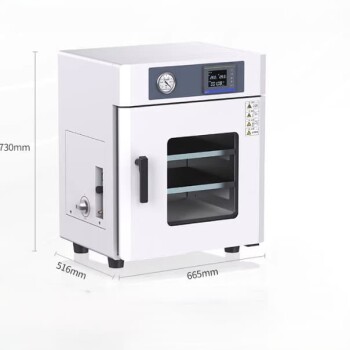
- 56L Vertical Laboratory Vacuum Drying Oven
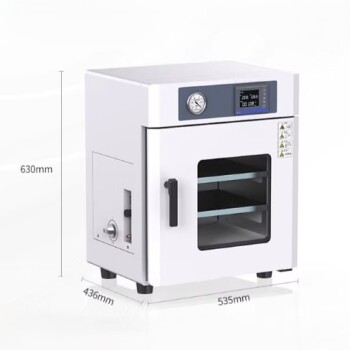
- 23L Laboratory Vacuum Drying Oven
- Laboratory Scientific Electric Heating Blast Drying Oven
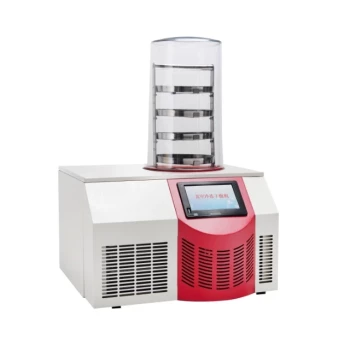
- Benchtop Laboratory Vacuum Freeze Dryer
- Dental Porcelain Zirconia Sintering Ceramic Vacuum Press Furnace
People Also Ask
- Why is a laboratory vacuum drying oven recommended for rice straw residues? Protect Your Biomass Integrity
- What role does a laboratory vacuum drying oven play in the preparation of modified multi-walled carbon nanotubes?
- What is the importance of using a laboratory vacuum drying oven? Preserving Slow-Release Microcapsule Integrity
- Why is a Laboratory Vacuum Drying Oven recommended for PBAT microspheres? Protect Sensitive Polymer Integrity
- What role does a laboratory vacuum drying oven play in processing nanoparticle powder samples? Protect Sample Integrity