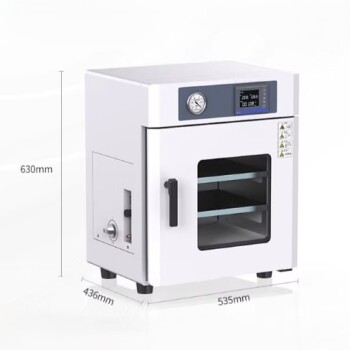
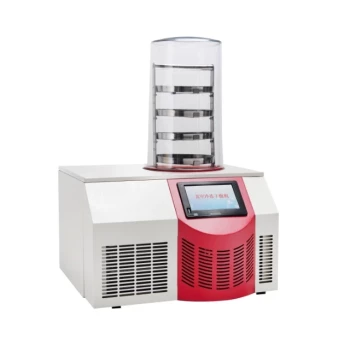
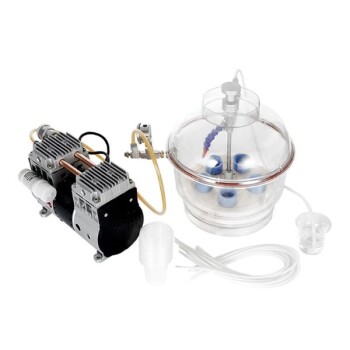
The critical necessity of a vacuum drying oven lies in the hygroscopic nature of aramid fibers, which naturally absorb significant amounts of moisture from the environment. Before any surface modification can occur, these fibers must be thoroughly dehydrated to prevent water from interfering with chemical bonding or causing structural defects during the resin curing process.
By effectively removing moisture from the fiber pores, vacuum drying prevents the formation of steam-induced voids and ensures a pristine surface for modifiers, ultimately securing the necessary interfacial shear strength between the fiber and the resin.
The Physical Challenge: Moisture and Voids
The Hygroscopic Nature of Aramid
Unlike some reinforcement materials, aramid fibers are not inert to humidity. They are porous and actively absorb water from the surrounding air.
If this moisture is not removed, it remains trapped within the fiber's structure. This latent moisture is the primary enemy of composite integrity.
Preventing Steam-Induced Voids
During the composite curing process, temperatures rise significantly. Any water trapped in the aramid fiber will turn into steam.
Because steam occupies a much larger volume than liquid water, it creates internal pressure. This leads to the formation of voids or bubbles within the cured matrix, which act as stress concentration points and weaken the final part.
The Chemical Necessity: Ensuring Reaction Efficiency
Removing Barriers to Grafting
Surface modifiers, such as rare earth solutions or epichlorohydrin, rely on direct contact with the fiber surface to react effectively.
Moisture acts as a physical and chemical barrier. If the fiber pores are filled with water molecules, the modifying agents cannot penetrate or bond with the fiber surface at a molecular level.
Maximizing Interfacial Shear Strength
The goal of surface modification is to improve the "grip" between the fiber and the resin, known as interfacial shear strength.
A vacuum drying oven ensures the fiber is chemically receptive. By dehydrating the fiber at elevated temperatures (typically around 110°C), the surface is primed for maximum chemical reactivity and mechanical interlocking.
Understanding the Trade-offs: Heat vs. Vacuum
The Role of Vacuum in Temperature Management
While heat alone can dry fibers, it often requires temperatures that are dangerously high to fully evacuate moisture from deep pores.
The vacuum environment lowers the boiling point of water. This allows for the efficient removal of moisture from fiber gaps at more moderate temperatures.
Avoiding Thermal Degradation
Using a vacuum reduces the risk of damaging the fiber. Excessive heat in the presence of oxygen can lead to surface oxidation or the degradation of the fiber's intrinsic mechanical properties.
By utilizing a vacuum, you achieve deep drying without subjecting the aramid to thermal extremes that could compromise its tensile strength before the composite is even built.
Making the Right Choice for Your Project
To ensure optimal results in aramid fiber surface modification, align your process with your specific performance requirements:
- If your primary focus is Structural Integrity: Prioritize vacuum drying to eliminate void formation, as steam generation during curing is the leading cause of composite delamination.
- If your primary focus is Chemical Bonding: Ensure the drying cycle reaches at least 110°C under vacuum to fully clear pores for modifiers like epichlorohydrin to react.
- If your primary focus is Fiber Preservation: Monitor the temperature carefully; the vacuum allows you to dry effectively without exceeding thermal limits that degrade the fiber.
Reliable adhesion starts with a pristine, moisture-free substrate, making vacuum drying the non-negotiable first step in high-performance composite manufacturing.
Summary Table:
| Factor | Impact on Aramid Fiber | Benefit of Vacuum Drying |
|---|---|---|
| Moisture Content | Trapped water in porous structure | Complete dehydration at lower boiling points |
| Structural Integrity | Steam causes internal voids/bubbles | Prevents delamination and stress concentration |
| Chemical Reactivity | Blocks modifiers (e.g., grafting) | Opens pores for effective molecular bonding |
| Thermal Safety | High heat risks fiber degradation | Preserves tensile strength in oxygen-free environments |
Elevate Your Composite Research with KINTEK Precision
Achieving maximum interfacial shear strength requires a pristine, moisture-free substrate. KINTEK provides the advanced laboratory equipment necessary for high-performance material science.
From our specialized vacuum drying ovens that ensure deep dehydration without thermal degradation, to high-temperature furnaces (CVD, PECVD, vacuum), autoclaves, and hydraulic pellet presses, we offer the complete toolkit for fiber modification and resin curing.
Ready to eliminate structural defects and optimize your chemical bonding results?
Contact our experts today to discover how KINTEK’s precision engineering can enhance your laboratory’s output.
References
- Azira Muratovna Yermakhanova, Berdiyar Baiserikov. Investigation of dielectric and strength properties of organoplastics. Review. DOI: 10.31643/2022/6445.33
This article is also based on technical information from Kintek Solution Knowledge Base .
Related Products
- 56L Vertical Laboratory Vacuum Drying Oven
- 23L Laboratory Vacuum Drying Oven
- Laboratory Scientific Electric Heating Blast Drying Oven
- Benchtop Laboratory Vacuum Freeze Dryer
- Dental Porcelain Zirconia Sintering Ceramic Vacuum Press Furnace
People Also Ask
- Why is a laboratory vacuum drying oven recommended for rice straw residues? Protect Your Biomass Integrity
- What role does a laboratory vacuum drying oven play in the preparation of modified multi-walled carbon nanotubes?
- What is the importance of using a laboratory vacuum drying oven? Preserving Slow-Release Microcapsule Integrity
- Why is a Laboratory Vacuum Drying Oven recommended for PBAT microspheres? Protect Sensitive Polymer Integrity
- What role does a laboratory vacuum drying oven play in processing nanoparticle powder samples? Protect Sample Integrity