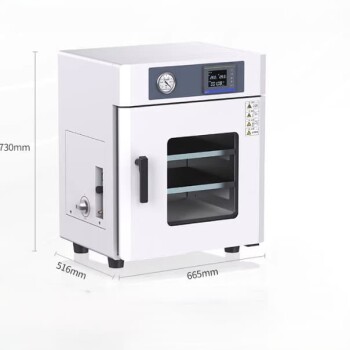
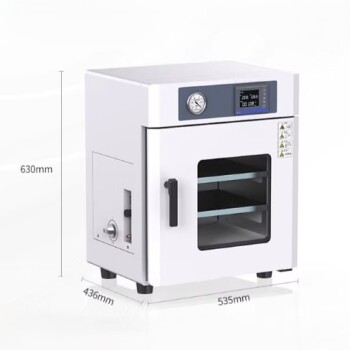
A vacuum oven is strictly required for drying UiO-66-NH2 metal-organic frameworks (MOFs) to achieve effective solvent removal without compromising the material's structural integrity. By lowering the pressure, you significantly reduce the boiling points of stubborn solvents like dimethylformamide (DMF) or methanol, allowing them to evaporate from the material's pores at a safe temperature of 100 °C.
The Core Insight "Drying" a MOF is actually an activation process: you must evacuate solvent molecules trapped deep within the pores to unlock the material's surface area. The vacuum oven allows you to do this at temperatures low enough to prevent the collapse of the porous framework and the degradation of sensitive amino functional groups.
The Mechanics of Effective Activation
Removing High-Boiling Solvents
The synthesis of UiO-66-NH2 often involves solvents with high boiling points, such as dimethylformamide (DMF). Under standard atmospheric pressure, removing DMF would require temperatures that could damage the MOF.
By applying a vacuum, you lower the boiling point of these solvents. This allows for thorough degassing and removal of DMF and methanol residues at a manageable 100 °C.
Accessing Internal Pores
Standard drying methods often only remove surface moisture. However, the value of a MOF lies in its internal porosity.
A vacuum environment creates a pressure gradient that pulls solvent molecules out from deep within the lattice structure. This ensures the pores are completely emptied, maximizing the material's specific surface area and adsorption activity.
Preserving Structural and Chemical Integrity
Preventing Structural Collapse
MOFs are porous crystalline structures that can be fragile under thermal stress. Subjecting UiO-66-NH2 to the high temperatures required to boil off solvents at normal pressure often leads to the collapse of the pore structure.
Using a vacuum allows for drying at lower temperatures, preserving the delicate lattice. This ensures the final product retains the high surface area required for its intended application.
Protecting Functional Groups
The "NH2" in UiO-66-NH2 refers to amino functional groups grafted onto the structure. These organic components can be sensitive to thermal decomposition or oxidation.
A vacuum oven provides an oxygen-deficient environment that minimizes the risk of oxidative degradation. Furthermore, the milder thermal profile (around 100 °C) ensures these amino groups remain chemically active and intact.
Common Pitfalls and Trade-offs
The Risk of Bumping
While vacuum drying is efficient, applying a deep vacuum too suddenly can cause "bumping" (violent boiling) of the residual solvent.
This mechanical stress can physically disrupt the MOF powder or displace it from the container. Vacuum pressure should be applied gradually to allow for controlled solvent release.
Equipment Dependencies
Unlike a standard convection oven, vacuum drying requires a reliable vacuum pump and often a cold trap to condense solvents like DMF.
Failure to maintain the vacuum pump or the cold trap can lead to solvent vapor damaging the pump or insufficient pressure reduction, resulting in incomplete activation.
Making the Right Choice for Your Goal
To ensure the highest quality synthesis of UiO-66-NH2, apply the following principles:
- If your primary focus is Adsorption Capacity: Prioritize the vacuum step to ensure pores are completely evacuated of DMF, which maximizes available surface area.
- If your primary focus is Chemical Functionality: Adhere strictly to the 100 °C limit under vacuum to protect the amino (NH2) groups from thermal degradation or oxidation.
The vacuum oven is not just a drying tool; it is the key to transitioning your material from a solvent-filled solid to a functional, high-performance framework.
Summary Table:
| Feature | Vacuum Oven Activation | Standard Convection Oven |
|---|---|---|
| Temperature Required | Lower (e.g., 100°C) | Higher (above solvent B.P.) |
| Structural Integrity | Preserves delicate lattice | Risk of pore collapse |
| Functional Groups | Protects -NH2 from oxidation | Potential thermal degradation |
| Solvent Removal | Deep pore evacuation | Surface-level moisture removal |
| Atmosphere | Oxygen-deficient (Safe) | Oxygen-rich (Oxidation risk) |
Maximize Your MOF Performance with KINTEK
Don't let inefficient drying compromise your research. KINTEK provides advanced laboratory solutions designed for the precise activation of metal-organic frameworks. Whether you need high-performance vacuum ovens, high-temperature muffle and tube furnaces, or specialized crushing and milling systems, we deliver the reliability your materials demand.
From protecting sensitive amino groups in UiO-66-NH2 to ensuring maximum surface area in your porous structures, our equipment is built for excellence. Enhance your lab’s efficiency and secure consistent results—contact KINTEK today for a tailored solution!
References
- Abbas Abbasnia, Ali Esrafili. UiO66-NH2-TiO2/NiF photoanode for photocatalytic fuel cell by towards simultaneous treatment of antibiotic wastewater and electricity generation. DOI: 10.1038/s41598-023-49019-y
This article is also based on technical information from Kintek Solution Knowledge Base .
Related Products
- 56L Vertical Laboratory Vacuum Drying Oven
- 23L Laboratory Vacuum Drying Oven
- Vacuum Heat Treat Sintering Brazing Furnace
- 2200 ℃ Graphite Vacuum Heat Treat Furnace
- Dental Porcelain Zirconia Sintering Ceramic Vacuum Press Furnace
People Also Ask
- Why is a laboratory vacuum drying oven recommended for rice straw residues? Protect Your Biomass Integrity
- What role does a laboratory vacuum drying oven play in the preparation of modified multi-walled carbon nanotubes?
- What is the importance of using a laboratory vacuum drying oven? Preserving Slow-Release Microcapsule Integrity
- Why is a Laboratory Vacuum Drying Oven recommended for PBAT microspheres? Protect Sensitive Polymer Integrity
- What role does a laboratory vacuum drying oven play in processing nanoparticle powder samples? Protect Sample Integrity