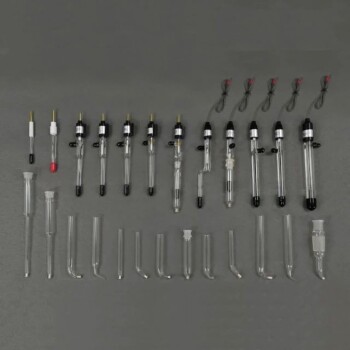
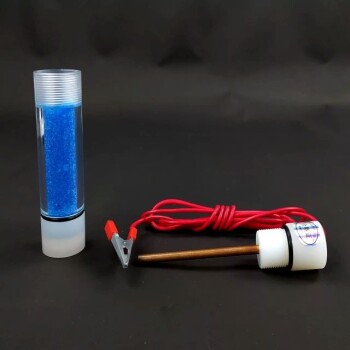
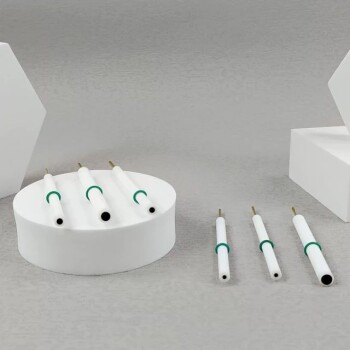
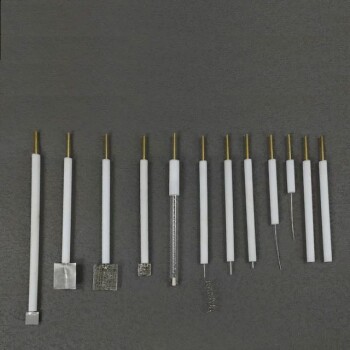
The Ag/AgCl reference electrode provides the stable electrochemical baseline required to validate the performance of Microbial Electrolysis Cells (MECs). It acts as a fixed benchmark with a known potential, allowing researchers to accurately measure potential changes at the working electrode without interference from system noise or environmental variables.
In electrochemical characterization, data is only as reliable as its reference point. By ensuring a known and constant potential, the Ag/AgCl electrode guarantees that your measurements of reaction efficiency—specifically for hydrogen evolution and acetate oxidation—are scientifically valid and reproducible.
The Role of Stability in MEC Characterization
Establishing a Fixed Benchmark
In an MEC, voltages fluctuate based on microbial activity and reaction kinetics. To make sense of these fluctuations, you need a "zero point" that does not move.
The Ag/AgCl reference electrode provides this known and highly stable electrochemical potential. It serves as an anchor, ensuring that the values you record reflect actual system performance rather than measurement artifacts.
Isolating the Working Electrode
MEC performance depends on the efficiency of the working electrode. However, a standard two-electrode setup only measures the total cell voltage, blurring the lines between anode and cathode performance.
By introducing the Ag/AgCl electrode as a reference, you can isolate and measure the potential changes of the working electrode specifically. This allows you to pinpoint exactly where efficiency losses are occurring.
Calculating Accurate Overpotential
The core metric of MEC efficiency is overpotential—the extra energy required to drive a reaction beyond its thermodynamic minimum.
Accurately determining the overpotential for key reactions, such as hydrogen evolution or acetate oxidation, is impossible without a stable reference. The Ag/AgCl electrode provides the precise baseline needed to calculate these energy costs.
Ensuring Data Integrity and Comparability
Reproducibility Across Batches
Microbial systems are inherently variable. To prove that an MEC design is effective, you must demonstrate that results are not one-off anomalies.
The Ag/AgCl electrode ensures high reproducibility of data. Because the reference potential is constant, you can confirm that consistent readings across different experimental batches are due to the system's stability, not measurement drift.
Comparative Analysis
Scientific advancement relies on comparing data with previous studies or different experimental conditions.
Using a standard Ag/AgCl reference ensures high comparability of your data. It allows you to benchmark your MEC's efficiency against other published works using the same standard, validating your findings within the broader scientific context.
Common Pitfalls to Avoid
The Risk of Reference Drift
While the Ag/AgCl electrode is chosen for its stability, it is not immune to degradation. If the reference electrode is compromised, the "known" potential shifts.
This drift effectively moves your benchmark. If the benchmark moves, your calculations for overpotential and electrode efficiency become erroneous, rendering the data invalid.
Misinterpreting Total Cell Potential
A common mistake is relying solely on the voltage difference between the anode and cathode without a reference.
Without the Ag/AgCl electrode to act as a third point of triangulation, you cannot determine if a drop in performance is due to the anode (microbial oxidation) or the cathode (hydrogen evolution).
Applying This to Your Research
To maximize the quality of your MEC characterization, consider your primary experimental goals:
- If your primary focus is process efficiency: Use the Ag/AgCl electrode to precisely calculate the overpotential of hydrogen evolution or acetate oxidation to identify energy losses.
- If your primary focus is experimental validation: Rely on the electrode to ensure your data is reproducible across multiple batches, proving the reliability of your system design.
A stable reference electrode is not just a tool; it is the foundation of credible electrochemical data.
Summary Table:
| Feature | Importance in MEC Characterization | Benefit to Researcher |
|---|---|---|
| Stable Potential | Acts as a fixed 'zero point' baseline | Eliminates measurement artifacts and noise |
| Isolation | Separates anode and cathode performance | Pinpoints exact sources of efficiency loss |
| Overpotential Calc. | Measures energy beyond thermodynamic minimum | Accurately quantifies reaction efficiency |
| Standardization | Provides a universal reference benchmark | Enables data comparability with global studies |
| Reproducibility | Maintains consistency across test batches | Validates system design and reliability |
Elevate your electrochemical research with precision-engineered solutions from KINTEK. Whether you are optimizing Microbial Electrolysis Cells or advancing battery technology, our comprehensive range of electrolytic cells, electrodes (including high-stability Ag/AgCl), and high-temperature reactors provides the reliability your data demands. Don't let measurement drift compromise your findings—contact our laboratory experts today to find the perfect equipment for your specific application.
References
- Hyungwon Chai, Sokhee P. Jung. Validity and Reproducibility of Counter Electrodes for Linear Sweep Voltammetry Test in Microbial Electrolysis Cells. DOI: 10.3390/en17112674
This article is also based on technical information from Kintek Solution Knowledge Base .
Related Products
- Reference Electrode Calomel Silver Chloride Mercury Sulfate for Laboratory Use
- Copper Sulfate Reference Electrode for Laboratory Use
- Electrolytic Electrochemical Cell Gas Diffusion Liquid Flow Reaction Cell
- Glassy Carbon Electrochemical Electrode
- Graphite Disc Rod and Sheet Electrode Electrochemical Graphite Electrode
People Also Ask
- What is the function of a reference electrode? Master Precision in Three-Electrode Reactor Reconstruction
- What is the recommended maintenance for the filling solution of a reference electrode? A Guide to Stable & Accurate Readings
- Which electrode is used as a ground reference? Master the Key to Accurate Electrochemical Measurements
- What is the reference electrode in potentiometry? The Key to Stable & Accurate Measurements
- Which electrode is used as a reference? A Guide to Accurate Electrochemical Measurements