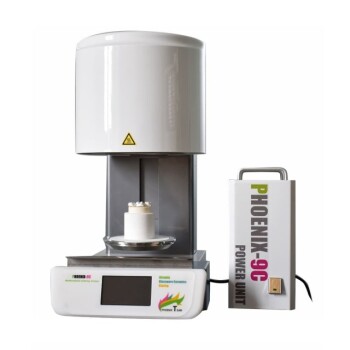
An atmosphere-controlled sintering furnace is strictly necessary for this process because it provides the dual conditions required to synthesize ordered intermetallic nanocrystals: a reductive environment to ensure metallic purity and high thermal energy to drive atomic rearrangement. Without this specific apparatus, it is impossible to simultaneously reduce metal precursors and overcome the kinetic barriers required for an ordered lattice structure.
The creation of ordered intermetallic nanocrystals requires a delicate balance of chemistry and physics. The furnace serves as the critical intersection where a reductive atmosphere enables the formation of pure metal, while precise heat forces those atoms into a highly structured, ordered arrangement.
The Critical Role of the Reductive Environment
To successfully anneal these nanocrystals, you must first ensure the materials are in the correct chemical state.
Transforming Precursors
The furnace introduces a specific reductive atmosphere, typically composed of hydrogen (H2) or a mixture of hydrogen and argon.
This environment is essential for chemically reducing metal salt precursors. It strips away non-metallic components, converting the salts into their pure metallic states.
Preventing Oxidation
Standard thermal annealing in air would be catastrophic for this process. The presence of oxygen would lead to immediate oxidation of the metal atoms.
The atmosphere-controlled furnace creates a sealed barrier against the outside environment. This ensures that once the metal is reduced, it remains pure and does not revert to an oxide form during heating.
The Mechanics of Atomic Ordering
Once the chemical state is secured, the physical arrangement of the atoms must be addressed.
Overcoming Kinetic Barriers
Achieving an ordered intermetallic structure is not chemically spontaneous at room temperature; it requires significant energy.
The furnace provides the high-temperature conditions necessary to overcome kinetic energy barriers. This energy input "unlocks" the atoms, allowing them to move within the solid state.
Facilitating Atomic Diffusion
With the kinetic barriers removed, metal atoms can undergo atomic diffusion.
This process allows atoms to migrate from a random, disordered distribution into a specific, ordered lattice arrangement. This transition is the defining characteristic of an ordered intermetallic nanocrystal.
Risks of Improper Environmental Control
Using an atmosphere-controlled furnace is not just about optimization; it is about avoiding specific failure modes inherent to material synthesis.
The Consequence of Oxidation
If the atmosphere is not strictly controlled to exclude oxygen, the high temperatures required for annealing will accelerate oxidation reactions.
This results in metal oxides rather than intermetallics, effectively destroying the intended electronic or magnetic properties of the nanocrystals.
The Problem of Kinetic Stagnation
Without precise temperature control capable of reaching high thermal thresholds, the atoms will lack the energy to diffuse.
Consequently, the material will remain in a randomly distributed state. You will be left with a disordered alloy rather than an ordered intermetallic crystal.
Making the Right Choice for Your Process
When designing your annealing protocol, understand that the furnace controls two distinct variables that must work in unison.
- If your primary focus is material purity: Ensure your furnace creates a consistent reductive atmosphere (H2 or H2/Ar) to fully reduce precursors and prevent oxidation.
- If your primary focus is crystal structure: Prioritize the furnace's ability to maintain high, stable temperatures to overcome kinetic barriers and drive the transition to an ordered lattice.
The atmosphere-controlled sintering furnace is the only tool that effectively synchronizes chemical reduction with physical ordering.
Summary Table:
| Feature | Function in Annealing | Benefit for Nanocrystals |
|---|---|---|
| Reductive Atmosphere | Removes oxygen & reduces metal salts | Ensures metallic purity and prevents oxidation |
| High Thermal Energy | Overcomes kinetic barriers | Enables atoms to unlock from disordered states |
| Atomic Diffusion | Facilitates solid-state migration | Drives the transition to an ordered lattice structure |
| Sealed Environment | Blocks external contaminants | Maintains chemical integrity during high-temp cycles |
Elevate Your Material Synthesis with KINTEK
Precision is non-negotiable when synthesizing ordered intermetallic nanocrystals. KINTEK specializes in advanced laboratory equipment, providing the high-performance atmosphere-controlled furnaces (including tube, vacuum, and atmosphere models) required to master the delicate balance of reductive chemistry and thermal energy.
Whether you are conducting cutting-edge battery research or developing new catalysts, our comprehensive portfolio—from high-temperature furnaces and crushing systems to high-pressure reactors and electrolytic cells—is designed to meet the rigorous demands of modern material science.
Ready to achieve superior crystalline structures? Contact KINTEK today to discover how our expert heating and processing solutions can optimize your lab's research outcomes.
References
- Jiawei Liu, Qingyu Yan. Recent progress in intermetallic nanocrystals for electrocatalysis: From binary to ternary to high‐entropy intermetallics. DOI: 10.1002/smm2.1210
This article is also based on technical information from Kintek Solution Knowledge Base .
Related Products
- Mesh belt controlled atmosphere furnace
- Controlled Nitrogen Inert Hydrogen Atmosphere Furnace
- 1200℃ Controlled Atmosphere Furnace Nitrogen Inert Atmosphere Furnace
- 1700℃ Controlled Atmosphere Furnace Nitrogen Inert Atmosphere Furnace
- 1400℃ Controlled Atmosphere Furnace with Nitrogen and Inert Atmosphere
People Also Ask
- What role does a controlled atmosphere furnace with argon gas flow play in the production of reduced graphene oxide (rGO)?
- What are some of the reasons why a controlled atmosphere furnace is desirable in sintering? Achieve Superior Sintering Results
- Why is a furnace equipped with a controlled atmosphere necessary for the preparation of active metal catalysts?
- How does a mesh belt furnace work? Achieve High-Volume, Repeatable Heat Treatment
- What is the process of a mesh belt furnace? Achieve Consistent, High-Volume Heat Treatment