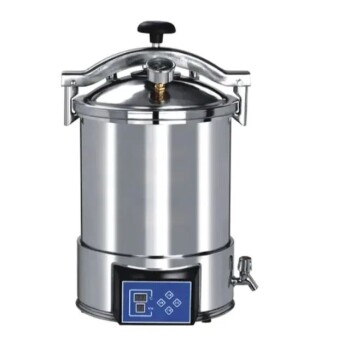
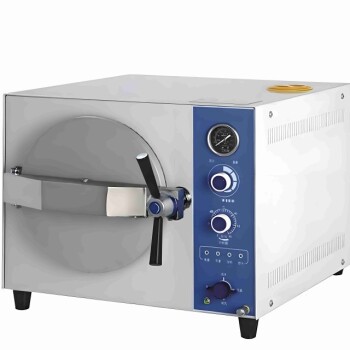
The autoclave functions as the critical engine for synthesis, creating the specific high-pressure and high-temperature environment necessary to grow ultra-long silver nanowires. By sealing the reaction mixture, it allows the system to surpass standard boiling points, driving the crystallization of silver salts into uniform structures up to 500 micrometers long without relying on chemical surfactants or polymers.
The autoclave provides a sealed, high-energy environment that physically forces silver salts to crystallize into high-aspect-ratio nanowires. This mechanical containment eliminates the need for chemical stabilizers, resulting in exceptional morphological uniformity and length.
The Role of Extreme Conditions
Elevating Reaction Parameters
In standard open-air synthesis, temperature is limited by the boiling point of the solvent. An autoclave seals the system, allowing pressures and temperatures to rise significantly higher.
This extreme environment provides the thermodynamic energy required to alter the behavior of the chemical reactants.
Driving Crystallization
The combined effect of high heat and pressure forces the crystallization of silver salts.
Under these intense conditions, the silver ions are compelled to arrange themselves into solid lattice structures, initiating the growth of the nanowire.
Achieving Structural Purity
Eliminating Chemical Stabilizers
A unique advantage of the autoclave method is the ability to synthesize wires in the absence of surfactants or polymers.
Many standard methods require these chemical additives to guide growth, but they can leave impurities. The autoclave's physical environment provides the necessary control naturally.
Unlocking Extreme Lengths
The specific conditions created within the autoclave enable the production of ultra-long nanowires.
While standard methods may produce shorter rods, the hydrothermal/solvothermal approach yields wires up to 500 micrometers in length with exceptionally high aspect ratios.
Controlling Growth Kinetics
Regulating Nucleation
The sealed environment allows for precise control over nucleation kinetics—the speed and manner in which the initial crystal seeds form.
By managing the pressure and temperature profile, you ensure that the silver grows outwardly into wires rather than aggregating into irregular clumps.
Ensuring Morphological Uniformity
Consistency is critical for the end application of nanowires.
The autoclave ensures that the reaction environment is uniform throughout the vessel, resulting in nanowires that possess excellent morphological uniformity rather than a mix of varied shapes and sizes.
Understanding the Trade-offs
Operational Safety and Complexity
Working with autoclaves introduces safety risks inherent to high-pressure vessels.
Operators must adhere to strict safety protocols and maintenance schedules to prevent seal failures or ruptures, adding a layer of operational complexity compared to open-beaker synthesis.
Scalability Limitations
Autoclave synthesis is typically a batch process.
While it produces high-quality results, scaling up production to industrial quantities is often more difficult and slower than continuous flow processes used in other synthesis methods.
Optimizing Your Synthesis Strategy
To determine if autoclave synthesis is the right approach for your specific requirements, consider these factors:
- If your primary focus is extreme aspect ratio: Rely on the autoclave to achieve lengths up to 500 micrometers that are difficult to attain via standard chemical reduction.
- If your primary focus is material purity: Choose this method to avoid the contamination risks associated with polymer or surfactant stabilizers.
- If your primary focus is mass production: Evaluate whether the batch-nature of autoclave synthesis creates a bottleneck for your required volume.
The autoclave is not just a heating vessel; it is a precision tool that substitutes chemical additives with physical force to create superior crystalline structures.
Summary Table:
| Feature | Autoclave Synthesis Benefits |
|---|---|
| Maximum Length | Up to 500 micrometers (Ultra-long) |
| Chemical Purity | Surfactant-free and polymer-free process |
| Reaction Environment | High-pressure, high-temperature (HPHT) |
| Morphology | Superior uniformity and high aspect ratio |
| Control Mechanism | Precise regulation of nucleation kinetics |
Elevate Your Material Synthesis with KINTEK Precision
Unlock the full potential of your hydrothermal and solvothermal research with KINTEK’s high-performance autoclaves and high-pressure reactors. Designed for researchers who demand extreme morphological uniformity and material purity, our equipment provides the stable, high-energy environment necessary for growing ultra-long silver nanowires and advanced crystalline structures.
From high-temperature furnaces to specialized hydrostatic and isostatic presses, KINTEK provides the comprehensive laboratory tools required for cutting-edge battery research and chemical engineering. Don't compromise on purity or aspect ratio—leverage our expertise to optimize your batch synthesis today.
Ready to scale your synthesis results? Contact KINTEK today for a custom consultation!
References
- Longxia Yang, Haicheng Wang. Silver Nanowires: From Synthesis, Growth Mechanism, Device Fabrications to Prospective Engineered Applications. DOI: 10.30919/es8d808
This article is also based on technical information from Kintek Solution Knowledge Base .
Related Products
- High Pressure Laboratory Autoclave Reactor for Hydrothermal Synthesis
- Mini SS High Pressure Autoclave Reactor for Laboratory Use
- Customizable Laboratory High Temperature High Pressure Reactors for Diverse Scientific Applications
- Desktop Fast Laboratory Autoclave Sterilizer 35L 50L 90L for Lab Use
- Desktop Fast High Pressure Laboratory Autoclave Sterilizer 16L 24L for Lab Use
People Also Ask
- What role does a high-pressure reactor (autoclave) play in the synthesis of NiCuFe-LDH? Master Hydrothermal Growth
- What Role Does a High-Pressure Reactor or Autoclave Play in HA Catalyst Synthesis? Achieve High Surface Area Materials
- What equipment is required for hydrothermal synthesis of Ga0.25Zn4.67S5.08? Optimize Your Semiconductor Production
- What is the function of a high-pressure reactor in the hydrothermal synthesis of boehmite? Expert Process Insights
- What role does an autoclave play in the synthesis of MnO2 nanofibers? Mastering Hydrothermal Growth