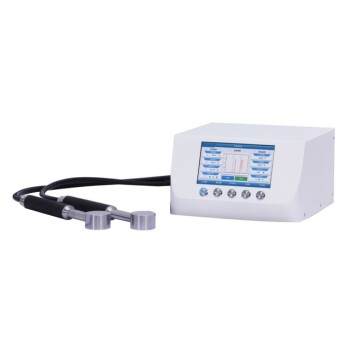
An infrared (IR) thermometer is strictly required because the sintering environment involves high-temperature, sealed vacuum or protective atmosphere chambers that make physical contact sensors impractical.
During processes like Spark Plasma Sintering (SPS) or Hot Pressing (HP), the Al-doped LLZO is contained within graphite molds. The IR thermometer provides a non-contact solution to monitor the surface temperature of these molds in real-time without breaching the chamber's integrity.
Core Takeaway Reliable temperature monitoring for Al-doped LLZO requires overcoming the physical barriers of sealed sintering chambers while managing the material's chemical sensitivity. An IR thermometer bridges this gap, enabling precise control over rapid heating rates to prevent fatal temperature overshoots and material decomposition.
Overcoming Physical Constraints
The primary driver for using IR technology is the physical configuration of the sintering equipment.
The Challenge of Closed Chambers
Sintering Al-doped LLZO often utilizes Spark Plasma Sintering (SPS) or Hot Pressing (HP).
These techniques operate within closed vacuum or protective atmosphere chambers to ensure purity and pressure control.
Limitations of Contact Sensors
Because the environment is sealed and operates at extreme temperatures, inserting standard contact-based measurement tools (like thermocouples) is physically difficult or impossible.
An IR thermometer bypasses this limitation by reading thermal radiation through a viewport, allowing for non-contact monitoring of the setup.
Monitoring the Graphite Mold
The IR thermometer is specifically aimed at the graphite mold surface.
Since the sample is encased within the mold, the mold surface acts as the proxy for the thermal state of the system.
Critical Process Control
Beyond physical access, the specific chemistry of Al-doped LLZO demands extreme thermal precision.
Managing Rapid Heating Rates
Fast sintering processes often utilize aggressive heating rates, such as 100 K/min.
To maintain this speed without losing control, the system requires instant, real-time feedback that only an optical sensor can consistently provide.
Preventing Material Decomposition
Al-doped LLZO is chemically sensitive to excessive heat.
If the temperature control lags, the system risks temperature overshoot, where the actual heat exceeds the setpoint.
The real-time data from the IR thermometer ensures the holding temperature is maintained precisely, preventing the material from decomposing.
Understanding the Trade-offs
While IR thermometers are essential, they introduce specific variables that must be managed.
Surface vs. Core Temperature
The IR thermometer measures the surface temperature of the graphite mold, not the sample directly inside.
Operators must account for a slight thermal gradient between the mold's exterior and the Al-doped LLZO core.
Emissivity Calibration
Accurate IR readings depend on the emissivity settings of the sensor.
Because the target is graphite, the thermometer must be calibrated specifically for graphite’s emissivity to prevent false temperature readings.
Making the Right Choice for Your Goal
To ensure successful sintering of Al-doped LLZO, align your monitoring strategy with your specific objectives.
- If your primary focus is Avoiding Decomposition: Prioritize the calibration of the IR thermometer to detect and prevent temperature overshoot immediately.
- If your primary focus is Process Efficiency: Utilize the real-time feedback loop to maximize heating rates (e.g., 100 K/min) without destabilizing the vacuum chamber environment.
Precision monitoring is the only way to balance rapid processing speed with the material stability required for high-performance electrolytes.
Summary Table:
| Feature | IR Thermometer Monitoring | Traditional Contact Sensors |
|---|---|---|
| Measurement Method | Non-contact (Optical) | Physical Contact (Probe) |
| Environment Suitability | Sealed Vacuum/Atmosphere Chambers | Open or Low-Temp Systems |
| Response Speed | Instantaneous (Real-time) | Slower Thermal Transfer |
| Primary Target | Graphite Mold Surface | Sample or Heater |
| Max Heating Rates | Supports up to 100 K/min | Limited by Thermal Lag |
| Key Benefit | Prevents Material Decomposition | Susceptible to Seal Breach |
Maximize Your Material Research Precision with KINTEK
Achieving the perfect sintering profile for Al-doped LLZO requires the right equipment and monitoring expertise. KINTEK specializes in high-performance laboratory solutions, including advanced Spark Plasma Sintering (SPS) support, high-temperature furnaces, and precision hydraulic presses.
Whether you are developing next-generation solid-state batteries or advanced ceramics, our comprehensive range of muffle, vacuum, and tube furnaces, along with our specialized high-pressure reactors and battery research tools, ensures your lab operates at the cutting edge of technology.
Ready to elevate your sintering process? Contact our technical experts today to find the perfect equipment and consumables for your specific application.
Related Products
- Infrared Thermal Imaging Temperature Measurement Double-Sided Coated Germanium Ge Lens
- Lab Infrared Press Mold
- Infrared Heating Quantitative Flat Plate Press Mold
- No Demolding Lab Infrared Press Mold for Laboratory Applications
- Oxygen Probe to Measure Temperature and Active Oxygen Content in Molten Steel
People Also Ask
- How do infrared temperature probes and graphite mold measurement holes function together? Precision Control in PCAS
- What are the applications of optical coating? Unlock Advanced Light Control for Your Industry
- What do optical coatings do? Control Light for Superior Optical Performance
- What is the optical coating? Master Light Control for Superior Optical Performance
- What is the process of optical coating? A Guide to High-Precision PVD Deposition