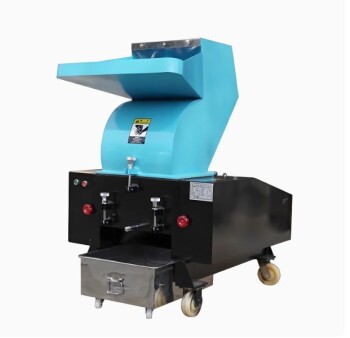
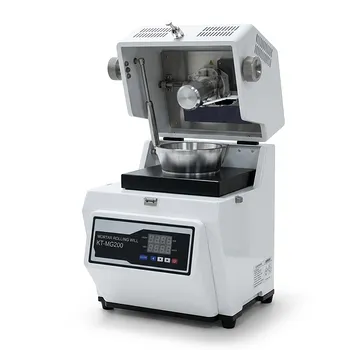
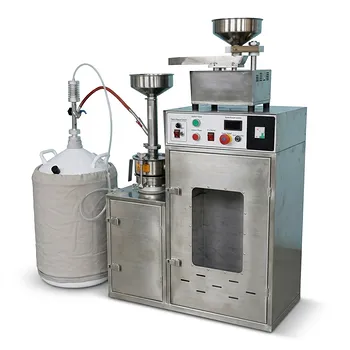
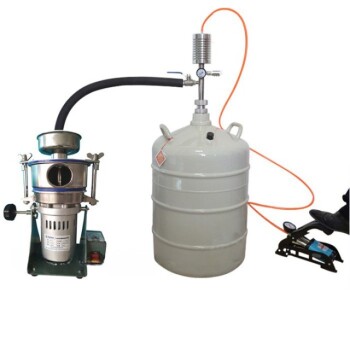
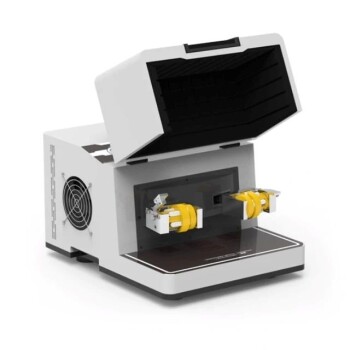
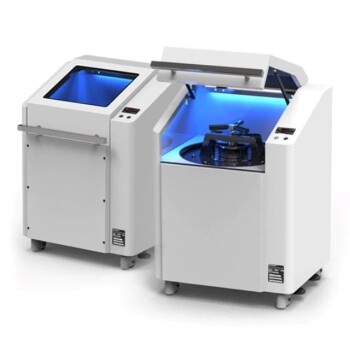
To ensure the structural integrity of martensitic steels at high temperatures, specialized grinding and mixing equipment is strictly necessary to achieve a uniform dispersion of nanoparticles. Without this precision, nanoparticles will clump together, failing to create the internal stress barriers required to stop the material from deforming over time.
To resist creep, martensitic steels rely on nanoparticles to create "threshold stress" that blocks atomic defects from moving. Uniform grinding and mixing are the only ways to ensure these particles remain separate and evenly distributed, directly leading to lower diffusion rates and a significantly longer operational lifespan.
The Mechanism of Creep Resistance
Creating Threshold Stress
The primary goal of introducing nanoparticles into martensitic steel is to generate threshold stress. This is a specific internal force that opposes the natural deformation of the material under heat and load.
Hindering Dislocation Movement
At the atomic level, materials deform (creep) when defects known as dislocations move through the metal's crystal lattice. Nanoparticles act as physical obstacles to block this movement.
Preventing "Climbing"
When dislocations encounter an obstacle, they attempt to bypass it via a mechanism called climbing. A uniform dispersion of nanoparticles makes this climbing process energetically difficult, effectively locking the material structure in place.
The Critical Role of Equipment
Eliminating Particle Agglomeration
Standard mixing often results in particles sticking together, or agglomerating. Specialized equipment is required to grind and mix the powder with enough precision to keep nanoparticles distinct and non-agglomerated.
Ensuring Homogeneous Distribution
For the material to perform reliably, the nanoparticles must be distributed evenly within the solid solution. Equipment capable of uniform mixing ensures there are no weak zones where dislocations can move freely.
Reducing Diffusion Rates
A uniform microstructure does more than just block physical movement; it also reduces diffusion rates. By slowing down the movement of atoms within the matrix, the equipment helps preserve the material's high-temperature properties for a longer duration.
Understanding the Risks of Improper Processing
The Danger of Inconsistency
If the grinding and mixing process creates an uneven distribution, the material will exhibit inconsistent creep resistance. Areas with fewer particles will become pathways for rapid deformation, rendering the reinforcement in other areas useless.
Impact on Operational Lifespan
The correlation between mixing uniformity and lifespan is direct. Poorly mixed materials will degrade faster because the threshold stress is not uniform, leading to premature failure under high-temperature service conditions.
Achieving Operational Longevity
To maximize the performance of high-temperature resistant materials, your equipment choice dictates your success.
- If your primary focus is maximizing the creep limit: Prioritize equipment that guarantees a non-agglomerating mixture to create the highest possible threshold stress against dislocation climbing.
- If your primary focus is extending operational lifespan: Ensure your process achieves a perfectly homogeneous solid solution to effectively reduce diffusion rates across the entire matrix.
Precision in the mixing phase is the defining factor between a standard alloy and a high-performance, heat-resistant steel.
Summary Table:
| Feature | Impact on Creep Resistance | Equipment Requirement |
|---|---|---|
| Particle Dispersion | Prevents agglomeration and weak zones | High-precision grinding |
| Dislocation Control | Blocks atomic defects from moving/climbing | Uniform nanoparticle distribution |
| Diffusion Rates | Lowers atomic movement at high temps | Homogeneous solid solution mixing |
| Threshold Stress | Creates internal force against deformation | Non-agglomerating powder processing |
Elevate Your Material Performance with KINTEK Precision
Maximize the creep limit and operational lifespan of your martensitic steels with KINTEK’s advanced processing solutions. As specialists in laboratory equipment, we provide the high-performance crushing and milling systems, high-temperature furnaces, and isostatic hydraulic presses essential for achieving a perfectly homogeneous, non-agglomerated nano-powder distribution. Whether you are developing heat-resistant alloys or conducting cutting-edge battery research, KINTEK delivers the consistency your materials demand.
Ready to eliminate material inconsistency? Contact our experts today to find the ideal equipment for your laboratory.
References
- Evgeniy Panin. Martensitic Transformations in Stainless Steels. DOI: 10.15407/ufm.23.04.684
This article is also based on technical information from Kintek Solution Knowledge Base .
Related Products
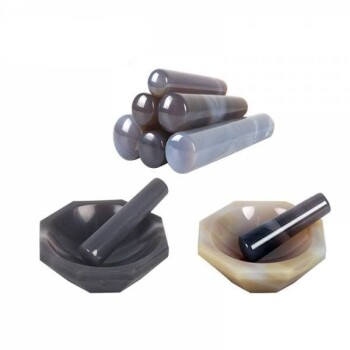
- Nature Agate Mortar and Pestle for Grinding and Mixing
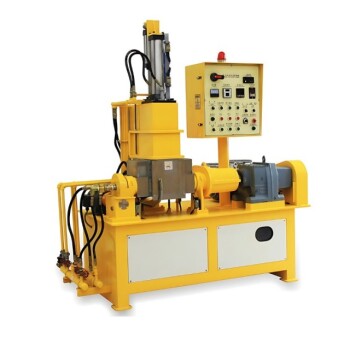
- Lab Internal Rubber Mixer Rubber Kneader Machine for Mixing and Kneading
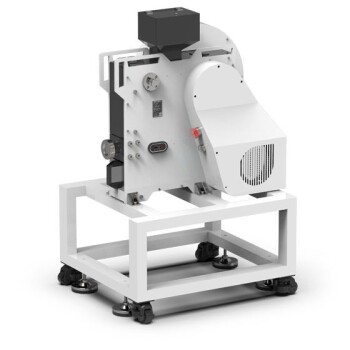
- Laboratory Jaw Crusher
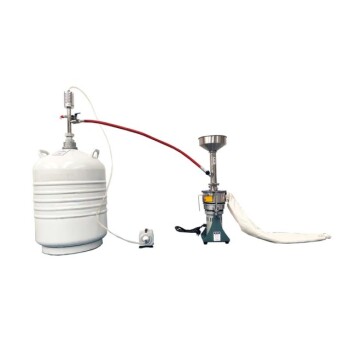
- Liquid Nitrogen Cryogenic Grinder Mill Cryomill Airflow Ultrafine Pulverizer
- High Energy Planetary Ball Mill Milling Machine for Laboratory
People Also Ask
- Why are agate mortars and pestles used for grinding iron oxide? Ensure Sample Purity for XRD Analysis
- What is the function of an agate mortar and pestle? Ensure Purity in Halide Solid-State Electrolyte Synthesis
- What is the primary function of an agate mortar and pestle? Optimize VO2+ CaZn2(PO4)2 Nanopowder Pre-Treatment
- Why is an agate mortar and pestle required for grinding Zr3(Al1-xSix)C2? Ensure Maximum Sample Purity
- Why is an agate mortar and pestle preferred for grinding MAX phase? Ensure Sample Purity & Zero Contamination