Grinding equipment is indispensable for ensuring the chemical homogeneity, reactivity, and analytical accuracy of cadmium sulfide (CdS) nanoparticles. By refining agglomerated materials both before and after thermal treatments, grinding facilitates efficient sulfurization reactions and ensures the final photocatalyst is suitable for both characterization and liquid-phase applications.
The use of grinding equipment in CdS synthesis is a critical step that optimizes the contact area between precursors for uniform chemical reactions and standardizes particle size to improve dispersibility and characterization precision.
Optimizing Chemical Reactivity and Synthesis
Increasing Precursor Contact Area
Before the annealing process, grinding is used to reduce the particle size of raw precursors. This maximization of the surface-to-volume ratio ensures that the precursors are in intimate contact.
This high level of contact is essential to facilitate the sulfurization reaction during annealing. Without it, the reaction may be incomplete or yield a non-homogeneous phase distribution within the CdS nanoparticles.
Refining Agglomerated Materials
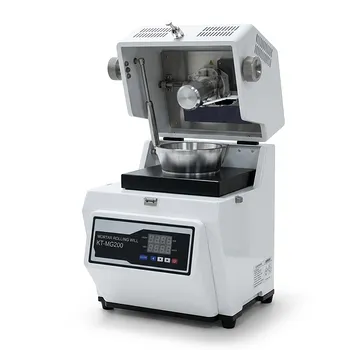
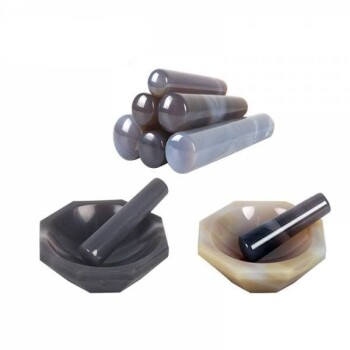
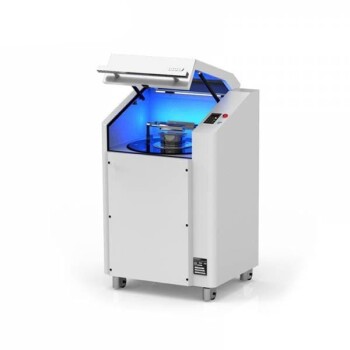
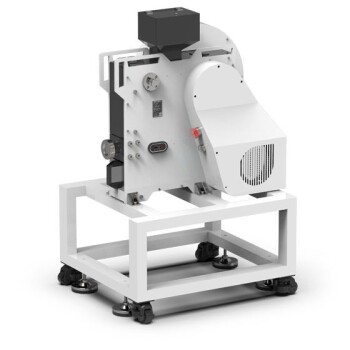
High-temperature treatments often cause nanoparticles to fuse or form agglomerates. Grinding equipment, such as high-purity agate mortars or laboratory pulverizers, is used to break these clusters back into fine powders.
Breaking these agglomerates ensures that the material achieves a uniform particle size distribution. This uniformity is a prerequisite for achieving stable and predictable behavior in downstream photocatalytic reactions.
Enhancing Material Characterization and Performance
Preparing Samples for Phase Analysis
When CdS is synthesized through methods like Spark Plasma Sintering (SPS), the resulting material is often a dense cylindrical block. For X-ray diffraction (XRD) to provide accurate phase identification, the sample must be in a fine powder form.
Grinding these dense blocks into powder allows for a random orientation of crystals during XRD. This ensures that the resulting data is a representative reflection of the material's actual phase composition rather than a localized artifact.
Removing Surface Contaminants
Synthesis methods involving carbon-based dies, such as SPS, can leave residual carbon contamination on the surface of the sintered sample. Grinding or polishing the surface is necessary to strip away these impurities.
Removing these contaminants is vital for obtaining clean analytical data. It prevents the carbon layer from masking the true phase-junction characteristics of the CdS nanoparticles during testing.
Improving Dispersibility in Solutions
The effectiveness of a CdS photocatalyst depends on its ability to remain suspended in a reaction solution. Grinding ensures the final powder has the high dispersibility required for these environments.
Uniformly dispersed particles provide more active sites for the photocatalytic process. This directly translates to higher efficiency in applications like hydrogen production or pollutant degradation.
Understanding the Trade-offs and Pitfalls
Potential for Material Contamination
While grinding is necessary, the choice of equipment is critical to avoid introducing impurities. Using low-quality mortars can lead to abrasive wear, where fragments of the grinding media contaminate the CdS sample.
To mitigate this, high-purity materials like agate or tungsten carbide are preferred. These materials minimize the risk of altering the chemical profile of the nanoparticles during the mechanical refinement process.
Mechanical Heat and Phase Stability
Intensive grinding, particularly in high-energy ball mills, generates significant frictional heat. In some cases, this heat can inadvertently trigger phase changes or affect the crystallinity of the phase-junction.
Operators must balance the duration and intensity of grinding to achieve the desired fineness without compromising the structural integrity of the CdS nanoparticles. Controlled, periodic grinding is often more effective than a single, high-intensity session.
How to Apply This to Your Project
Recommendations for Synthesis and Analysis
- If your primary focus is maximizing photocatalytic activity: Ensure post-annealing grinding is thorough to achieve a uniform particle size that facilitates high dispersibility in reaction solutions.
- If your primary focus is accurate phase characterization: Use grinding specifically to remove surface contaminants and transform dense blocks into powders suitable for representative XRD analysis.
- If your primary focus is preventing sample impurity: Utilize high-purity agate mortars and limit grinding time to reduce the risk of media wear and thermal degradation.
By mastering the mechanical refinement of CdS nanoparticles, researchers can ensure both the chemical purity and the functional efficiency of the resulting phase-junction materials.
Summary Table:
| Stage of Synthesis | Role of Grinding Equipment | Key Benefit for CdS Nanoparticles |
|---|---|---|
| Pre-Annealing | Increasing precursor contact area | Facilitates complete sulfurization reactions |
| Post-Annealing | Refining fused agglomerates | Ensures uniform particle size and high dispersibility |
| Post-SPS Treatment | Removing surface contaminants | Eliminates carbon residue for clean analytical data |
| Characterization | Powdering dense samples (XRD) | Enables representative phase identification |
| Performance Prep | Reducing cluster size | Maximizes active sites for photocatalysis |
Elevate Your Nanomaterial Precision with KINTEK
Achieving the perfect phase-junction in CdS nanoparticles requires more than just chemistry—it requires precision mechanical refinement. KINTEK specializes in high-performance laboratory equipment designed to protect your material integrity.
Whether you are refining precursors with our high-purity crushing and milling systems, synthesisng materials in our advanced high-temperature furnaces (muffle, vacuum, or CVD), or preparing samples with our hydraulic presses, we provide the tools you need for research excellence. Our portfolio also includes essential consumables like high-purity ceramics, crucibles, and PTFE products to ensure zero contamination during intensive grinding.
Ready to enhance your lab's efficiency and analytical accuracy? Contact our experts today to find the ideal milling and heating solutions tailored to your specific research goals!
References
- Xinlong Zheng, Xinlong Tian. Synthesis of Phase Junction Cadmium Sulfide Photocatalyst under Sulfur‐Rich Solution System for Efficient Photocatalytic Hydrogen Evolution. DOI: 10.1002/smll.202207623
This article is also based on technical information from Kintek Solution Knowledge Base .
Related Products
- Three-dimensional electromagnetic sieving instrument
- Laboratory High Throughput Tissue Grinding Mill Grinder
- Laboratory Grinding Mill Mortar Grinder for Sample Preparation
- Vibrating Disc Mill Small Laboratory Grinding Machine
- Laboratory Disc Cup Vibratory Mill for Sample Grinding
People Also Ask
- Why is sieving equipment essential for the classification of processed bio-activated carbon? Optimize Performance
- What are the limitations of sieving? Understanding the Constraints of Particle Size Analysis
- What are advantages and disadvantages of sieving method? A Guide to Reliable & Cost-Effective Particle Sizing
- How is sieving important? The Critical Role of Particle Size Analysis in Quality Control
- What is sieving and how does it work? A Guide to Accurate Particle Size Analysis