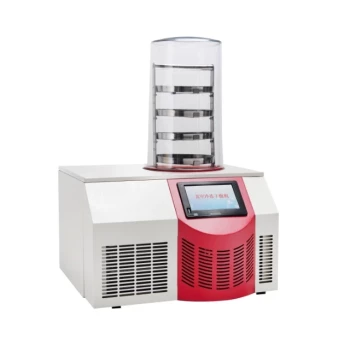
The primary function of a vacuum drying oven in this context is to create a controlled environment that utilizes high temperature and negative pressure to aggressively extract trace moisture and residual solvents. This process targets contaminants trapped deep within the microscopic pores of LAGP (Lithium Aluminum Germanium Phosphate) ceramic pellets and polymer interface layers, ensuring they are chemically inert before coming into contact with reactive lithium metal.
Core Insight The structural integrity of a solid-state battery relies on the chemical purity of its interfaces. Vacuum drying is not merely a cleaning step; it is a critical stabilization process that prevents moisture-induced side reactions, stops the escalation of interfacial resistance, and secures the battery's long-term cycling performance.
The Microscopic Challenge
The Trap Within the Pores
LAGP ceramic pellets are porous materials. While they provide the necessary ionic conductivity, their physical structure acts as a trap for environmental moisture and air.
Simply wiping or air-drying these components is insufficient because contaminants hide within these microscopic voids.
The Risk of Residual Solvents
Polymer interface coatings are often applied using solvents. Even after the coating appears dry to the naked eye, trace amounts of solvent molecules often remain bound within the polymer matrix.
Without removal, these solvents can degrade the electrolyte performance or react unpredictably under voltage.
The Mechanics of Vacuum Drying
The Role of Negative Pressure
A standard oven cannot effectively pull moisture out of a deep pore. By applying negative pressure (vacuum), the oven lowers the boiling point of water and solvents.
This pressure differential forces trapped volatiles to vaporize and exit the porous structure of the LAGP pellet and the polymer layer.
Thermal Activation at 110°C
Heat provides the kinetic energy required to break the bonds holding water molecules to the material surface. The primary reference suggests a temperature of approximately 110°C.
This temperature is high enough to drive off moisture effectively but must be controlled to avoid damaging the polymer components.
The Consequences of Moisture
Preventing Anode Corrosion
Lithium metal is highly reactive to water. If moisture remains in the LAGP or the interface layer, it will react with the lithium anode immediately upon assembly.
This reaction consumes active lithium and generates detrimental byproducts, compromising the cell instantly.
Suppressing Interfacial Resistance
When side reactions occur between moisture and lithium, they create a resistive layer at the interface. This acts as a barrier to ion flow.
Thorough drying suppresses the growth of this resistance, ensuring that ions can move freely between the anode and the electrolyte.
Ensuring Cycling Stability
Long-term battery life is defined by stability. If reactions continue slowly over time due to trapped contaminants, the battery capacity will fade rapidly.
Vacuum drying ensures the baseline chemistry is stable, allowing for reliable, repeated charging and discharging.
Operational Considerations
The Re-absorption Risk
Vacuum drying is not a permanent fix. Once the components are removed from the oven, the porous LAGP pellets will immediately begin re-absorbing moisture from the air.
It is critical to transfer these components directly into an inert environment (like an argon-filled glovebox) immediately after drying.
Material sensitivity
While 110°C is effective for LAGP ceramics, one must be mindful of the polymer interface layers.
Ensure that the specific polymer used for the interface coating can withstand the drying temperature without melting or degrading, which would destroy the coating's uniformity.
Making the Right Choice for Your Process
To maximize the reliability of your all-solid-state lithium metal batteries, integrate vacuum drying as a mandatory hold point in your assembly workflow.
- If your primary focus is Cycle Life: Prioritize the duration of the drying phase to ensure deep-pore moisture extraction, as this minimizes the continuous growth of resistive layers over time.
- If your primary focus is Safety: Ensure the vacuum level is sufficient to remove all flammable residual solvents from the polymer coating to prevent gas generation or thermal instability.
Treat the vacuum drying stage as the foundation of your battery's chemical health—skipping it ensures failure, while perfecting it enables performance.
Summary Table:
| Feature | Purpose in LAGP Treatment | Benefit to Battery Performance |
|---|---|---|
| Negative Pressure | Lowers boiling points of volatiles | Extracts moisture trapped deep within microscopic pores |
| 110°C Thermal Heat | Provides kinetic energy to break bonds | Efficiently drives off residual solvents and water molecules |
| Contaminant Removal | Eliminates reactive impurities | Prevents anode corrosion and gas generation |
| Interfacial Stability | Cleans ceramic and polymer layers | Minimizes interfacial resistance and extends cycle life |
Elevate Your Battery Research with KINTEK Precision
Ensure the chemical purity and structural integrity of your solid-state electrolytes with KINTEK’s high-performance vacuum drying ovens. Whether you are working on LAGP ceramic pellets, polymer interface coatings, or advanced battery research tools and consumables, our equipment provides the precise temperature control and vacuum stability required to eliminate moisture-induced failures.
From high-temperature furnaces and hydraulic presses for pellet preparation to ULT freezers and argon-compatible solutions, KINTEK specializes in laboratory equipment that empowers researchers to achieve superior cycling stability and safety.
Ready to optimize your assembly process? Contact our technical experts today to find the perfect drying solution for your lab!
Related Products
- 56L Vertical Laboratory Vacuum Drying Oven
- 23L Laboratory Vacuum Drying Oven
- Laboratory Scientific Electric Heating Blast Drying Oven
- Benchtop Laboratory Vacuum Freeze Dryer
- Dental Porcelain Zirconia Sintering Ceramic Vacuum Press Furnace
People Also Ask
- Why is a laboratory vacuum drying oven recommended for rice straw residues? Protect Your Biomass Integrity
- What role does a laboratory vacuum drying oven play in the preparation of modified multi-walled carbon nanotubes?
- What is the importance of using a laboratory vacuum drying oven? Preserving Slow-Release Microcapsule Integrity
- Why is a Laboratory Vacuum Drying Oven recommended for PBAT microspheres? Protect Sensitive Polymer Integrity
- What role does a laboratory vacuum drying oven play in processing nanoparticle powder samples? Protect Sample Integrity