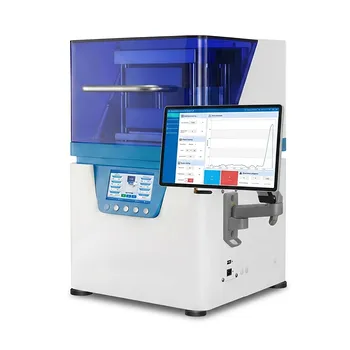
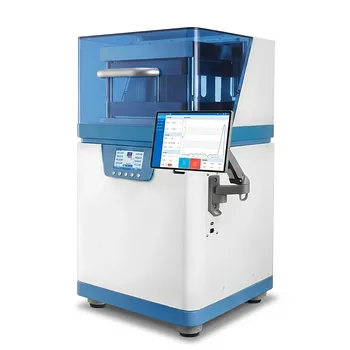
Precise pressure control is the fundamental variable in tungsten skeleton fabrication. It directly dictates the success of subsequent metal infiltration by establishing the material's initial pore structure. Without this precision, the resulting composite will fail to meet the rigorous electrical conductivity or mechanical strength requirements of high-performance applications.
Core Takeaway: A laboratory hydraulic press is essential because it allows for the exact calibration of initial porosity, ensuring that pores are large enough to facilitate molten metal flow via capillary action but small enough to maintain structural integrity and minimize residual voids.
Defining Porosity and Infiltration Dynamics
The Goldilocks Zone of Pressure
In the preparation of tungsten skeletons, the forming pressure—typically between 5–9 MPa—determines the initial porosity. If the pressure is too low, the pores remain excessively large, which results in high residual porosity after infiltration and compromised electrical conductivity.
Facilitating Molten Metal Flow
Conversely, exceeding the required pressure makes the pores too narrow and constricted. This physical obstruction prevents molten silver or other infiltrants from flowing through the skeleton, leading to an incomplete composite material.
Optimizing Capillary Force
Precise pressure settings are required to achieve the ideal capillary force. This force is what draws the secondary metal into the tungsten matrix, and it is entirely dependent on the specific diameter and distribution of the pores created during the pressing stage.
Mechanical Integrity and Structural Uniformity
Eliminating Density Gradients
A laboratory hydraulic press provides the uniform internal density distribution necessary to eliminate macroscopic defects. Without precise control over how pressure is maintained and released, the green compact can develop internal density gradients that lead to warping during sintering.
Particle Rearrangement and Interlocking
The application of controlled axial pressure facilitates particle displacement and rearrangement. This process enhances mechanical interlocking and "cold welding" between tungsten particles, allowing the green compact to reach a stable state that resists micro-cracking.
Minimizing Sintering Shrinkage
By achieving a specific initial density (often around 50% of the theoretical density), the press minimizes shrinkage deformation during high-temperature sintering. This ensures the final part retains its intended dimensions and reduces the need for expensive post-process machining.
Understanding the Trade-offs
High Pressure vs. Low Pressure Risks
Using a press without precise settings introduces significant risks to the material's final properties. High-pressure settings improve mechanical strength and reduce sintering time but can cause particle crushing or "over-compaction," which seals off the pathways needed for infiltration.
Impact of Pressure Stability
Inconsistent pressure application or sudden release can trigger thermal stresses and micro-cracks within the green body. While manual presses are available, they often lack the repeatability required for high-purity tungsten research, where a 1 MPa deviation can drastically alter the final yield rate.
How to Apply This to Your Project
Recommendations for Material Goals
- If your primary focus is electrical conductivity: Use the lower end of the recommended pressure range (approx. 5-7 MPa) to ensure a robust, continuous network for the infiltrant metal.
- If your primary focus is mechanical wear resistance: Aim for higher compaction pressures to increase particle interlocking, provided the pore network remains interconnected for infiltration.
- If your primary focus is dimensional accuracy: Utilize a press with a controlled pressure release cycle to eliminate internal stresses and prevent non-uniform shrinkage during sintering.
By mastering the precise application of pressure, you ensure that the tungsten skeleton serves as a perfect architectural foundation for high-performance composite materials.
Summary Table:
| Key Factor | Impact of Precise Pressure Control | Consequence of Poor Control |
|---|---|---|
| Porosity Level | Achieves "Goldilocks Zone" (5–9 MPa) for infiltration | High residual voids or closed-off pore networks |
| Capillary Force | Optimizes pore diameter to draw in molten metal | Incomplete infiltration; poor electrical conductivity |
| Density Uniformity | Eliminates internal gradients and macroscopic defects | Warping, cracking, or non-uniform shrinkage during sintering |
| Mechanical Bond | Promotes particle interlocking and "cold welding" | Structural failure or micro-cracking in the green body |
| Dimensional Accuracy | Minimizes shrinkage; reduces post-process machining | Significant deformation and high material waste |
Elevate Your Material Synthesis with KINTEK Precision
Precision is the foundation of high-performance composite research. At KINTEK, we understand that even a 1 MPa deviation can compromise the integrity of your tungsten skeleton. Our comprehensive range of laboratory hydraulic presses—including manual, electric, hot, and isostatic models—is designed to provide the exact pressure control and repeatability your research demands.
Whether you are optimizing electrical conductivity or mechanical wear resistance, KINTEK offers a full ecosystem of tools to support your workflow, from crushing and milling systems to high-temperature muffle and vacuum furnaces for sintering.
Ready to achieve superior structural uniformity and infiltration success? Contact KINTEK today to find the perfect pressing solution for your laboratory.
References
- Jincheng Zhao, Hongmei Li. Low-Temperature Sintering and Infiltration of High-W Contacts. DOI: 10.3390/app13179608
This article is also based on technical information from Kintek Solution Knowledge Base .
Related Products
- Laboratory Hydraulic Press Split Electric Lab Pellet Press
- Laboratory Hydraulic Press Lab Pellet Press Machine for Glove Box
- Laboratory Hydraulic Press Lab Pellet Press for Button Battery
- Automatic Laboratory Hydraulic Pellet Press Machine for Lab Use
- Fully Automatic Heated Hydraulic Lab Press for Materials Sintering and Sample Preparation
People Also Ask
- What role does a laboratory hydraulic press play in platinum recovery research? Enhancing Sample Precision
- What are the specific applications of a lab hydraulic press in biochar evaluation? Optimize density and data accuracy.
- What are the roles of a laboratory hydraulic press and stainless steel molds in the preparation of graphite samples?
- What is the role of a laboratory hydraulic press in electrode prep? Maximize Energy Density & Sealing Precision
- Why must a laboratory hydraulic press equipped with cylindrical molds be used when preparing BZY green bodies? High Density