Vacuum drying is an essential processing step required to safely remove ethanol dispersants and moisture from titanium metal slurry without compromising the material's integrity. By utilizing a vacuum, manufacturers can evaporate solvents at significantly lower temperatures, preventing chemical degradation and ensuring a defect-free final product.
Vacuum drying serves a dual purpose: it prevents the oxidation of titanium powder by operating at low temperatures, and it eliminates solvent residues that would otherwise cause porosity defects during the final sintering phase.
Preserving Chemical Purity
The Sensitivity of Titanium Powder
Titanium is highly reactive to oxygen, particularly when in powder form.
Exposing this powder to high temperatures in standard atmospheric conditions accelerates oxidation. This chemical reaction degrades the quality of the metal before it is even molded.
The Low-Temperature Advantage
Vacuum drying lowers the boiling point of liquids.
This allows the equipment to remove volatile components, such as ethanol dispersants and moisture, without subjecting the titanium to high heat. By keeping the temperature low, the process effectively preserves the metallic purity of the titanium powder.
Ensuring Structural Integrity
Eliminating Solvent Residues
Before molding, the slurry contains liquid dispersants used to create a uniform mixture.
These solvents must be completely evacuated from the mixture. If they are not removed efficiently, they become trapped within the solidifying mass.
Preventing Porosity Defects
The downstream processes for titanium usually involve vacuum hot pressing and sintering.
If solvent residues remain in the material during these high-pressure, high-heat stages, they will vaporize and expand. This expansion creates voids—known as porosity defects—inside the metal, significantly weakening the final part.
Common Pitfalls to Avoid
The Risk of Standard Thermal Drying
Attempting to dry titanium slurry using standard high-heat methods is a critical error.
While heat can remove solvents, the temperature required to do so at atmospheric pressure inevitably leads to oxidation. This compromises the mechanical properties of the titanium.
Incomplete Moisture Removal
Failing to achieve a full vacuum can leave trace amounts of moisture in the slurry.
Even microscopic amounts of retained moisture can result in structural failure during sintering. Vacuum drying is the only reliable method to ensure total evacuation of these contaminants.
Making the Right Choice for Your Goal
To ensure the success of your titanium manufacturing process, prioritize the drying phase based on your specific quality targets:
- If your primary focus is Material Chemistry: Ensure your vacuum parameters are set to keep temperatures below the oxidation threshold of your specific titanium grade.
- If your primary focus is Mechanical Strength: Verify that the drying cycle is long enough to remove 100% of solvent residues to eliminate porosity risks during sintering.
Vacuum drying is not merely a dehydration step; it is a protective measure that guarantees the chemical and structural viability of titanium components.
Summary Table:
| Key Challenge | Risk Factor | Vacuum Drying Solution | Impact on Quality |
|---|---|---|---|
| Oxidation | High oxygen reactivity | Lowered boiling points/Low temp | Preserves metallic purity |
| Solvent Residue | Ethanol & moisture | Complete solvent evacuation | Prevents internal voids |
| High Heat | Material degradation | Atmospheric pressure avoidance | Maintains mechanical properties |
| Sintering Prep | Porosity defects | Trace moisture removal | Ensures high-density parts |
Elevate Your Titanium Processing with KINTEK Precision
Don't let oxidation or porosity defects compromise your high-performance materials. At KINTEK, we specialize in advanced laboratory solutions tailored for the most demanding applications. Whether you are working with titanium slurries or advanced ceramics, our range of vacuum drying systems, high-temperature furnaces, and isostatic hydraulic presses ensures your research and production meet the highest standards of purity and strength.
From battery research consumables to specialized PTFE and ceramic crucibles, KINTEK provides the tools necessary for defect-free material synthesis. Optimize your manufacturing workflow—Contact KINTEK today!
Related Products
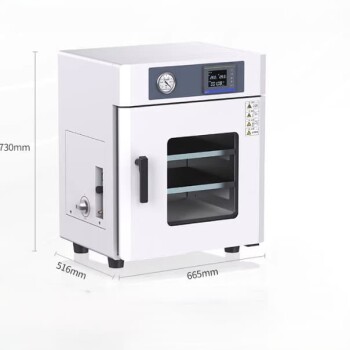
- 56L Vertical Laboratory Vacuum Drying Oven
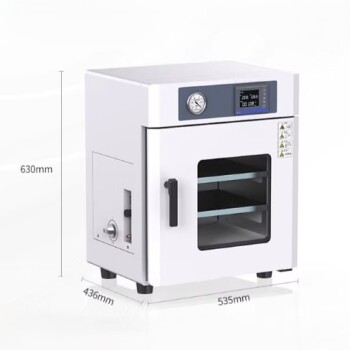
- 23L Laboratory Vacuum Drying Oven
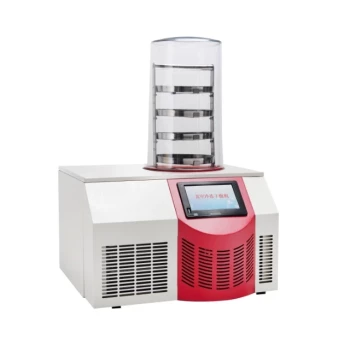
- Benchtop Laboratory Vacuum Freeze Dryer
- Vacuum Cold Mounting Machine for Sample Preparation
People Also Ask
- Why is a laboratory vacuum drying oven recommended for rice straw residues? Protect Your Biomass Integrity
- What role does a laboratory vacuum drying oven play in the preparation of modified multi-walled carbon nanotubes?
- What is the importance of using a laboratory vacuum drying oven? Preserving Slow-Release Microcapsule Integrity
- Why is a Laboratory Vacuum Drying Oven recommended for PBAT microspheres? Protect Sensitive Polymer Integrity
- What role does a laboratory vacuum drying oven play in processing nanoparticle powder samples? Protect Sample Integrity