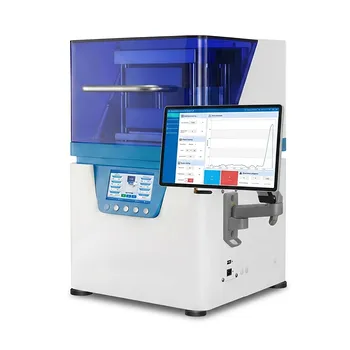
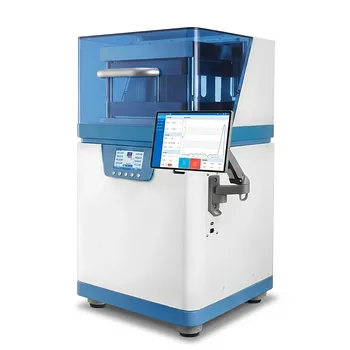
Precision in sample preparation is the foundation of electromagnetic characterization. A laboratory hydraulic press is required because it applies the stable, high-pressure force necessary to mold composite materials into rings with exact geometric dimensions and uniform density. This process eliminates internal air voids and ensures a perfect fit within the coaxial fixture, which is critical for obtaining accurate permittivity and permeability data from a Vector Network Analyzer (VNA).
The hydraulic press transforms a raw material mixture into a standardized, defect-free specimen that fits perfectly within the VNA's coaxial line, preventing measurement errors caused by geometric gaps, internal air pockets, or density inconsistencies.
Ensuring Geometric Precision and Fixture Fit
The Role of Exact Dimensions
The VNA calculates electromagnetic parameters based on the assumption that the sample occupies a specific volume within the coaxial line. Standardized molds, typically producing an outer diameter of 7.0 mm and an inner diameter of 3.04 mm, are used with the press to meet these mathematical requirements.
Eliminating Air Gaps
Even a microscopic gap between the sample and the metal walls of the coaxial fixture can lead to significant measurement errors. The hydraulic press ensures the material is compressed sufficiently to achieve a tight mechanical fit, preventing the "air gap effect" that artificially lowers the measured permittivity.
Consistency Across Samples
Manual molding cannot replicate the multi-ton force required for high-quality specimens. A hydraulic press provides repeatable pressure application, ensuring that every ring produced has the same dimensions and can be compared across different test batches.
Maintaining Internal Structural Integrity
Eliminating Micro-Air Bubbles
Internal voids act as dielectric impurities that distort how electromagnetic waves interact with the material. The high axial pressure of a hydraulic press expels residual micro-air bubbles, ensuring the VNA measures the intrinsic properties of the composite rather than the air trapped inside it.
Achieving Uniform Density
Inconsistent density creates internal gradients that scatter microwave signals unpredictably. The press ensures a uniform distribution of mass throughout the ring, which is vital for obtaining stable and reliable complex permittivity and magnetic permeability data.
Optimizing Filler Contact
For composite materials involving conductive or magnetic powders, the particles must be in close proximity to interact correctly with the electromagnetic field. The pressing process enhances electrical contact between fillers and the matrix (such as paraffin), optimizing the material's perceived shielding effectiveness and absorption.
Understanding the Trade-offs
The Risk of Over-Pressing
Applying excessive pressure can crush delicate filler particles or deform the polymer matrix, potentially altering the material's original properties. It is essential to determine the optimal pressure setpoint for each specific material composition to avoid structural damage.
Thermal Considerations
When mixing materials with paraffin or thermoplastics, the press may need to be heated. While heat helps achieve a void-free structure, excessive temperatures can cause the matrix to leak out of the mold or lead to thermal degradation of the active microwave-absorbing components.
Mold Maintenance
The precision of the hydraulic press is only as good as the molds used. Over time, high-pressure cycles can cause mechanical wear on the mold surfaces, leading to slight dimensional deviations that can compromise the accuracy of VNA data.
How to Apply This to Your Project
Recommendations for Sample Preparation
- If your primary focus is maximum data accuracy: Use a hydraulic press with a calibrated pressure gauge to ensure the specimen fits the coaxial fixture with zero perceptible wiggle room.
- If your primary focus is material benchmarking: Standardize your pressing force and duration (e.g., 10 MPa for 5 minutes) to ensure that density variations do not skew your comparative results.
- If your primary focus is high-frequency performance: Prioritize the removal of all micro-air bubbles by using a vacuum-assisted mixing process before the final hydraulic press molding.
By utilizing a laboratory hydraulic press, you eliminate the physical variables that often lead to "noisy" or incorrect electromagnetic data, allowing for a true assessment of your material's performance.
Summary Table:
| Key Feature | Benefit for VNA Testing | Standard Requirement |
|---|---|---|
| Geometric Precision | Prevents air gap effects & measurement errors | 7.0mm OD / 3.04mm ID |
| Uniform Density | Ensures stable permittivity & permeability data | High, repeatable pressure |
| Void Elimination | Removes micro-air bubbles & dielectric impurities | High axial compression |
| Filler Contact | Enhances electrical contact between particles | Optimized filler distribution |
Elevate Your Material Characterization with KINTEK Precision
Inaccurate sample preparation leads to unreliable data. KINTEK specializes in high-performance laboratory equipment designed to eliminate variables in your research. Our precision hydraulic presses (pellet, hot, and isostatic) and custom molds ensure your coaxial rings meet the exacting standards required for Vector Network Analyzer testing.
Beyond sample preparation, KINTEK offers a comprehensive range of solutions, including:
- High-Temperature Furnaces: Muffle, tube, vacuum, and CVD systems for advanced material synthesis.
- Material Processing: Crushing, milling, and sieving equipment for uniform powder preparation.
- Advanced Reactors: High-temperature high-pressure reactors and autoclaves for complex chemical reactions.
- Laboratory Essentials: Electrolytic cells, cooling solutions, and high-quality ceramic crucibles.
Don’t let geometric inconsistencies or internal voids compromise your results. Contact KINTEK today to discover how our high-precision equipment can enhance your lab's efficiency and data accuracy.
References
- Shuangyin Zeng, Hai‐Tao Feng. Co3O4 Nanoparticle-Modified Porous Carbons with High Microwave Absorption Performances. DOI: 10.3390/nano13061073
This article is also based on technical information from Kintek Solution Knowledge Base .
Related Products
- Laboratory Hydraulic Press Lab Pellet Press Machine for Glove Box
- Laboratory Hydraulic Press Split Electric Lab Pellet Press
- Fully Automatic Heated Hydraulic Lab Press for Materials Sintering and Sample Preparation
- Automatic Laboratory Hydraulic Press for XRF & KBR Pellet Press
- Laboratory Hydraulic Press Lab Pellet Press for Button Battery
People Also Ask
- How do laboratory hydraulic presses contribute to zero-gap electrolyzers? Optimize Performance & Safety
- Why is a laboratory hydraulic press necessary for ZrO2/Cr2O3 interface analysis? Optimize Sample Density and Accuracy
- How do a precision laboratory hydraulic press and specialized molds contribute to the fabrication of spherical ceramic samples? Achieving High-Density Material Precision
- What is the role of a laboratory hydraulic press in the preparation of rare earth denitrification catalysts?
- How does pressure control of a laboratory hydraulic press affect W-Ti alloys? Optimize Grain Structure & Density