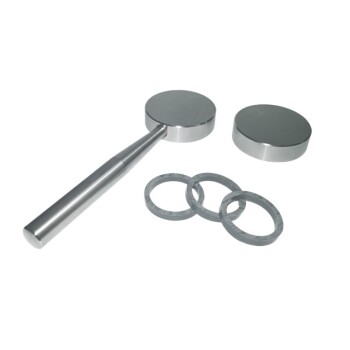
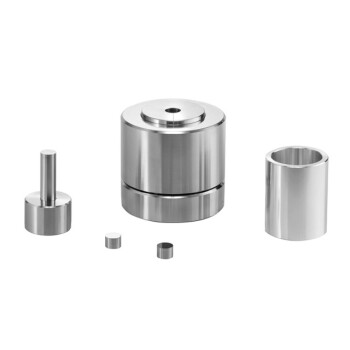
Li2S–GeSe2–P2S5 electrolytes generally require significant pressurization during Electrochemical Impedance Spectroscopy (EIS) testing to physically densify the material. Placing the sample in a test mold under continuous pressure, such as 1 metric ton, is the only effective way to eliminate voids between powder particles and ensure continuous ionic pathways.
The primary purpose of pressurization is to minimize voids between particles. Reducing these voids lowers grain boundary resistance, allowing the EIS results to accurately represent the material's intrinsic ionic conductivity rather than the looseness of its packing.
The Challenge of Solid-State Conductivity
The Nature of Powdered Electrolytes
Unlike liquid electrolytes, which naturally wet surfaces and fill gaps, solid-state electrolytes like Li2S–GeSe2–P2S5 often exist as powders during testing.
In a loose powder state, individual particles touch only at small, discrete points. This lack of contact creates significant physical gaps, or voids, throughout the sample.
The Barrier of Grain Boundaries
These physical voids act as insulators that block the flow of lithium ions.
In impedance spectroscopy, the resistance encountered at the interface between two particles is called grain boundary resistance. If the particles are not pressed tightly together, this resistance becomes artificially high, dominating the test results.
The Function of Pressure in EIS
Mechanically Closing Voids
Applying high pressure (e.g., 1 metric ton) to the test mold mechanically forces the powder particles together.
This compression collapses the voids and increases the contact area between particles. By physically densifying the pellet, you create a more continuous medium for ion transport.
Revealing Intrinsic Conductivity
The goal of the EIS test is to measure the properties of the material itself, not the artifacts of its preparation.
By minimizing grain boundary resistance through pressure, the total resistance measured becomes a true reflection of the intrinsic ionic conductivity of the Li2S–GeSe2–P2S5 material. Without pressure, the data would merely reflect how loosely the powder was packed.
Understanding the Trade-offs
Pressure Consistency
Ideally, pressure must be continuous and stable throughout the measurement.
If the pressure relaxes during the EIS scan, the contact resistance will change mid-test, resulting in noisy or uninterpretable data. The test mold must be capable of maintaining the load without fluctuation.
Equipment Limitations
While higher pressure generally improves particle contact, the test mold itself has mechanical limits.
Applying force beyond the mold's rating can deform the equipment or the electrode pistons. This alters the geometric cell constant (thickness and area), which leads to calculation errors when converting raw resistance (Ohms) into conductivity (S/cm).
Ensuring Accurate Material Characterization
To obtain valid data for solid-state electrolytes, consider the following regarding pressure application:
- If your primary focus is determining material potential: Apply sufficient pressure (e.g., 1 metric ton) to ensure the measured impedance reflects the material's chemistry, not its packing density.
- If your primary focus is reproducible data: Ensure the test mold maintains constant pressure throughout the duration of the EIS frequency sweep to prevent data drift.
Ultimately, pressure is the bridge that turns a loose powder into a functional conductive solid for testing purposes.
Summary Table:
| Factor | Effect of No Pressure | Effect of High Pressure (e.g., 1 ton) |
|---|---|---|
| Particle Contact | Small, discrete points; many voids | Dense packing; maximized contact area |
| Grain Boundary Resistance | Artificially high (insulating) | Minimized; allows ionic flow |
| Data Accuracy | Reflects packing density only | Reflects intrinsic material conductivity |
| Ionic Pathways | Discontinuous and blocked | Continuous and stable |
Elevate Your Battery Research with KINTEK
Precise material characterization starts with the right tools. KINTEK specializes in high-performance laboratory equipment designed for the rigorous demands of solid-state electrolyte testing.
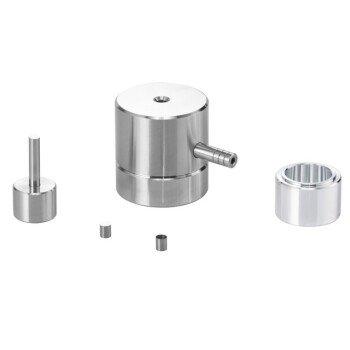
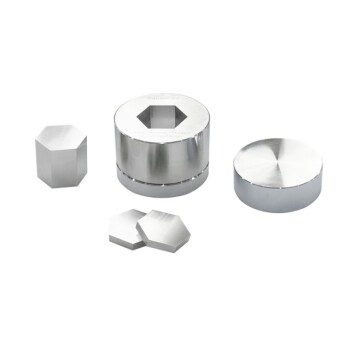
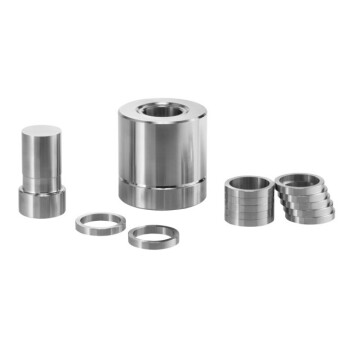
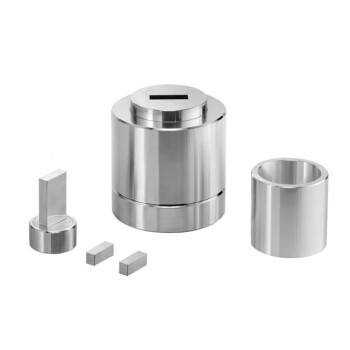
Whether you need robust hydraulic presses (pellet, hot, or isostatic) to eliminate grain boundary resistance or precision test molds for stable EIS measurements, our solutions ensure your data reflects the true potential of your materials. Beyond battery research tools and consumables, we offer a comprehensive range of high-temperature furnaces, autoclaves, and crushing systems to streamline your entire R&D workflow.
Ready to achieve superior data consistency? Contact KINTEK today to find the perfect equipment for your laboratory.
Related Products
- XRF Boric Acid Lab Powder Pellet Pressing Mold for Laboratory Use
- Special Shape Press Mold for Lab
- Anti-Cracking Press Mold for Lab Use
- Carbide Lab Press Mold for Laboratory Applications
- Isostatic Molding Pressing Molds for Lab
People Also Ask
- What is the purpose of using a mold for pellet pressing when preparing catalyst test samples? Ensure Data Consistency
- What is the XRF method of sampling? Achieve Accurate Elemental Analysis with Proper Sample Prep
- What is the XRF pressed pellet method? A Fast, Cost-Effective Sample Prep Guide
- How are samples prepared for XRF analysis? Achieve Accurate and Reliable Results
- How do you make XRF pellets? A 4-Step Guide to Flawless Sample Preparation