A reference electrode is a stable electrode with a well-known electrode potential. It is used to complete the electrical circuit necessary for an electrochemical measurement. The reference electrode provides contact with the sample through its liquid junction and provides a stable and reproducible potential to which the indicating electrode potential can be compared. The typical reference electrode consists of an internal element, normally silver-silver chloride, surrounded by an electrolyte-containing filling solution, which is contained in either a glass or plastic body salt bridge, which terminates at the liquid junction.
Toggle Categories
Get Instant Support
Choose your preferred way to connect with our team
-
Get Free Quote Fill out form for detailed pricing
-
Send Email Detailed inquiry support
-
WhatsApp Quick mobile chat
Response Time
Within 8 hours on working days, 24 hours on holidays
reference electrode
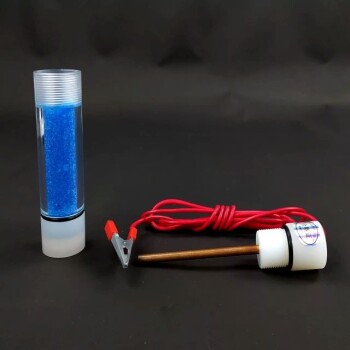

Reference Electrode Calomel Silver Chloride Mercury Sulfate for Laboratory Use
Item Number: ELERA
$19.90
Our Ag/Ag+ pseudo-reference electrode is suitable for most organic solvents, while our commercially available reference electrodes are "no-leak" and suitable for many non-aqueous applications. Our platinum auxiliary electrode is inert and the most commonly used material, while other less expensive materials such as carbon and copper can also be used. Trust us to provide you with the most reliable and accurate reference electrode solutions.
Applications of Reference Electrode
- Used to measure the potential difference between the working electrode and the solution, making it possible to determine the redox potential of the analyte solution.
- Used as a standard for the calibration of other electrodes.
- Used in electrochemical experiments involving non-aqueous solutions to determine the redox potential of the solution.
- Used in potentiometric titrations to determine the endpoint of the titration.
- Used in various electroanalytical techniques such as cyclic voltammetry, chronoamperometry, and impedance spectroscopy to study electrochemical reactions.
- Used in the electroplating industry to measure the potential difference between the anode and the cathode in order to control the thickness and quality of the plating.
- Used in the corrosion industry to measure the potential difference between the metal surface and the solution in order to determine the corrosion rate and to evaluate the effectiveness of corrosion inhibitors.
- Used in the field of bioelectrochemistry to study the redox properties of biological molecules and their interactions with other molecules.
Advantages of Reference Electrode
- Provides a stable and reproducible potential for accurate measurements.
- Ensures analytical process efficiency with fast response time.
- Helps to maintain the electrical circuit necessary for an electrochemical measurement.
- Compatible with a wide range of samples.
- Can be used in conjunction with any half-cell.
- Allows for the determination of the cell potential in electrochemical cells.
- Used in various electrochemical measurements and devices such as DPV and electrochemical biosensors.
- Different types of reference electrodes are available to suit different applications.
- Double junction electrodes have lower chambers that can be customized to match the sample, ensuring compatibility.
- A range of common reference systems is available, such as Saturated Calomel (Hg/HgCl), Ag/AgCl, Cu/CuSO4, Hg/HgSO4, and Hg/HgO.
- Ag/AgCl is the most common reference system, while saturated calomel electrodes (Hg/HgCl) are very stable.
- The reference electrode plays an important role in electrode measurements, and a greater knowledge of its role is essential for accurate measurements.
Our Reference Electrode is a cost-effective solution that comes with a complete customisation service. It offers a wide range of advantages such as compatibility with different solvents, high accuracy, and stability. Our electrodes are available as a standard solution, or you can opt for a custom-designed electrode to cater to your specific requirements. Our electrodes are designed to provide a constant current density and potential, ensuring consistent results. Our electrodes are ideal for use in electrochemical cells, and we offer a no-leak guarantee.
FAQ
What Is Reference Electrode With An Example?
A reference electrode is an electrode with a stable and known electrode potential, used in electrochemical measurements and devices. An example of a reference electrode is the Standard Hydrogen Electrode (SHE), which has a potential of 0.000 V and an activity of H+ of 1 Molar. Other examples of reference electrodes include the Normal Hydrogen Electrode (NHE), Saturated Calomel Electrode (SCE), Silver Chloride Electrode, Copper-Copper Sulfate Electrode, and the pH Electrode. Reference electrodes are used in building electrochemical cells and determining the potential of the other half-cell.
What Is The Role Of Reference Electrode?
The role of the reference electrode is to complete the electrical circuit necessary for an electrochemical measurement by providing the second electrode of a complete electrode cell whose total potential is measured. The reference electrode achieves this by providing contact with the sample through its liquid junction. For a reference electrode to be useful, it must provide both a stable and reproducible potential to which the indicating electrode potential can be compared. Most difficulties experienced while performing measurements with electrodes can be traced to the reference electrode, and more specifically, to the reference electrode's liquid junction.
What Is Reference Electrode Used For?
A reference electrode is used to provide a stable and defined potential for electrochemical measurements. It consists of an internal element, typically silver-silver chloride, surrounded by an electrolyte-containing filling solution. The purpose of the reference electrode is to complete the electrical circuit necessary for an electrochemical measurement by providing the second electrode of a complete electrode cell whose total potential is measured. Most electrodes combine a stable reference and a working cell in one probe, but separate reference electrodes are available for certain applications. The choice of reference electrode depends on factors such as sample compatibility, stability, and temperature considerations.
What Is A Reference Electrode Vs Counter Electrode?
A reference electrode is used as a comparison point for the potential of the working electrode in an electrochemical experiment. It must maintain a stable potential throughout the experiment. Common examples include Ag/AgCl, Ag/Ag+ and the saturated calomel electrode (SCE). On the other hand, a counter electrode transfers electrons between itself and some species in solution, in order to prevent inhibition of electron transfer at the working electrode. It must transfer electrons quickly and is commonly made of platinum metal, such as a platinum wire or a high surface area platinum gauze electrode.
What Is The Difference Between Standard And Reference Electrode?
Standard electrode potential is the potential difference between a half-cell and a standard reference electrode. A reference electrode, on the other hand, is an electrode that has a stable and well-known electrode potential. The key difference is that the standard electrode potential is a relative value, while the reference electrode potential is an absolute value. The standard electrode potential can be used to predict the direction of electron flow in a reaction, whereas the reference electrode potential is used to measure the potential of other half-cells and determine the absolute potential of a given electrode.
REQUEST A QUOTE
Our professional team will reply to you within one business day. Please feel free to contact us!
Related Articles

The Architecture of Certainty: Why Three Electrodes Are Better Than Two
Discover why the three-electrode system is the standard for electrochemical precision, separating current flow from voltage measurement for true analytical clarity.
Read more
The Invisible Architecture of Accuracy: Mastering Electrode Installation
Master the lifecycle of electrode installation—from inspection to alignment and maintenance—to ensure safety and reproducibility in electrochemical experiments.
Read more
The Geometry of Trust: Stabilizing the Electrochemical Cell
Data integrity begins with physical stability. Learn how to adjust your PTFE electrode stand to master gravity, eliminate vibration, and ensure reproducibility.
Read more
Why Your Graphite Components Keep Failing—And How to Stop It for Good
Graphite parts failing below their temp limit? We reveal the hidden cause (oxidation) and show you how to protect your experiments and budget.
Read more
The Choreography of Electrons: Why Precision Demands a Trinity
Precision in coating evaluation isn't about power; it's about separation. Discover why the three-electrode system is the only way to silence electrochemical noise.
Read more
The Silent Interface: Mastery Over Electrode Decay
Electrode failure is rarely sudden; it is the compound interest of neglect. Learn the disciplined maintenance protocols that preserve accuracy and longevity.
Read more
Why Your High-Temperature Furnace Elements Keep Failing (And How to Stop It)
Discover the hidden causes of MoSi2 heating element failure, like pesting and chemical attack, and learn how to achieve reliable, repeatable results.
Read more
Guide to Reference Electrodes in Electrochemical Measurements
Detailed guide on reference electrodes, their use, maintenance, checking methods, regeneration, storage, and applications.
Read more
Glymercury Electrode: Composition, Characteristics, and Applications
An in-depth look at the glymercury electrode, its composition, characteristics, and applications in analytical chemistry.
Read more
Common Reference Electrodes in Electrochemical Studies
An overview of the key requirements and types of reference electrodes used in electrochemical systems, particularly in lithium-ion batteries.
Read more
Use and Care of Reference Electrodes
Detailed guide on the use, calibration, and maintenance of reference electrodes in electrochemical studies.
Read more
Design and Application of Reference Electrodes in Lithium Batteries
An in-depth analysis of the design, features, and applications of reference electrodes in lithium batteries.
Read more
Understanding Electrodes in Electrochemical Systems: Working, Counter, and Reference Electrodes
An overview of the roles and characteristics of working, counter, and reference electrodes in electrochemical systems.
Read more
Design Principle and Application of Reference Electrodes for Lithium Batteries
Discusses the design principles, types, applications, and future directions of reference electrodes in lithium batteries.
Read more
Introduction to Rotating Disc Electrodes and Common Electrochemical Applications
An overview of rotating disc electrodes and their applications in various electrochemical studies, including catalyst evaluation, battery research, and corrosion protection.
Read more
Electrochemistry Basics: Conditions and Precautions for Using Different Reference Electrodes
A guide on the requirements and conditions for using various reference electrodes in electrochemistry.
Read more
Identifying and Addressing Issues with a Bad Reference Electrode in Measurement Systems
This article discusses the signs and solutions for a bad reference electrode in measurement systems, focusing on IR voltage drop, high-frequency artifacts, and methods to identify and save a bad reference electrode.
Read more
Design and Application of Reference Electrodes in Lithium Batteries
This article discusses the selection and design of reference electrodes for lithium batteries, focusing on active materials like lithium metal, lithium alloys, and lithium-embedded oxides.
Read more
Exploring Rotating Electrode Technology in Electrochemistry
An in-depth analysis of rotating electrode technology, its applications, and its impact on electrochemical reactions under different flow conditions.
Read more
Understanding the Rotating Disk Electrode: Principles and Applications
Explores the development, principles, and applications of the rotating disk electrode in electrochemistry.
Read more