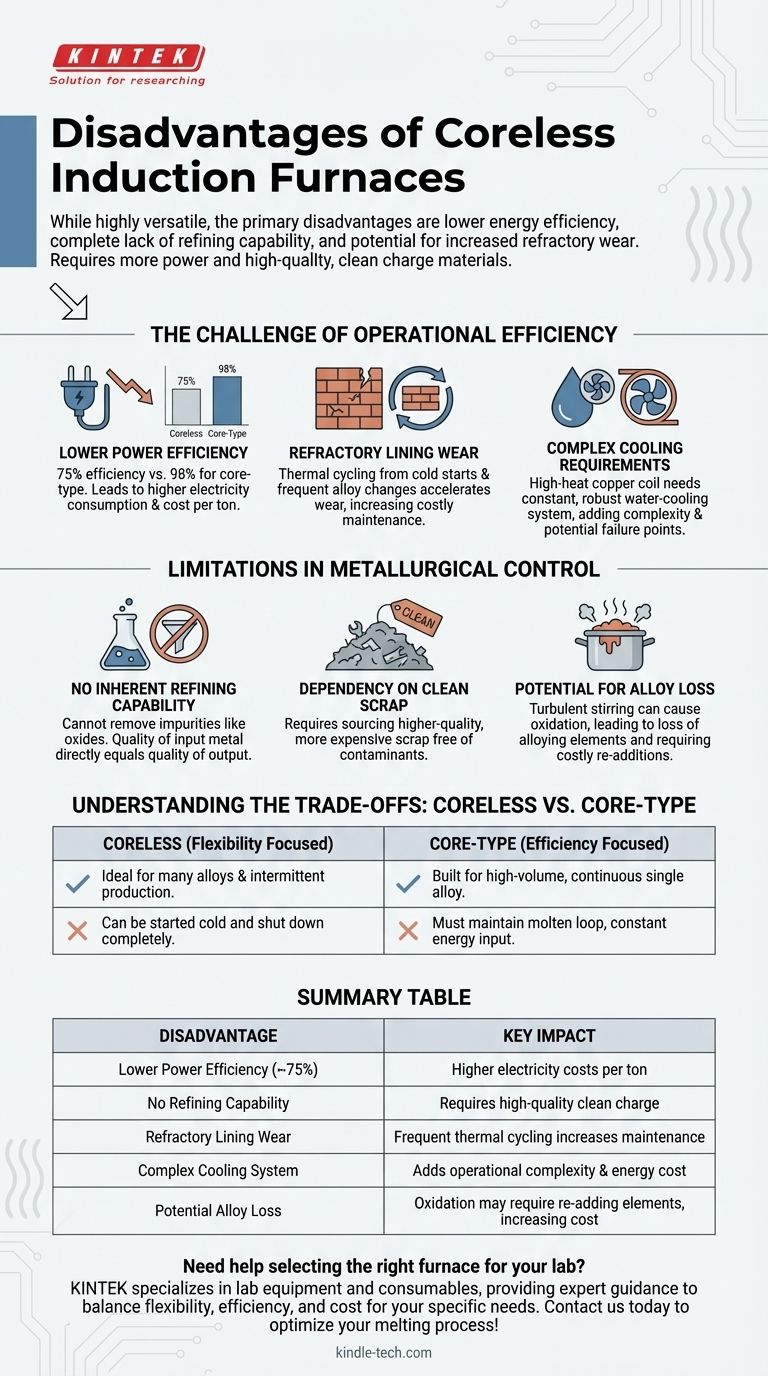
While highly versatile, the primary disadvantages of a coreless induction furnace are its lower energy efficiency, its complete lack of refining capability, and the potential for increased refractory wear. These factors mean it requires more power to operate and is dependent on high-quality, clean charge materials to produce a melt of known composition.
The coreless induction furnace trades high efficiency for high flexibility. Its key drawbacks—lower power efficiency and an inability to refine metals—are the direct trade-off for its valuable ability to start and stop quickly and handle frequent alloy changes.
The Challenge of Operational Efficiency
A coreless furnace's design prioritizes flexibility over raw power efficiency, leading to higher operational costs compared to alternatives. This is a critical financial consideration for any high-volume operation.
Lower Power Efficiency
A coreless induction furnace typically operates with a power efficiency of around 75%. This stands in stark contrast to a core-type furnace, which can achieve efficiencies up to 98%. This efficiency gap translates directly into higher electricity consumption and cost per ton of metal melted.
Refractory Lining Wear
The ability to shut down and start cold is a major advantage, but this thermal cycling places significant stress on the refractory lining. Frequent alloy changes can also accelerate wear, leading to more frequent, costly, and time-consuming relining procedures.
Complex Cooling Requirements
The high-conductivity copper coil is the heart of the furnace and generates immense heat. It requires a constant, robust water-cooling system to prevent overheating and failure. This system adds complexity, a point of potential failure, and an additional energy cost to the operation.
Limitations in Metallurgical Control
Perhaps the most significant operational drawback is the furnace's relationship with the metal it melts. It is a melter, not a refiner, which places strict constraints on the input materials.
No Inherent Refining Capability
The single most important metallurgical drawback is the lack of refining capacity. A coreless furnace cannot remove impurities like oxides from the charge material. The quality of the metal you put in is directly related to the quality you get out.
Dependency on Clean Scrap
Because the furnace cannot refine, charge materials must be clean, free of contaminants, and of a known composition. This often means sourcing higher-quality, more expensive scrap, which can significantly impact the overall cost of production.
Potential for Alloy Loss
During the melting process, the turbulent stirring action can expose the melt to the atmosphere, leading to the oxidation and loss of some alloying elements. These lost elements must be analyzed and re-added to the melt to meet final specifications, adding cost and an extra step to the process.
Understanding the Trade-offs: Coreless vs. Core-Type
The disadvantages of the coreless furnace are best understood when compared to its primary alternative, the core-type furnace. The choice between them is a classic engineering trade-off between flexibility and specialized efficiency.
Flexibility vs. Throughput
The coreless furnace excels in environments requiring flexibility. It is ideal for foundries producing many different alloys or those with intermittent production schedules. In contrast, the core-type furnace is built for high-volume, continuous throughput of a single, consistent alloy.
Startup and Shutdown
A coreless furnace can be started cold and shut down completely. A core-type furnace must maintain a continuous loop of molten metal to function and is rarely allowed to cool, requiring constant energy input even when idle.
Making the Right Choice for Your Operation
Selecting the correct furnace technology requires a clear understanding of your specific production goals and operational constraints.
- If your primary focus is operational flexibility and varied alloys: The coreless furnace is the correct choice, as its ability to perform cold starts and handle frequent material changes outweighs its lower energy efficiency.
- If your primary focus is high-volume, continuous production of a single alloy: The superior energy efficiency (~98%) of a core-type furnace will result in significantly lower long-term operational costs.
- If your primary concern is managing raw material costs: Be prepared for the coreless furnace's demand for high-quality, clean scrap, which may be more expensive than the materials usable in other furnace types.
Understanding these fundamental trade-offs is the key to selecting the right furnace technology for your specific production goals.
Summary Table:
| Disadvantage | Key Impact |
|---|---|
| Lower Power Efficiency (~75%) | Higher electricity costs per ton melted |
| No Refining Capability | Requires high-quality, clean charge materials |
| Refractory Lining Wear | Frequent thermal cycling increases maintenance costs |
| Complex Cooling System | Adds operational complexity and energy cost |
| Potential Alloy Loss | Oxidation may require re-adding elements, increasing cost |
Need help selecting the right furnace for your lab? At KINTEK, we specialize in lab equipment and consumables, providing expert guidance to help you choose the ideal induction furnace that balances flexibility, efficiency, and cost for your specific laboratory needs. Contact us today to optimize your melting process and achieve superior results!
Visual Guide
Related Products
- Vacuum Heat Treat Sintering Brazing Furnace
- Vacuum Induction Melting Spinning System Arc Melting Furnace
- 1400℃ Laboratory High Temperature Tube Furnace with Alumina Tube
- 600T Vacuum Induction Hot Press Furnace for Heat Treat and Sintering
- 1700℃ Laboratory High Temperature Tube Furnace with Alumina Tube
People Also Ask
- What is the process of vacuum brazing? Achieve High-Purity, Strong Metal Joining
- How is the greatest joint strength obtained in brazing? Master the 3 Keys to Superior Metallurgical Bonds
- What is vacuum brazing? The Ultimate Guide to High-Purity, Flux-Free Metal Joining
- What is the most important factor influencing the strength of the brazed joint? Master Joint Clearance for Maximum Strength
- What is vacuum brazed? The Ultimate Guide to High-Purity Metal Joining