Blog The Architecture of Emptiness: Mastering Material Selection in Vacuum Furnaces
The Architecture of Emptiness: Mastering Material Selection in Vacuum Furnaces

The Architecture of Emptiness: Mastering Material Selection in Vacuum Furnaces

29 minutes ago

The Contradiction of the Void

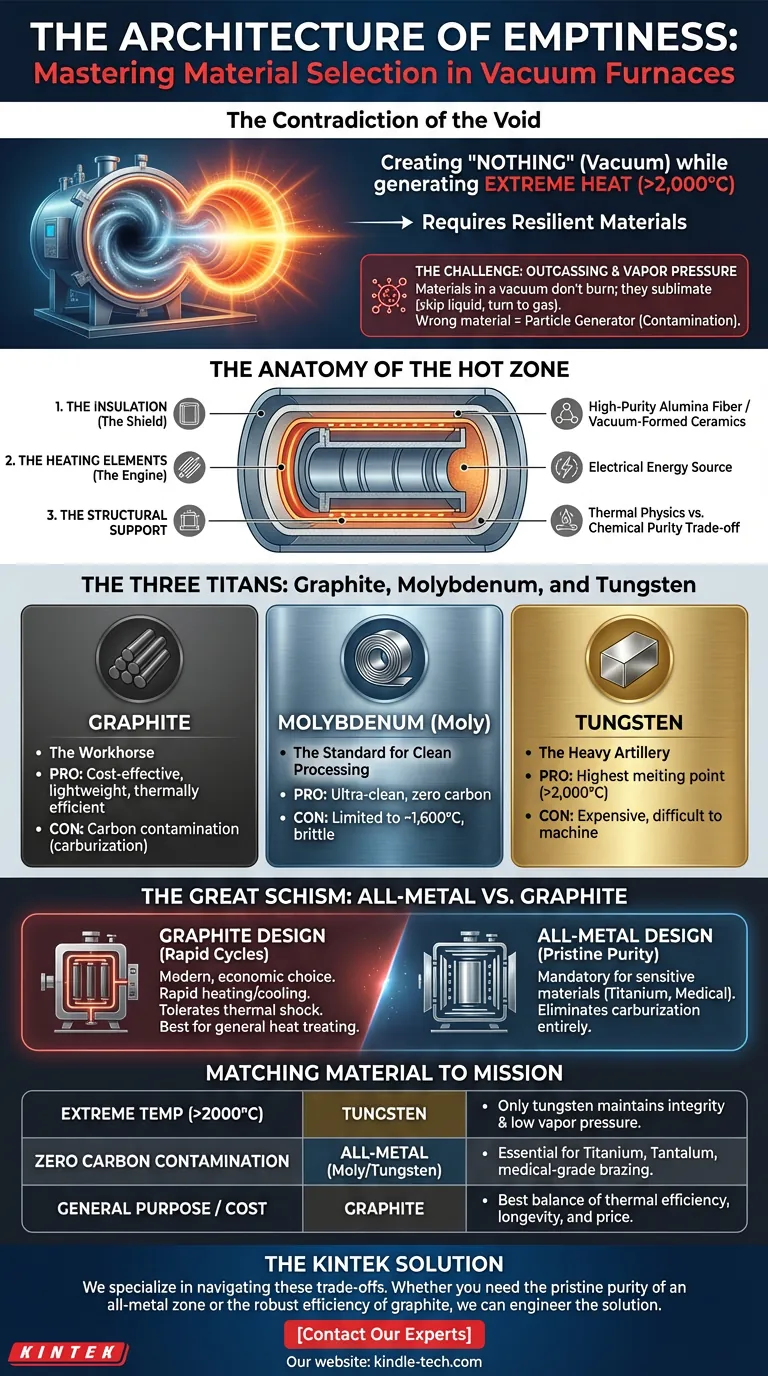
A vacuum furnace is an engineering paradox.

Its purpose is to create "nothing"—a space devoid of air and contaminants. Yet, to achieve this emptiness while generating temperatures that can melt steel, we must fill it with materials that are incredibly resilient.

The central challenge in vacuum furnace design isn't just generating heat. That is the easy part.

The hard part is managing extreme energy in a near-total absence of atmosphere without the furnace itself becoming the contaminant.

When materials are heated in a vacuum, they behave strangely. They don't burn; they sublimate. They skip the liquid phase and turn directly into gas, a phenomenon known as outgassing.

If you choose the wrong material, your furnace doesn't just fail; it becomes a particle generator, ruining the very chemistry of the parts you are trying to process.

This is the silent war against Vapor Pressure.

The Anatomy of the Hot Zone

The "Hot Zone" is the heart of the system. It is where the battle between thermal energy and structural integrity takes place.

To win this battle, engineers rely on materials that possess a specific kind of stubbornness: they must refuse to vaporize, even at 2,000°C.

The anatomy of a functional hot zone relies on three primary components:

  1. The Insulation (The Shield): Usually constructed from high-purity alumina fiber or vacuum-formed ceramics. Its job is to contain the violence of the heat efficiently.
  2. The Heating Elements (The Engine): The source of energy. Since combustion is impossible in a vacuum, this is purely electrical.
  3. The Structural Support: Often the same material as the heating elements or insulation shielding.

The materials used here are not arbitrary. They are a calculated trade-off between thermal physics and chemical purity.

The Three Titans: Graphite, Molybdenum, and Tungsten

In the world of high-vacuum processing, only a few materials survive the cut.

The primary requirement is low vapor pressure. If a material releases particles at high heat, the vacuum is compromised.

The industry relies on three distinct materials to solve this:

1. Graphite

Graphite is the workhorse. It is used for heating elements and insulation (graphite fiber).

  • The Pro: It is cost-effective, lightweight, and thermally efficient.
  • The Con: It is carbon. If your process is sensitive to carbon contamination (carburization), graphite is a dealbreaker.

2. Molybdenum (Moly)

Molybdenum is the standard for "clean" processing.

  • The Pro: It provides an ultra-clean environment with zero carbon potential.
  • The Con: It is generally limited to temperatures around 1,600°C and is more brittle than graphite.

3. Tungsten

Tungsten is the heavy artillery.

  • The Pro: It has the highest melting point of all metals. When you need to go above 2,000°C in a clean environment, Tungsten is the only option.
  • The Con: It is expensive and difficult to machine.

The Great Schism: All-Metal vs. Graphite

The most critical decision an engineer makes when configuring a vacuum furnace is the choice of the hot zone.

This decision usually falls into two camps: The All-Metal Design or The Graphite Design.

It is rarely a question of which is "better." It is a question of what your specific application can tolerate.

The Case for Graphite

Modern furnaces often favor graphite. It allows for rapid heating and cooling cycles because materials like graphite fiber insulation have low heat storage capacity. It doesn't crack easily under thermal shock.

For general heat treating where the alloy isn't hyper-sensitive to carbon, graphite is the logical, economic choice.

The Case for All-Metal

Some materials are chemically jealous. They will react with any free carbon particles in the atmosphere.

Medical implants (Titanium) and aerospace superalloys often require a pristine environment. In these cases, an All-Metal Hot Zone (using Molybdenum or Tungsten shields and elements) is mandatory. It eliminates the risk of carburization entirely.

Summary: Matching Material to Mission

When selecting a furnace, you are really selecting a contamination risk profile.

Here is how the trade-offs break down:

Application Goal Recommended Hot Zone Why?
Extreme Temp (>2000°C) Tungsten Only tungsten maintains structural integrity and low vapor pressure at these extremes.
Zero Carbon Contamination All-Metal (Moly/Tungsten) Essential for Titanium, Tantalum, or medical-grade brazing to prevent surface reactions.
General Purpose / Cost Graphite Offers the best balance of thermal efficiency, longevity, and price for standard applications.

The KINTEK Solution

There is a romance to the precision required in vacuum processing, but there is no room for error.

Choosing between a molybdenum shield or a graphite element changes the fundamental chemistry of your lab's output. It requires a partner who understands not just the equipment, but the science of the materials inside it.

At KINTEK, we specialize in navigating these trade-offs. We help laboratories configure the precise thermal environment required for their specific materials.

Whether you need the pristine purity of an all-metal zone or the robust efficiency of graphite, we can engineer the solution.

Contact Our Experts

Visual Guide

The Architecture of Emptiness: Mastering Material Selection in Vacuum Furnaces Visual Guide

Related Products

Related Articles

Related Products

1700℃ Muffle Oven Furnace for Laboratory

1700℃ Muffle Oven Furnace for Laboratory

Get superior heat control with our 1700℃ Muffle Furnace. Equipped with intelligent temperature microprocessor, TFT touch screen controller & advanced insulation materials for precise heating up to 1700C. Order now!

1800℃ Muffle Oven Furnace for Laboratory

1800℃ Muffle Oven Furnace for Laboratory

KT-18 muffle furnace with Japan Al2O3 polycrystalline fibe and Silicon Molybdenum heating element, up to 1900℃, PID temperature control and 7" smart touch screen. Compact design, low heat loss, and high energy efficiency. Safety interlock system and versatile functions.

1400℃ Muffle Oven Furnace for Laboratory

1400℃ Muffle Oven Furnace for Laboratory

Get precise high-temperature control up to 1500℃ with KT-14M Muffle furnace. Equipped with a smart touch screen controller and advanced insulation materials.

Horizontal High Temperature Graphite Vacuum Graphitization Furnace

Horizontal High Temperature Graphite Vacuum Graphitization Furnace

Horizontal Graphitization Furnace: This type of furnace is designed with the heating elements placed horizontally, allowing for uniform heating of the sample. It's well-suited for graphitizing large or bulky samples that require precise temperature control and uniformity.

Laboratory High Pressure Vacuum Tube Furnace

Laboratory High Pressure Vacuum Tube Furnace

KT-PTF High Pressure Tube Furnace: Compact split tube furnace with strong positive pressure resistance. Working temp up to 1100°C and pressure up to 15Mpa. Also works under controller atmosphere or high vacuum.

Ultra-High Temperature Graphite Vacuum Graphitization Furnace

Ultra-High Temperature Graphite Vacuum Graphitization Furnace

The ultra-high temperature graphitization furnace utilizes medium frequency induction heating in a vacuum or inert gas environment. The induction coil generates an alternating magnetic field, inducing eddy currents in the graphite crucible, which heats up and radiates heat to the workpiece, bringing it to the desired temperature. This furnace is primarily used for graphitization and sintering of carbon materials, carbon fiber materials, and other composite materials.

2200 ℃ Tungsten Vacuum Heat Treat and Sintering Furnace

2200 ℃ Tungsten Vacuum Heat Treat and Sintering Furnace

Experience the ultimate refractory metal furnace with our Tungsten vacuum furnace. Capable of reaching 2200℃, perfect for sintering advanced ceramics and refractory metals. Order now for high-quality results.

Molybdenum Vacuum Heat Treat Furnace

Molybdenum Vacuum Heat Treat Furnace

Discover the benefits of a high-configuration molybdenum vacuum furnace with heat shield insulation. Ideal for high-purity, vacuum environments like sapphire crystal growth and heat treatment.

Laboratory Muffle Oven Furnace Bottom Lifting Muffle Furnace

Laboratory Muffle Oven Furnace Bottom Lifting Muffle Furnace

Efficiently produce batches with excellent temperature uniformity using our Bottom Lifting Furnace. Features two electric lifting stages and advanced temperature control up to 1600℃.

1700℃ Laboratory High Temperature Tube Furnace with Alumina Tube

1700℃ Laboratory High Temperature Tube Furnace with Alumina Tube

Looking for a high-temperature tube furnace? Check out our 1700℃ Tube Furnace with Alumina Tube. Perfect for research and industrial applications up to 1700C.

1400℃ Laboratory High Temperature Tube Furnace with Alumina Tube

1400℃ Laboratory High Temperature Tube Furnace with Alumina Tube

Looking for a tube furnace for high-temperature applications? Our 1400℃ Tube Furnace with Alumina Tube is perfect for research and industrial use.

1200℃ Split Tube Furnace with Quartz Tube Laboratory Tubular Furnace

1200℃ Split Tube Furnace with Quartz Tube Laboratory Tubular Furnace

KT-TF12 split tube furnace: high-purity insulation, embedded heating wire coils, and max. 1200C. Widely used for new materials and chemical vapour deposition.

2200 ℃ Graphite Vacuum Heat Treat Furnace

2200 ℃ Graphite Vacuum Heat Treat Furnace

Discover the power of the KT-VG Graphite Vacuum Furnace - with a maximum working temperature of 2200℃, it's perfect for vacuum sintering of various materials. Learn more now.

1700℃ Controlled Atmosphere Furnace Nitrogen Inert Atmosphere Furnace

1700℃ Controlled Atmosphere Furnace Nitrogen Inert Atmosphere Furnace

KT-17A Controlled atmosphere furnace: 1700℃ heating, vacuum sealing technology, PID temperature control, and versatile TFT smart touch screen controller for laboratory and industrial use.

Graphite Vacuum Furnace High Thermal Conductivity Film Graphitization Furnace

Graphite Vacuum Furnace High Thermal Conductivity Film Graphitization Furnace

The high thermal conductivity film graphitization furnace has uniform temperature, low energy consumption and can operate continuously.

Vertical High Temperature Graphite Vacuum Graphitization Furnace

Vertical High Temperature Graphite Vacuum Graphitization Furnace

Vertical high temperature graphitization furnace for carbonization and graphitization of carbon materials up to 3100℃.Suitable for shaped graphitization of carbon fiber filaments and other materials sintered in a carbon environment.Applications in metallurgy, electronics, and aerospace for producing high-quality graphite products like electrodes and crucibles.

Graphite Vacuum Continuous Graphitization Furnace

Graphite Vacuum Continuous Graphitization Furnace

High-temperature graphitization furnace is a professional equipment for graphitization treatment of carbon materials. It is a key equipment for the production of high-quality graphite products. It has high temperature, high efficiency and uniform heating. It is suitable for various high-temperature treatments and graphitization treatments. It is widely used in metallurgy, electronics, aerospace, etc. industry.

1400℃ Controlled Atmosphere Furnace with Nitrogen and Inert Atmosphere

1400℃ Controlled Atmosphere Furnace with Nitrogen and Inert Atmosphere

Achieve precise heat treatment with KT-14A controlled atmosphere furnace. Vacuum sealed with a smart controller, it's ideal for lab and industrial use up to 1400℃.

Laboratory Vacuum Tilt Rotary Tube Furnace Rotating Tube Furnace

Laboratory Vacuum Tilt Rotary Tube Furnace Rotating Tube Furnace

Discover the versatility of Laboratory Rotary Furnace: Ideal for calcination, drying, sintering, and high-temperature reactions. Adjustable rotating and tilting functions for optimal heating. Suitable for vacuum and controlled atmosphere environments. Learn more now!

Vacuum Heat Treat Sintering Brazing Furnace

Vacuum Heat Treat Sintering Brazing Furnace

A vacuum brazing furnace is a type of industrial furnace used for brazing, a metalworking process that joins two pieces of metal using a filler metal that melts at a lower temperature than the base metals. Vacuum brazing furnaces are typically used for high-quality applications where a strong, clean joint is required.


Leave Your Message