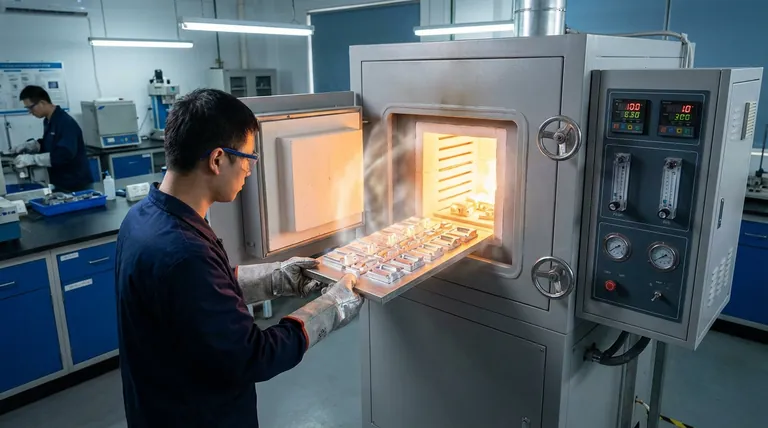
You’ve spent days, maybe weeks, machining a complex component to precise specifications. It’s a perfect piece of engineering. Now for the final, critical step: heat treatment. You place it in the furnace, set the temperature profile you’ve used a dozen times, and wait.
Hours later, you open the door, only to find a disaster. The once-gleaming surface is covered in a flaky, dark scale. Or perhaps it looks fine, but a hardness test reveals it’s now too soft and structurally useless. All that time, effort, and expensive material—wasted in a single, silent step. What went wrong?
The Frustrating Cycle of Trial-and-Error
If this scenario sounds familiar, you are not alone. It’s a story that plays out in R&D labs and on production floors everywhere. When a heat treatment process yields inconsistent results, the frantic troubleshooting begins.
Engineers and technicians often find themselves in a loop, trying to fix the problem by adjusting the most obvious parameters:
- "Let's tweak the temperature ramp rate."
- "Maybe a longer hold time will do it."
- "Is it a bad batch of raw material?"
- "Let's just try pumping in some nitrogen to push the air out."
While these efforts are logical, they rarely lead to a reliable, permanent fix. The inconsistency persists, leading to serious business consequences. Scrap rates climb, directly impacting your bottom line. R&D projects stall, turning a two-week timeline into a two-month investigation. Most critically, unpredictable product quality can erode customer trust and damage your brand's reputation for reliability. You're stuck fighting fires instead of innovating.
The Invisible Culprit: Why Your Furnace Atmosphere Is More Than Just 'Hot Air'
The reason these fixes fail is that they only address the symptoms, not the root cause. The problem isn't your heating profile or your material. The culprit is something most people treat as an afterthought: the very environment inside your furnace.
Here’s the fundamental truth: At high temperatures, the furnace atmosphere is not a passive space; it is an active chemical ingredient in your process.
When you heat a material in ambient air (which is 21% reactive oxygen), you are essentially creating a high-speed chemical reaction. That destructive scaling on your steel part? That’s oxidation—a rapid, high-temperature form of rust. The part that became too soft? That could be decarburization, where carbon is literally leached from the surface of the steel by that same reactive atmosphere.
This is why tinkering with time and temperature is like trying to bake a cake while ignoring that you've used salt instead of sugar. You can adjust the oven temperature all you want, but you'll never get the right result. Simply pumping in some nitrogen might seem like a solution, but is it pure enough? Is it displacing all the oxygen? For highly reactive metals like titanium, even nitrogen itself can be a contaminant.
You must stop thinking of the atmosphere as a passive shield and start treating it as what it is: a controllable variable you must select to either protect your material or deliberately modify it.
From Guesswork to Control: Choosing the Right Atmospheric Tool
To truly master your heat treatment, you need to move beyond guesswork and gain precise control over this chemical environment. This requires a tool designed not just to get hot, but to manage the atmosphere with intent.
This is precisely where purpose-built atmosphere and vacuum furnaces demonstrate their value. They are not simply insulated boxes; they are sealed, highly engineered systems designed to create and maintain a specific processing environment.
This is the principle behind KINTEK's range of laboratory furnaces. They are designed as solutions to the very problems you face:
For Surface Protection
If your goal is to prevent oxidation and decarburization on most common metals, you need to remove the reactive oxygen. A KINTEK furnace with a controlled inert gas system does exactly this, purging the chamber with high-purity nitrogen or argon to create a truly neutral environment where your parts are completely protected.
For Surface Modification
If your goal is to deliberately change your material's surface—like hardening steel through carburizing or nitriding—you need a reactive atmosphere. This requires a furnace specifically built to handle and control active gases like dissociated ammonia or endothermic gas, enabling you to achieve consistent, predictable changes to your material's chemistry.
For Ultimate Purity
If you're working with highly reactive metals like titanium or performing ultra-clean processes like high-purity brazing, even trace amounts of gas can be catastrophic. The only true solution is to remove the atmosphere almost entirely. A KINTEK high-vacuum furnace provides the ultimate level of control, creating a pristine environment that ensures nothing can interfere with your process.
Beyond Fixing Failures: Unlocking New Material Capabilities
When you finally gain absolute control over your furnace atmosphere, you're doing more than just solving a quality control headache. You are unlocking a new tier of capability for your entire organization.
Suddenly, problems transform into possibilities:
- You can confidently process advanced, high-value materials you previously had to avoid.
- Your R&D team can develop innovative products with superior hardness, wear resistance, and longevity.
- Your production can achieve near-zero scrap rates for heat-treated components, drastically cutting costs and accelerating project timelines.
- You can deliver guaranteed, repeatable quality batch after batch, cementing your reputation as an industry leader.
Mastering the furnace atmosphere isn't just about preventing bad outcomes; it's about enabling great ones. Your technical challenge with inconsistent parts is directly linked to your business goals of innovation, efficiency, and market leadership. Let our team help you bridge that gap. We can help you move from troubleshooting to true process mastery. To discuss your unique project and material challenges, please Contact Our Experts.
Visual Guide

Related Products
- 1700℃ Controlled Atmosphere Furnace Nitrogen Inert Atmosphere Furnace
- 1200℃ Controlled Atmosphere Furnace Nitrogen Inert Atmosphere Furnace
- 1400℃ Controlled Atmosphere Furnace with Nitrogen and Inert Atmosphere
- Controlled Nitrogen Inert Hydrogen Atmosphere Furnace
- Mesh belt controlled atmosphere furnace
Related Articles
- Controlled Atmosphere Furnace: Comprehensive Guide to Advanced Heat Treatment
- The Benefits of Controlled Atmosphere Furnaces for Sintering and Annealing Processes
- How Controlled Atmosphere Furnaces Improve Quality and Consistency in Heat Treatment
- The Importance of Inert Atmosphere Gases in Furnace Atmospheres
- It’s Not the Heat, It’s the Atmosphere: Why Your Furnace Is Ruining Your Samples



















