The short answer is yes, but most common battery testers you have for disposable alkaline cells will not give you an accurate or useful result for lithium-based batteries. Testing lithium chemistry requires specialized equipment that measures properties far beyond simple voltage.
The core issue is that a lithium battery's voltage remains remarkably stable throughout its discharge cycle. A simple voltage check can't reliably determine its state of charge or, more importantly, its overall health.

Why Standard Testers Fall Short with Lithium
Traditional battery testers, often designed for alkaline or lead-acid batteries, rely on a simple principle: measuring voltage under a small load. This method is fundamentally incompatible with the unique chemistry of lithium-ion and its variants.
The Flat Discharge Curve Problem
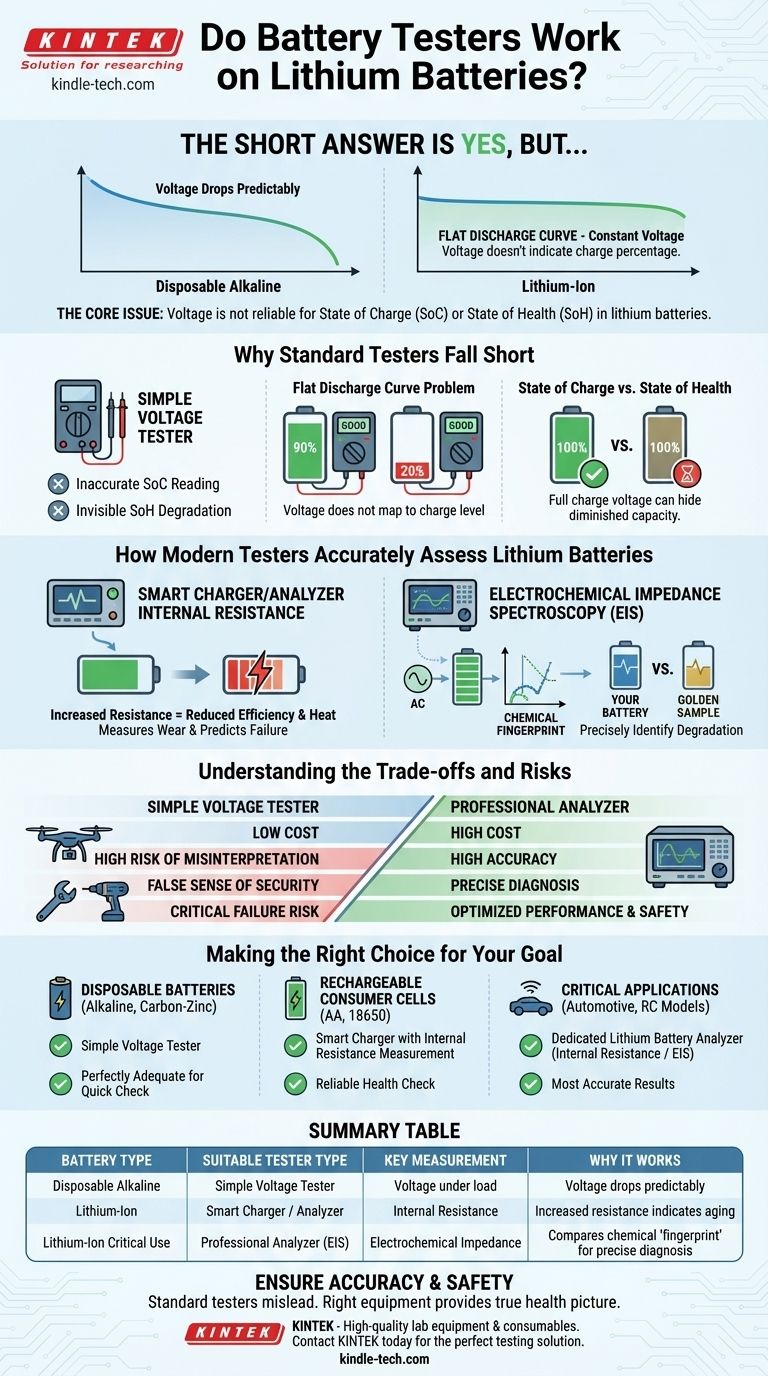
A key characteristic of lithium-ion batteries is their very flat discharge curve. This means the battery will output a nearly constant voltage from the moment it's fully charged until it is almost completely depleted.
An old-style tester will likely show a lithium battery as "good" whether it has 90% or 20% of its charge remaining. This makes voltage a poor indicator of its actual state of charge (SoC).
State of Charge vs. State of Health
Even if you could accurately map voltage to charge, it tells you nothing about the battery's State of Health (SoH). SoH refers to the battery's ability to store and deliver power compared to a new one.
This degradation, caused by age and use, is invisible to a simple voltmeter. A battery can show a full charge voltage but have a severely diminished capacity and be unable to perform under a real-world load.
How Modern Testers Accurately Assess Lithium Batteries
To get a true picture of a lithium battery's condition, advanced testers must look at its internal chemical properties. This is where specialized techniques come into play.
Measuring Internal Resistance
One of the most reliable indicators of a lithium battery's health is its internal resistance. As a battery ages and degrades, its internal resistance increases.
This rise in resistance reduces the battery's ability to deliver current efficiently, causing it to heat up more under load and deliver less power. Professional testers measure this value to assess wear and predict failure.
Advanced Spectroscopy and Benchmarking
The most sophisticated testers use methods like Electrochemical Impedance Spectroscopy (EIS). This involves sending a range of AC signals through the battery to measure its impedance (resistance to alternating current).
This creates a detailed chemical "fingerprint" of the battery. As mentioned in the reference material, this data can be compared against a pre-scanned profile of a known-good battery, often called a "golden sample," to precisely identify degradation.
Understanding the Trade-offs and Risks
Using the wrong tool for the job can be misleading at best and dangerous at worst. It's crucial to understand the limitations and what's at stake.
The Cost of Specialized Equipment
A simple voltage tester for disposable batteries might cost a few dollars. In contrast, a reliable tool that can measure the internal resistance of lithium cells, or a charger with this capability, can be significantly more expensive. Professional-grade spectroscopy analyzers represent a major investment.
The Danger of Misinterpretation
Using a basic voltage tester on a lithium battery can give a false sense of security. You might believe a battery is healthy when, in fact, it has high internal resistance and is close to failing. In high-draw applications like drones or electric vehicles, this could lead to a sudden and critical power failure.
Making the Right Choice for Your Goal
The right testing method depends entirely on the type of battery you have and the importance of its application.
- If your primary focus is a quick check for disposable batteries (alkaline, carbon-zinc): A simple, inexpensive voltage tester is perfectly adequate for the task.
- If your primary focus is managing rechargeable consumer cells (AA, 18650): Invest in a smart charger that includes an internal resistance measurement feature for a reliable health check.
- If your primary focus is critical applications (automotive, power tools, RC models): You need a dedicated lithium battery analyzer that measures internal resistance or uses advanced spectroscopy for the most accurate results.
Choosing the right tool empowers you to manage your batteries effectively, ensuring both performance and safety.
Summary Table:
| Battery Type | Suitable Tester Type | Key Measurement | Why It Works |
|---|---|---|---|
| Disposable Alkaline | Simple Voltage Tester | Voltage under load | Voltage drops predictably as charge depletes. |
| Lithium-Ion | Smart Charger / Analyzer | Internal Resistance | Increased resistance indicates aging and reduced capacity. |
| Lithium-Ion (Critical Use) | Professional Analyzer (EIS) | Electrochemical Impedance | Compares a chemical "fingerprint" to a known-good battery for precise health diagnosis. |
Ensure the accuracy and safety of your lithium battery testing.
Standard testers can give misleading results, but the right equipment provides a true picture of battery health and state of charge. KINTEK specializes in high-quality lab equipment and consumables, serving the precise needs of laboratories and technicians.
Our range of analytical tools can help you make informed decisions, prevent failures, and extend battery life.
Contact KINTEK today to find the perfect testing solution for your application.
Visual Guide
Related Products
- Aluminum Foil Current Collector for Lithium Battery
- Laboratory Test Sieves and Sieving Machines
- Filter Testing Machine FPV for Dispersion Properties of Polymers and Pigments
- Button Battery Case for Battery Lab Applications
- Battery Lab Equipment 304 Stainless Steel Strip Foil 20um Thick for Battery Test
People Also Ask
- Why is carbon coating important? Boost Battery Performance and Longevity
- How will carbon nanotubes change the world? Powering the Green Revolution with Superior Materials
- What is the purpose of laminating? Protect and Enhance Your Documents for Long-Term Use
- What are the advantages of nickel foam? Unlock Superior Performance in Energy & Catalysis
- How to check the power of a lithium-ion battery? Master the difference between charge level and battery health.