Knowledge vacuum induction melting furnace Does induction heating only work on metals? Unlocking the Science for Non-Metals
Author avatar

Tech Team · Kintek Solution

Updated 2 months ago

Does induction heating only work on metals? Unlocking the Science for Non-Metals


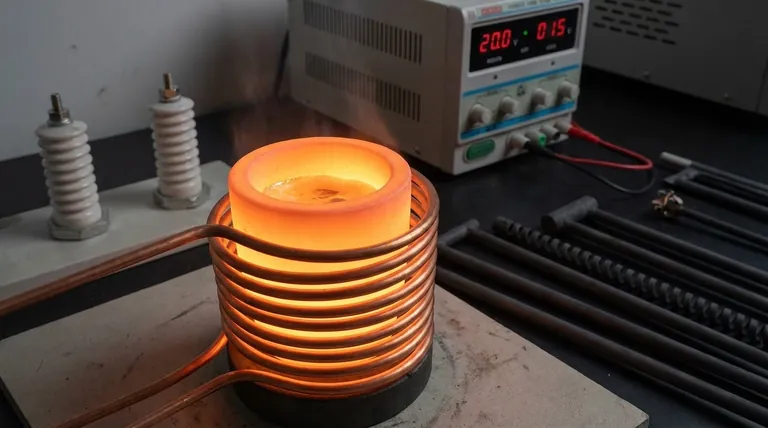
In short, induction heating is overwhelmingly used for metals, but it's not strictly limited to them. The technology works on any material that is either a good electrical conductor or has strong magnetic properties. While this describes most metals, it also includes a few specific non-metals like graphite and silicon carbide.

The question isn't whether a material is a metal, but whether it possesses the right electrical and magnetic properties. Induction heating works by converting electromagnetic energy into heat, a process that requires a material to be either electrically conductive or to exhibit magnetic hysteresis.
Does induction heating only work on metals? Unlocking the Science for Non-Metals

The Core Principles: How Induction Generates Heat

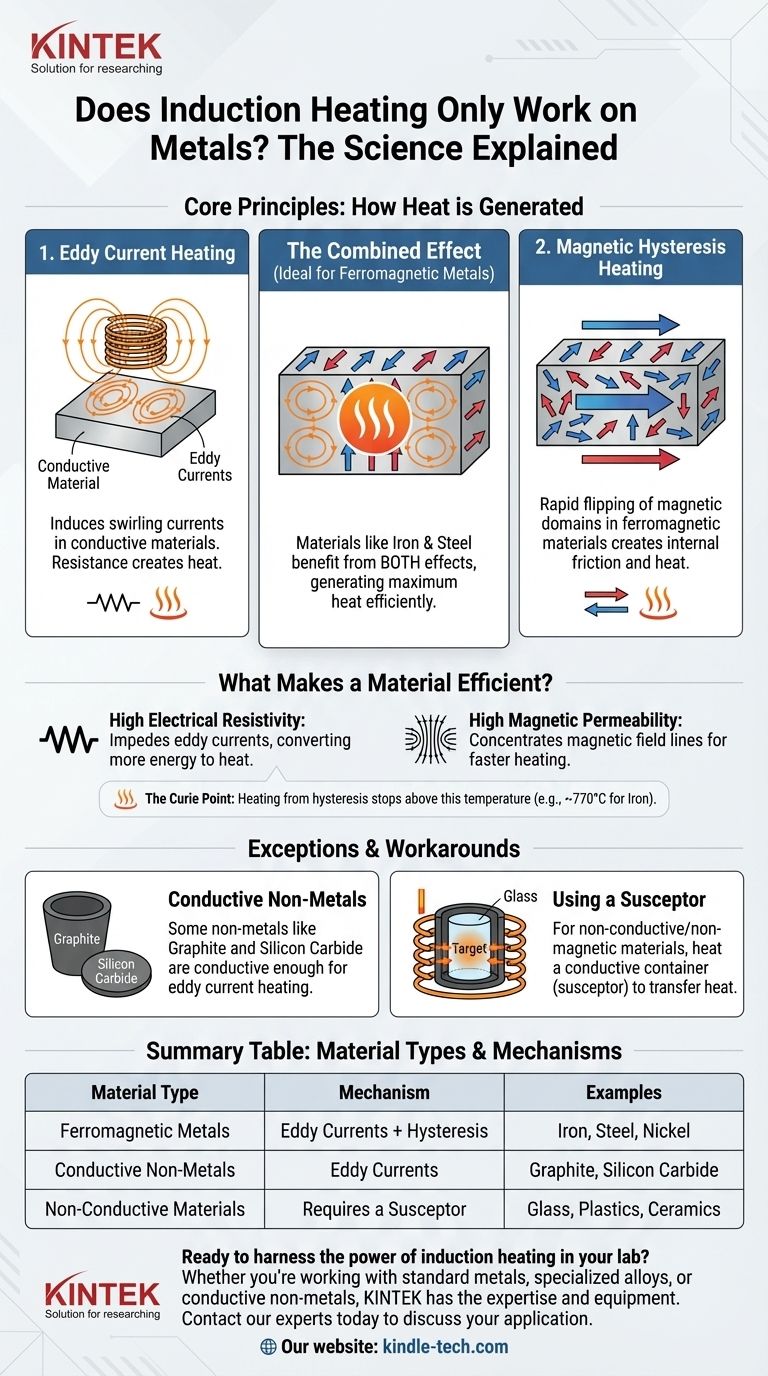
To understand which materials work, you must first understand the two phenomena that generate heat in an induction system. A material only needs one of these properties to be heated, but the best materials have both.

Eddy Current Heating

An induction coil generates a powerful, rapidly alternating magnetic field.

When an electrically conductive material is placed in this field, it induces small, swirling electrical currents within the material, known as eddy currents.

Because every material has some electrical resistance, these currents generate heat as they flow, much like the element in an electric stove. This is the primary way conductive materials like copper or aluminum can be heated.

Magnetic Hysteresis Heating

This effect only occurs in ferromagnetic materials, such as iron, nickel, and cobalt.

These materials are composed of tiny magnetic regions called "domains." When exposed to the alternating magnetic field, these domains rapidly flip their orientation to align with the field.

This rapid flipping creates significant internal friction, which generates a tremendous amount of heat. This process is known as hysteresis loss.

The Combined Effect in Ferromagnetic Metals

Materials like iron and steel are ideal for induction heating because they benefit from both effects simultaneously.

They are electrically conductive, allowing for powerful eddy currents. They are also ferromagnetic, generating intense heat through hysteresis. This dual-action heating is why induction cooktops work so effectively with cast iron and stainless steel pans.

What Makes a Material "Good" for Induction?

Beyond the basic principles, a few key properties determine how efficiently a material will heat.

Electrical Resistivity

Somewhat counterintuitively, materials with extremely high electrical conductivity (like copper) are harder to heat. Their low resistance means the eddy currents flow easily without generating much friction (heat).

Materials with higher resistivity, like steel or titanium, impede the flow of these currents more, converting more electrical energy into heat.

Magnetic Permeability

Permeability is a measure of how easily a material can be magnetized.

High magnetic permeability, a characteristic of ferromagnetic materials, concentrates the magnetic field lines. This intensifies both the eddy currents and the hysteresis effect, leading to much faster and more efficient heating.

The Curie Point Limitation

Ferromagnetic materials lose their magnetic properties above a specific temperature, known as the Curie point (around 770°C or 1420°F for iron).

Above this temperature, all heating from magnetic hysteresis stops. The material can still be heated further by eddy currents alone, but the heating rate will decrease significantly.

The Exceptions and Workarounds

While induction is metal-focused, there are important exceptions and clever techniques for heating other materials.

Heating Conductive Non-Metals

Some non-metals are sufficiently conductive to be heated directly by eddy currents.

The most common examples are graphite, carbon fiber, and some semiconductors like silicon carbide. These materials are used in specialized industrial and scientific applications.

Using a Susceptor

For materials that are neither conductive nor magnetic (like glass, plastics, or ceramics), a clever workaround is employed.

The target material is placed inside a container made of a conductive material, often graphite. This container, called a susceptor, is heated by the induction field. The susceptor then transfers its heat to the target material via conventional conduction or radiation.

Making the Right Choice for Your Goal

Understanding these principles allows you to select the right material or strategy for your specific application.

  • If your primary focus is maximum heating efficiency: Choose ferromagnetic metals like carbon steel, cast iron, or 400-series stainless steel.
  • If you must heat a non-conductive or non-magnetic material: Use a conductive susceptor, such as a graphite crucible, to act as the heating element.
  • If you are working with high-conductivity metals like copper or aluminum: Be prepared for lower efficiency and the need for a system with much higher power and frequency.

Ultimately, success with induction heating comes from matching the material's properties to the principles of electromagnetism.

Summary Table:

Material Type Induction Heating Mechanism Common Examples
Ferromagnetic Metals Eddy Currents + Magnetic Hysteresis Iron, Steel, Nickel
Conductive Non-Metals Eddy Currents Graphite, Silicon Carbide
Non-Conductive Materials Requires a Susceptor Glass, Plastics, Ceramics

Ready to harness the power of induction heating in your lab? Whether you're working with standard metals, specialized alloys, or conductive non-metals like graphite, KINTEK has the expertise and equipment to meet your needs. Our advanced induction heating systems are designed for precision, efficiency, and reliability. Contact our experts today to discuss your specific application and discover how KINTEK can enhance your laboratory processes with the right solution.

Visual Guide
Does induction heating only work on metals? Unlocking the Science for Non-Metals Visual Guide

Related Products

People Also Ask

Related Products

600T Vacuum Induction Hot Press Furnace for Heat Treat and Sintering

600T Vacuum Induction Hot Press Furnace for Heat Treat and Sintering

Discover the 600T Vacuum Induction Hot Press Furnace, designed for high-temperature sintering experiments in vacuum or protected atmospheres. Its precise temperature and pressure control, adjustable working pressure, and advanced safety features make it ideal for nonmetal materials, carbon composites, ceramics, and metal powders.

Lab-Scale Vacuum Induction Melting Furnace

Lab-Scale Vacuum Induction Melting Furnace

Get precise alloy composition with our Vacuum Induction Melting Furnace. Ideal for aerospace, nuclear energy, and electronic industries. Order now for effective smelting and casting of metals and alloys.

Infrared Heating Quantitative Flat Plate Press Mold

Infrared Heating Quantitative Flat Plate Press Mold

Discover advanced infrared heating solutions with high-density insulation and precise PID control for uniform thermal performance in various applications.

10L Heating Chilling Circulator Cooling Water Bath Circulator for High and Low Temperature Constant Temperature Reaction

10L Heating Chilling Circulator Cooling Water Bath Circulator for High and Low Temperature Constant Temperature Reaction

Experience efficient lab performance with KinTek KCBH 10L Heating Chilling Circulator. Its all-in-one design offers reliable heating, chilling, and circulating functions for industrial and lab use.

5L Heating Chilling Circulator Cooling Water Bath Circulator for High and Low Temperature Constant Temperature Reaction

5L Heating Chilling Circulator Cooling Water Bath Circulator for High and Low Temperature Constant Temperature Reaction

KinTek KCBH 5L Heating Chilling Circulator - Ideal for labs and industrial conditions with multi-functional design and reliable performance.

50L Heating Chilling Circulator Cooling Water Bath Circulator for High and Low Temperature Constant Temperature Reaction

50L Heating Chilling Circulator Cooling Water Bath Circulator for High and Low Temperature Constant Temperature Reaction

Experience versatile heating, chilling, and circulating capabilities with our KinTek KCBH 50L Heating Chilling Circulator. Ideal for labs and industrial settings, with efficient and reliable performance.

20L Heating Chilling Circulator Cooling Water Bath Circulator for High and Low Temperature Constant Temperature Reaction

20L Heating Chilling Circulator Cooling Water Bath Circulator for High and Low Temperature Constant Temperature Reaction

Maximize lab productivity with KinTek KCBH 20L Heating Chilling Circulator. Its all-in-one design offers reliable heating, chilling, and circulating functions for industrial and lab use.

30L Heating Chilling Circulator Cooling Water Bath Circulator for High and Low Temperature Constant Temperature Reaction

30L Heating Chilling Circulator Cooling Water Bath Circulator for High and Low Temperature Constant Temperature Reaction

Get versatile lab performance with KinTek KCBH 30L Heating Chilling Circulator. With max. heating temp of 200℃ and max. chilling temp of -80℃, it's perfect for industrial needs.

100L Heating Chilling Circulator Cooling Water Bath Circulator for High and Low Temperature Constant Temperature Reaction

100L Heating Chilling Circulator Cooling Water Bath Circulator for High and Low Temperature Constant Temperature Reaction

Get all-in-one heating, chilling, and circulating capabilities with our KinTek KCBH 80L Heating Chilling Circulator. High efficiency, reliable performance for labs and industrial applications.

Lab Infrared Press Mold

Lab Infrared Press Mold

Easily release samples from our lab infrared press mold for accurate testing. Ideal for battery, cement, ceramics, and other sample preparation research. Customizable sizes available.

High Temperature Constant Temperature Heating Circulator Water Bath Chiller Circulator for Reaction Bath

High Temperature Constant Temperature Heating Circulator Water Bath Chiller Circulator for Reaction Bath

Efficient and reliable, KinTek KHB Heating Circulator is perfect for your lab needs. With a max. heating temperature of up to 300℃, it features accurate temperature control and fast heating.

Heated Hydraulic Press Machine with Integrated Manual Heated Plates for Lab Use

Heated Hydraulic Press Machine with Integrated Manual Heated Plates for Lab Use

Efficiently process heat-pressing samples with our Integrated Manual Heated Lab Press. With a heating range up to 500°C, it's perfect for various industries.

Controlled Nitrogen Inert Hydrogen Atmosphere Furnace

Controlled Nitrogen Inert Hydrogen Atmosphere Furnace

KT-AH Hydrogen atmosphere furnace - induction gas furnace for sintering/annealing with built-in safety features, dual housing design, and energy-saving efficiency. Ideal for lab and industrial use.

Laboratory Small Constant Temperature Heated Magnetic Stirrer Heater and Stirrer

Laboratory Small Constant Temperature Heated Magnetic Stirrer Heater and Stirrer

The Laboratory Small Constant Temperature Heating Magnetic Stirrer is a versatile tool designed for precise temperature control and efficient mixing in various laboratory applications.

Laboratory Scientific Electric Heating Blast Drying Oven

Laboratory Scientific Electric Heating Blast Drying Oven

The desktop fast autoclave sterilizer is a compact and reliable device used for rapid sterilization of medical, pharmaceutical, and research items.

Manual High Temperature Heated Hydraulic Press Machine with Heated Plates for Lab

Manual High Temperature Heated Hydraulic Press Machine with Heated Plates for Lab

The High Temperature Hot Press is a machine specifically designed for pressing, sintering and processing materials in a high temperature environment. It is capable of operating in the range of hundreds of degrees Celsius to thousands of degrees Celsius for a variety of high temperature process requirements.

24T 30T 60T Heated Hydraulic Press Machine with Heated Plates for Laboratory Hot Press

24T 30T 60T Heated Hydraulic Press Machine with Heated Plates for Laboratory Hot Press

Looking for a reliable Hydraulic Heated Lab Press? Our 24T / 40T model is perfect for material research labs, pharmacy, ceramics, and more. With a small footprint and the ability to work inside a vacuum glove box, it's the efficient and versatile solution for your sample preparation needs.

Automatic High Temperature Heated Hydraulic Press Machine with Heated Plates for Lab

Automatic High Temperature Heated Hydraulic Press Machine with Heated Plates for Lab

The High Temperature Hot Press is a machine specifically designed for pressing, sintering and processing materials in a high temperature environment. It is capable of operating in the range of hundreds of degrees Celsius to thousands of degrees Celsius for a variety of high temperature process requirements.

Electric Rotary Kiln Continuous Working Small Rotary Furnace Heating Pyrolysis Plant

Electric Rotary Kiln Continuous Working Small Rotary Furnace Heating Pyrolysis Plant

Efficiently calcine and dry bulk powder and lump fluid materials with an electric heating rotary furnace. Ideal for processing lithium ion battery materials and more.

Silicon Carbide SiC Thermal Heating Elements for Electric Furnace

Silicon Carbide SiC Thermal Heating Elements for Electric Furnace

Experience the advantages of Silicon Carbide (SiC) Heating Element: Long service life, high corrosion and oxidation resistance, fast heating speed, and easy maintenance. Learn more now!


Leave Your Message