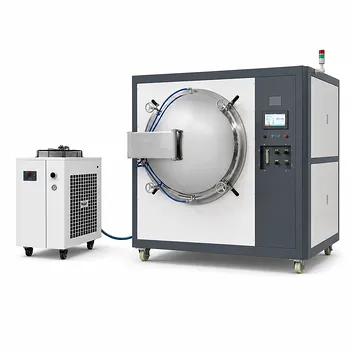
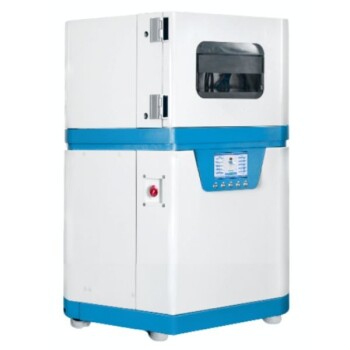
Vacuum hot press sintering significantly outperforms atmospheric sintering for carbon nanotube (CNT)/copper composites by addressing the critical issues of material oxidation and poor interfacial wetting. While atmospheric sintering relies solely on thermal energy to bond particles, vacuum hot pressing introduces simultaneous axial mechanical pressure and a protective vacuum environment.
This combination allows the copper matrix to reach a thermoplastic state where applied pressure forces particle rearrangement and plastic deformation. This results in a composite with significantly higher density, lower porosity, and stronger bonding between the copper and the nanotubes than is possible with pressure-less atmospheric methods.
Core Takeaway Atmospheric sintering often yields porous, oxidized composites due to the lack of external pressure and the presence of oxygen. By contrast, a vacuum hot press furnace utilizes mechanical force to physically close pores and drive diffusion bonding while maintaining a vacuum to ensure the copper matrix remains chemically pure.
The Mechanics of Superior Densification
Driving Plastic Deformation
In atmospheric sintering, densification is driven primarily by surface energy reduction, which is often insufficient for composite materials. Vacuum hot pressing applies uniaxial mechanical pressure (e.g., 30–60 MPa) directly to the powder mixture.
This external force causes the copper particles—which are in a thermoplastic state at high temperatures—to undergo plastic deformation. This physical compression fills the microscopic voids between particles that heat alone cannot eliminate, leading to significantly higher relative densities.
Overcoming Non-Wetting Behavior
Carbon nanotubes and copper have poor natural wettability, meaning molten or soft copper tends to bead up rather than spread over the carbon surface.
Atmospheric sintering struggles to overcome this surface tension. The mechanical pressure in a hot press effectively forces the softened copper matrix to penetrate and fill the spaces between the carbon nanotubes. This overcomes the non-wetting barrier and ensures a continuous matrix structure.
Elimination of Internal Gases
Atmospheric sintering can trap gases within the closing pores of the material. A vacuum hot press system actively evacuates the chamber.
This vacuum environment removes internal gases from the powder mass before pore closure occurs. By eliminating these gas pockets, the process significantly reduces residual porosity and prevents the formation of internal defects that would compromise electrical and mechanical performance.
Enhancing Material Chemistry and Bonding
Prevention of Matrix Oxidation
Copper is highly susceptible to oxidation at sintering temperatures. In an atmospheric furnace, even trace amounts of oxygen can lead to the formation of copper oxides.
Oxide layers act as insulators and weaken the structural integrity of the composite. The vacuum environment (e.g., -0.1 MPa) effectively prevents the oxidation of the copper matrix. This ensures that the resulting composite maintains the high electrical and thermal conductivity inherent to pure copper.
Controlled Diffusion Bonding
Strong adhesion between the CNTs and the copper is essential for load transfer. The simultaneous application of heat and pressure accelerates solid-state diffusion.
Unlike rapid sintering methods (such as Spark Plasma Sintering) that use instantaneous pulses, vacuum hot pressing typically employs extended holding times (e.g., one hour). This prolonged exposure to heat and pressure promotes thorough elemental diffusion, allowing for the formation of a distinct, robust interfacial transition layer between the matrix and the reinforcement.
Understanding the Trade-offs
Process Speed vs. Diffusion Quality
While vacuum hot pressing produces superior interfaces, it is a slower process compared to techniques like Spark Plasma Sintering (SPS).
SPS utilizes pulsed current for rapid heating, whereas vacuum hot pressing relies on external heating elements and longer soak times. However, this slower pace is often advantageous for research and high-performance applications, as it allows for more complete diffusion and equilibrium within the microstructure.
Complexity and Throughput
The requirement for high-vacuum pumps and hydraulic pressure systems makes vacuum hot pressing more complex than simple atmospheric tube furnaces.
This complexity generally limits the throughput volume compared to continuous atmospheric sintering belts. It is a batch process designed for high-quality, high-value components rather than mass-market commodity production.
Making the Right Choice for Your Goal
To determine if vacuum hot pressing is the correct approach for your specific composite application:
- If your primary focus is maximum density and conductivity: Choose vacuum hot pressing to eliminate porosity and prevent oxide layers that impede electron flow.
- If your primary focus is interfacial mechanics: Select vacuum hot pressing to leverage the extended diffusion time and pressure, which drives the physical interlocking of the matrix and nanotubes.
- If your primary focus is studying diffusion behavior: Use vacuum hot pressing, as the controlled holding times allow for the development of measurable interfacial transition layers.
The vacuum hot press converts the potential of carbon nanotube/copper composites into reality by physically forcing cohesion where chemistry alone falls short.
Summary Table:
| Feature | Atmospheric Sintering | Vacuum Hot Press Sintering |
|---|---|---|
| Driving Force | Surface energy (Heat only) | Heat + Uniaxial Mechanical Pressure |
| Material Density | Lower (Higher porosity) | Maximum (Near-theoretical density) |
| Oxidation Risk | High (Copper oxides form) | Minimal (Vacuum protected) |
| Interfacial Bonding | Weak (Non-wetting issues) | Strong (Forced penetration & diffusion) |
| Internal Gases | Often trapped in pores | Actively evacuated before closure |
| Best For | Mass-market commodity parts | High-performance R&D and composites |
Elevate Your Material Research with KINTEK Precision
Achieving peak performance in CNT/copper composites requires the perfect balance of pressure, vacuum, and temperature. KINTEK specializes in advanced laboratory equipment designed to solve your toughest sintering challenges.
From our precision vacuum hot press systems and induction melting furnaces to our high-performance hydraulic presses (isostatic and pellet), we provide the tools necessary to eliminate porosity and prevent oxidation in your sensitive materials. Our comprehensive portfolio also includes CVD/PECVD systems, high-temperature reactors, and essential ceramic consumables tailored for high-stakes research.
Ready to optimize your composite densification? Contact our technical experts today to find the ideal furnace solution for your laboratory’s unique requirements.
Related Products
- Vacuum Hot Press Furnace Heated Vacuum Press Machine Tube Furnace
- 600T Vacuum Induction Hot Press Furnace for Heat Treat and Sintering
- Vacuum Hot Press Furnace Machine for Lamination and Heating
- Vacuum Hot Press Furnace Machine Heated Vacuum Press
- Vacuum Heat Treat and Pressure Sintering Furnace for High Temperature Applications
People Also Ask
- What advantages does a vacuum hot press furnace provide for LSLBO ceramic electrolytes? Achieve 94% Relative Density
- What role does a Vacuum Hot Press (VHP) furnace play in the densification of austenitic stainless steel 316 composites?
- What are the advantages of using a vacuum hot pressing furnace? Superior Densification for 2024Al/Gr/SiC Composites
- What are the advantages of a vacuum hot press furnace for LTPO solid electrolytes? Boost Density and Conductivity
- What core processing conditions does a vacuum hot press furnace provide? Achieve High-Density Cu-SiC/Diamond Composites