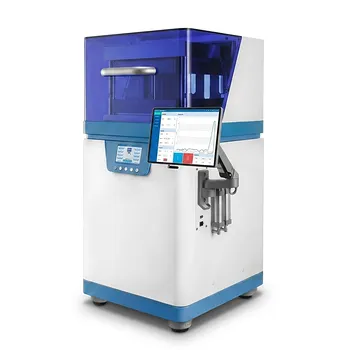
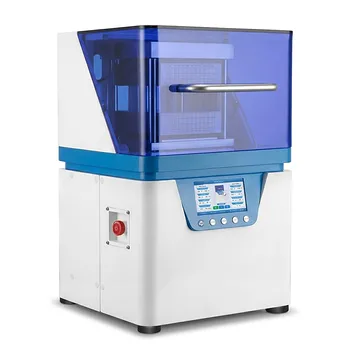
Sample preparation is the critical bridge between raw activated carbon and high-quality spectral data. In FTIR analysis, a mortar and pestle are used to grind the activated carbon into a fine powder and blend it homogeneously with spectroscopic-grade potassium bromide (KBr). A pellet press then applies several tons of hydraulic pressure to this mixture within a die, transforming it into a thin, translucent disc that allows infrared radiation to pass through the sample for accurate measurement of surface functional groups.
The mortar and pellet press work in tandem to create a uniform, infrared-transparent medium. This process ensures that the infrared beam penetrates the activated carbon particles rather than being scattered, allowing the spectrometer to identify the specific chemical vibrations of the material's surface.
The Role of the Mortar and Pestle
Achieving Particle Size Uniformity
The mortar and pestle are utilized to reduce the activated carbon to a fine, consistent particle size. If the particles are too large, they will scatter the infrared light, resulting in a noisy spectrum and poor baseline stability.
Homogenization with the KBr Matrix
A small quantity of the sample is ground together with spectroscopic-grade KBr powder. This ensures the activated carbon is evenly distributed throughout the KBr, which acts as an infrared-transparent carrier for the analysis.
Preventing Sample Agglomeration
Thorough grinding prevents the carbon from clumping, which is essential for creating a pellet with a uniform optical path. This allows the infrared beam to interact with the internal functional group structures of the carbon rather than just the outer edges of large clusters.
The Function of the Pellet Press
High-Pressure Solidification
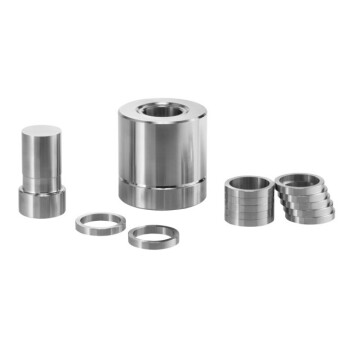
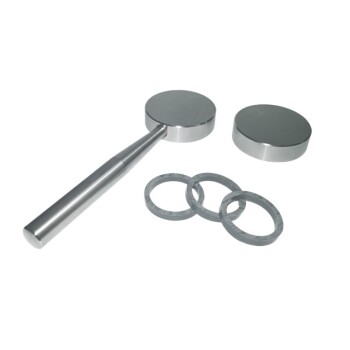
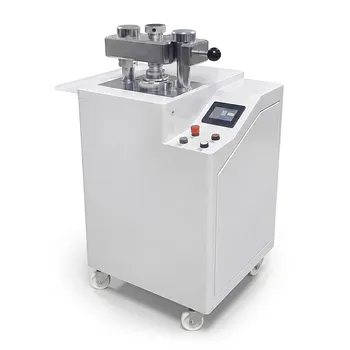
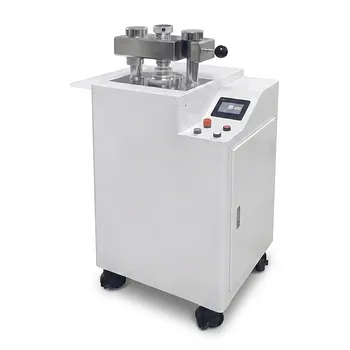
The KBr mixture is placed into a pellet die—a durable steel container with an internal plunger. A hydraulic press then applies a load, typically around 10 tonnes, to the plunger to compress the powder into a solid, thin disc.
Creating an Infrared-Transparent Window
Because KBr is naturally transparent to infrared radiation, the high pressure eliminates air gaps and fuses the powder into a translucent pellet. This allows the spectrometer to detect the vibration information of oxygen-containing groups like carboxyl, hydroxyl, and carbonyl without interference from the carrier material.
Fixing the Sample Pathlength
The press ensures the pellet has a consistent thickness, which is vital for reproducible results. The resulting disc is often retained in a metal collar and placed into a V-shaped sample holder within the spectrometer's optical path.
Understanding the Trade-offs and Technical Challenges
The Impact of Moisture Absorption
KBr is highly hygroscopic, meaning it absorbs moisture from the air rapidly. If the grinding or pressing process takes too long in a humid environment, water will appear as a broad peak in the spectrum, potentially masking the hydroxyl groups inherent to the activated carbon.
Sample-to-KBr Ratio
The concentration of activated carbon must be carefully controlled, usually making up only a small percentage of the total pellet weight. If the concentration is too high, the pellet will be opaque, blocking the infrared beam entirely; if too low, the signal from the functional groups will be too weak to detect.
Pellet Clarity and Integrity
Applying insufficient pressure can result in a cloudy or "milky" pellet that scatters light, while excessive pressure or uneven loading can crack the disc. Achieving a perfectly translucent pellet is a skill-dependent task that directly impacts the resolution of the final characteristic spectra.
How to Apply This to Your Project
When preparing activated carbon for FTIR, your methodology should be dictated by your specific analytical goals:
- If your primary focus is identifying trace functional groups: Use a higher sample-to-KBr ratio and ensure the mortar and pestle are pre-warmed or used in a glove box to eliminate all moisture interference.
- If your primary focus is quantitative comparison between samples: Maintain a strictly consistent weight of both KBr and activated carbon, and use a digital hydraulic press to ensure the exact same tonnage is applied to every pellet.
- If your primary focus is rapid screening: Utilize a mini-pellet press with a smaller die diameter (e.g., 7mm) to reduce the time spent grinding and the amount of KBr required for each test.
Proper sample preparation transforms a physical material into a clear window through which the chemical evolution of activated carbon can be observed.
Summary Table:
| Component | Role in Sample Preparation | Impact on FTIR Result |
|---|---|---|
| Mortar & Pestle | Fine grinding & homogenization with KBr | Prevents light scattering and ensures uniform optical path. |
| Pellet Press | Solidification under high pressure (~10 tons) | Creates a translucent disc for clear infrared beam penetration. |
| KBr Matrix | Infrared-transparent carrier | Minimizes background interference while supporting the sample. |
| Pressure Die | Houses sample during compression | Maintains consistent pellet thickness for reproducible data. |
Elevate Your Spectroscopic Accuracy with KINTEK
Precise sample preparation is the foundation of reliable FTIR analysis. At KINTEK, we specialize in providing high-performance laboratory equipment designed to meet the rigorous demands of material science. From hydraulic pellet presses (pellet, hot, isostatic) and precision crushing and milling systems to high-purity ceramics and crucibles, our solutions ensure your activated carbon samples are perfectly prepared for clear, reproducible results.
Our extensive portfolio also includes:
- High-Temperature Furnaces: Muffle, tube, vacuum, and CVD systems.
- Pressure Vessels: High-temperature high-pressure reactors and autoclaves.
- Advanced Cooling: ULT freezers, cold traps, and freeze dryers.
Whether you are a researcher or a distributor looking for reliable OEM/ODM support, KINTEK delivers the quality and certifications you need to succeed.
Contact us today to optimize your laboratory workflow!
References
- Aderonke Adetutu Okoya, Abimbola Bankole Akinyele. Sorption of Selected Metals from Cement Factory Wastewater using Alkali Activated Carbons Derived from PET (Polyethylene terephthalate). DOI: 10.3923/tasr.2023.103.117
This article is also based on technical information from Kintek Solution Knowledge Base .
Related Products
- kbr pellet press 2t
- Laboratory Hydraulic Pellet Press for XRF KBR FTIR Lab Applications
- Automatic Laboratory Hydraulic Press for XRF & KBR Pellet Press
- XRF & KBR steel ring lab Powder Pellet Pressing Mold for FTIR
- XRF & KBR plastic ring lab Powder Pellet Pressing Mold for FTIR
People Also Ask
- How do you prepare samples for IR spectroscopy? A Step-by-Step Guide for Solids, Liquids, and Gases
- What measurement methods are commonly used for powder samples in infrared spectroscopy? Optimize Your FTIR Analysis
- Why KBr is used in IR spectrophotometry? A Key to Transparent Sample Analysis
- How do you prepare KBr pellets for FTIR analysis? Master the Technique for High-Quality IR Spectra
- Why we use KBr pellets in IR? Unlock Clear Sample Analysis with Infrared-Transparent Matrix