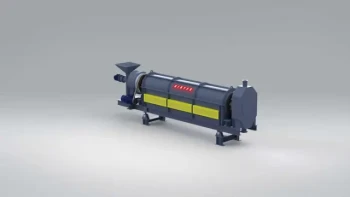
Annular steam pipes function as the critical delivery system for high-temperature water vapor within vertical activation furnaces, directly influencing the speed and quality of the process. Positioned beneath the material platform, these pipes utilize micro-pores to distribute steam evenly throughout the chamber. This precise configuration maximizes the contact area between the activator and the carbonized residues, leading to a faster and more consistent chemical reaction.
By transitioning from erratic steam injection to a uniform, micro-pore delivery system, you fundamentally alter the reaction kinetics. This approach ensures that every particle of carbonized residue receives equal exposure to the activator, accelerating production while standardizing quality.
Optimizing the Delivery Mechanism
Strategic Placement Beneath the Platform
The physical location of the pipes is the first step in ensuring efficiency. The annular pipes are situated beneath the material platform in the vertical furnace.
This placement allows the activating agent to interact with the material bed from the bottom up. It ensures the steam permeates the carbonized residues comprehensively as it rises.
The Function of Micro-Pore Design
Efficiency is heavily dependent on how the steam enters the chamber. These pipes are engineered with micro-pores rather than standard outlets.
This design feature allows for the injection of high-temperature water vapor in a highly controlled manner. It prevents localized saturation and ensures the activator is spread uniformly across the entire chamber cross-section.
Driving Chemical Efficiency
Maximizing Contact Area
The primary driver of activation efficiency is the ratio of contact between the steam and the carbon. The annular design creates a maximized contact area between the steam activator and the carbonized residues.
By eliminating "dead zones" where steam might not reach, the system ensures that the entire material load is being activated simultaneously.
Accelerating Reaction Rates
When contact area is maximized, the chemistry proceeds more rapidly. The uniform distribution of steam leads to an accelerated chemical activation reaction rate.
This reduces the dwell time required in the furnace, allowing for higher throughput without sacrificing the extent of activation.
Critical Considerations for Consistency
Ensuring Uniform Pore Development
The ultimate goal of activation is creating a specific internal surface area. The annular pipe system ensures the uniform development of the pore structure in the final product.
Without this uniform injection, the furnace would produce activated carbon with inconsistent adsorption properties.
System Dependency
It is important to note that this efficiency relies entirely on the integrity of the micro-pores.
Because the system depends on fine distribution rather than high-pressure blasting, keeping these pores clear and functional is essential for maintaining the uniform injection profile described.
Making the Right Choice for Your Goal
To determine if this configuration aligns with your production targets, consider your specific activation requirements:
- If your primary focus is Production Speed: The maximized contact area accelerates the reaction rate, allowing you to process batches more quickly.
- If your primary focus is Product Consistency: The uniform injection mechanism ensures that the pore structure is developed evenly across the entire batch, reducing quality variance.
By optimizing the point of contact between steam and carbon, annular pipes turn a simple chemical reaction into a highly efficient, controlled manufacturing process.
Summary Table:
| Feature | Function & Benefit |
|---|---|
| Placement | Situated beneath the material platform to ensure bottom-up steam permeation. |
| Micro-Pore Design | Enables controlled, uniform injection of high-temperature vapor across the chamber. |
| Contact Area | Maximizes the interaction between steam and carbonized residues, eliminating dead zones. |
| Reaction Kinetics | Accelerates chemical activation, reducing dwell time and increasing production throughput. |
| Output Quality | Ensures consistent pore structure development for superior adsorption properties. |
Elevate Your Material Activation with KINTEK Precision
At KINTEK, we understand that uniform heat and precise activator delivery are the cornerstones of high-performance carbon production. Whether you are scaling up production speed or refining product consistency, our advanced thermal processing solutions are engineered to meet the most rigorous laboratory and industrial standards.
Beyond activation furnaces, KINTEK specializes in a comprehensive range of laboratory equipment, including:
- High-Temperature Furnaces: Muffle, tube, rotary, vacuum, and CVD/PECVD systems.
- Processing Equipment: Crushing, milling, and sieving systems.
- Material Synthesis: High-pressure reactors, autoclaves, and electrolytic cells.
- Battery Research: Specialized tools and consumables for energy storage innovation.
Ready to optimize your activation efficiency? Contact our technical experts today to discover how our high-temperature systems and precision engineering can transform your material research and production outcomes.
References
- Shuo Shao, Simiao Wang. An activated carbon preparation device using traditional Chinese medicine waste residue as raw material. DOI: 10.25236/ijfet.2023.051115
This article is also based on technical information from Kintek Solution Knowledge Base .
Related Products
- Vertical Laboratory Tube Furnace
- Vertical High Temperature Graphite Vacuum Graphitization Furnace
- Large Vertical Graphite Vacuum Graphitization Furnace
- Electric Rotary Kiln Small Rotary Furnace for Activated Carbon Regeneration
- Graphite Vacuum Furnace Bottom Discharge Graphitization Furnace for Carbon Materials
People Also Ask
- What is the function of a laboratory vertical tube furnace in microalgae catalytic pyrolysis? Optimize Your Bio-Fuel.
- How does a laboratory tube furnace provide atmospheric control during the sintering of glass-ceramics? Achieve Precision
- Why is a laboratory tube furnace required for LMTP0.1/CA materials? Achieve Precise Carbon Coating & Crystal Growth
- How does a laboratory tube furnace provide precise temperature control? Expert Simulation for Steam Cracking
- How does the temperature control precision of a laboratory tube furnace affect the quality of grown single crystals?