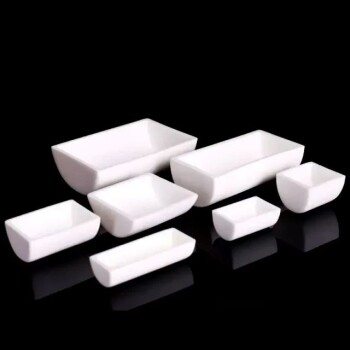
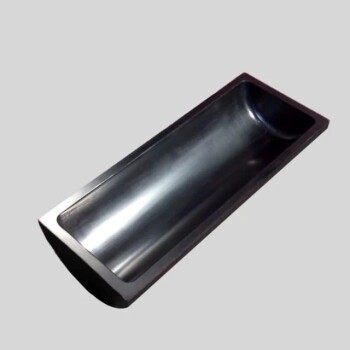
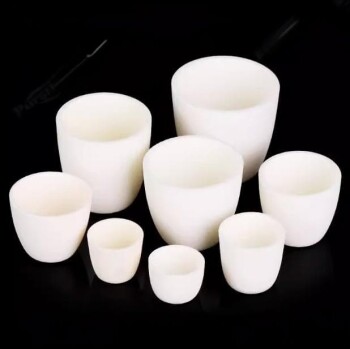
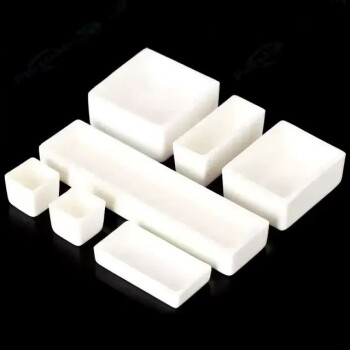
The choice of crucible and substrate dictates the dimensional growth of h-BCN by determining whether the synthesis occurs via solid-state pyrolysis or gas-phase deposition. A boat-shaped crucible facilitates the formation of bulk porous ceramics through in-situ reaction, while graphite paper positioned downstream captures gaseous intermediates to produce structured microtubes.
The spatial arrangement of materials within a furnace creates distinct chemical environments that allow for the simultaneous engineering of different structural dimensions. By leveraging the specific physicochemical properties of crucibles and substrates, researchers can produce both 3D bulk materials and 1D microstructures in a single synthesis cycle.
The Role of Boat-Shaped Crucibles in Bulk Synthesis
In-Situ Pyrolysis Mechanisms
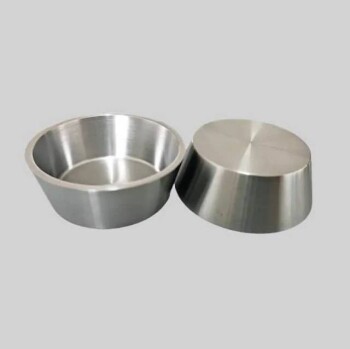
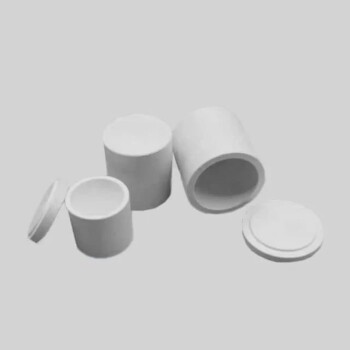
The boat-shaped crucible serves as the primary reaction vessel where the precursor material is contained and heated. This setup promotes in-situ pyrolysis, a process where the chemical transformation occurs directly within the bulk mass of the precursor.
Formation of Porous Ceramic Structures
Because the reaction is confined to the crucible, the resulting h-BCN typically takes the form of bulk porous ceramics. This environment is ideal for creating high-volume materials that maintain a three-dimensional network.
The Influence of Graphite Paper as a Deposition Substrate
Gas-Phase Intermediate Capture
Graphite paper placed downstream from the crucible acts as a specialized collection site for volatile species. Its physicochemical surface properties are specifically tuned to attract and capture gas-phase intermediates that escape the primary crucible.
Morphology Control: From Gas to Microtubes
Once these intermediates are captured on the graphite surface, they undergo a secondary growth process. This specific interaction induces the growth of h-BCN into microtubes (MTs), shifting the morphology from bulk structures to high-aspect-ratio 1D forms.
Understanding the Trade-offs
Spatial Sensitivity and Gradient Effects
The primary challenge of this dual-growth method is the sensitivity to furnace positioning. Variations in temperature and gas flow velocity between the crucible and the downstream substrate can lead to inconsistent quality in the microtubes.
Competition for Precursors
There is an inherent trade-off between the yield of bulk ceramics and the density of microtubes. High yields in the crucible may reduce the volume of gaseous intermediates available for downstream deposition, potentially limiting the growth of the microstructures.
How to Apply This to Your Project
Understanding these interactions allows for precise control over the final material output based on your specific application needs.
- If your primary focus is high-surface-area bulk materials: Prioritize the volume and heating rate within the boat-shaped crucible to maximize in-situ pyrolysis.
- If your primary focus is structural reinforcement or electronics: Optimize the distance and surface treatment of the downstream graphite paper to enhance the quality of the microtubes.
- If your primary focus is process efficiency: Calibrate the furnace flow to ensure sufficient intermediate transport so that both 3D ceramics and 1D microtubes are harvested simultaneously.
By strategically placing substrates relative to the precursor source, you can effectively transform a single chemical process into a multi-dimensional manufacturing system.
Summary Table:
| Component | Synthesis Mechanism | Resulting Morphology | Best Application |
|---|---|---|---|
| Boat-Shaped Crucible | In-situ Pyrolysis (Solid-state) | 3D Bulk Porous Ceramics | High-surface-area materials |
| Graphite Paper | Gas-phase Deposition | 1D Microtubes (MTs) | Electronics & Reinforcement |
| Downstream Position | Intermediate Species Capture | High-aspect-ratio structures | Nanostructure engineering |
Elevate Your Material Synthesis with KINTEK Precision
Achieving the perfect h-BCN morphology—whether 1D microtubes or 3D porous ceramics—requires precise thermal control and high-quality labware. KINTEK specializes in providing the advanced tools necessary for cutting-edge material science research.
From our high-performance tube and CVD furnaces designed for optimal gas-phase deposition to our durable ceramic crucibles and PTFE products, we provide the reliability your lab demands. Our comprehensive portfolio also includes:
- High-Temperature Furnaces: Muffle, vacuum, and atmosphere-controlled systems.
- Specialized Substrates & Consumables: High-purity ceramics, crucibles, and graphite materials.
- Processing Equipment: Crushing, milling, and hydraulic pellet presses for precursor preparation.
Ready to optimize your synthesis results? Contact KINTEK today to discover how our specialized laboratory equipment and consumables can enhance your research efficiency and material quality.
References
- L. Xia, X. Z. Huang. Ultra-light h-BCN architectures derived from new organic monomer with tunable electromagnetic wave absorption. DOI: 10.17615/xk35-7938
This article is also based on technical information from Kintek Solution Knowledge Base .
Related Products
- Alumina Al2O3 Ceramic Crucible Semicircle Boat with Lid for Engineering Advanced Fine Ceramics
- Electron Beam Evaporation Coating Gold Plating Tungsten Molybdenum Crucible for Evaporation
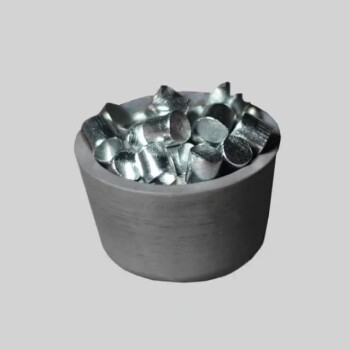
- High Purity Pure Graphite Crucible for Evaporation
- Electron Beam Evaporation Coating Oxygen-Free Copper Crucible and Evaporation Boat
- Ceramic Evaporation Boat Set Alumina Crucible for Laboratory Use
People Also Ask
- Why are alumina crucibles and mother powder essential for LATP sintering? Optimize Your Solid Electrolyte Performance
- Why are high-purity alumina crucibles used for liquid lead corrosion experiments? Ensure Data Accuracy at 550°C
- Why Use Alumina Crucibles & Powder Burial for NaSICON? Ensure Phase Purity and Prevent Elemental Volatilization
- What is the primary purpose of using alumina crucibles for LLTO ceramics? Optimize Your High-Temperature Sintering
- What are the benefits of using an alumina crucible with a lid for TiB2 nanopowder heat treatment? Ensure High Purity