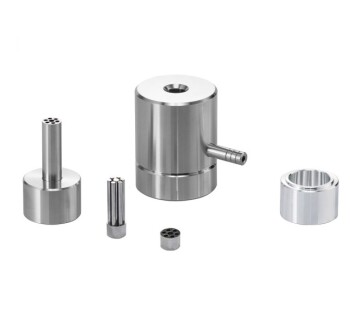
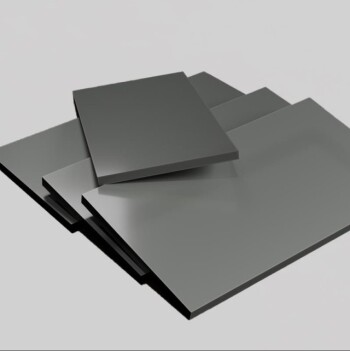
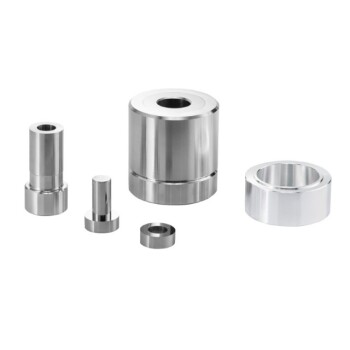
In the hot-pressing of ZrB2–SiC–TaC ceramics, the graphite assembly functions as both the thermal reactor and the mechanical shaping vessel. The graphite mold generates or conducts the intense heat required for sintering while transmitting uniaxial pressure, whereas flexible graphite paper acts as a critical interface liner to isolate the ceramic powder from the mold walls to prevent adhesion.
Core Takeaway: Success in sintering ZrB2–SiC–TaC depends on the synergy between the rigid mold and the flexible liner. The mold provides the thermal and mechanical energy necessary for densification, while the graphite paper ensures the chemical purity of the surface and allows for the non-destructive removal of the finished ceramic.
The Role of the Graphite Mold
Acting as a Thermal Engine
The graphite mold is not merely a container; it is an active participant in the thermal process. It functions either as a resistive heating element itself or as a highly efficient heat transfer medium. This allows it to conduct thermal energy directly to the ZrB2–SiC–TaC sample, enabling the system to reach the extreme temperatures required for sintering.
Structural Containment and Shaping
At its most basic level, the mold provides a high-temperature resistant forming cavity. It defines the geometry of the ceramic component, holding the loose powder in the desired shape as temperature and pressure increase.
Transmission of Uniaxial Pressure
Beyond shaping, the mold serves as the mechanical linkage between the hydraulic rams and the ceramic powder. It must withstand significant axial loads to transfer uniform pressure (often uniaxial) to the powder. This pressure facilitates particle rearrangement and plastic flow, which are critical for achieving high density in the final ceramic part.
The Function of Flexible Graphite Paper
Chemical Isolation
Flexible graphite paper is used as a liner between the ceramic powder and the rigid inner walls of the graphite mold. Its primary function is to prevent direct contact, which stops chemical reactions that could occur between the reactive ceramic powder and the mold material at sintering temperatures.
Prevention of Adhesion
Without this liner, the ceramic material would likely bond to the mold walls during densification. The graphite paper acts as a non-stick barrier, ensuring the sintered sample remains distinct from the tooling.
Lubrication and Demolding
The paper provides a lubricative layer that facilitates smooth demolding after the process is complete. By reducing friction and preventing sticking, the paper significantly extends the service life of the expensive graphite mold by reducing wear and tear during sample removal.
Understanding the Trade-offs
Mold Degradation and Consumption
While graphite molds are highly resistant to heat, they are ultimately consumables. Repeated cycling at the high temperatures required for ZrB2–SiC–TaC ceramics can lead to gradual oxidation or mechanical fatigue, eventually compromising the dimensional accuracy of the parts.
Liner Fragility
Flexible graphite paper is effective but fragile. If the paper tears during the loading process or shifts under pressure, the ceramic powder will contact the mold. This leads to localized defects, surface contamination, and potentially catastrophic sticking that can ruin both the sample and the mold.
Making the Right Choice for Your Goal
To optimize your hot-pressing process for ZrB2–SiC–TaC ceramics, prioritize the following based on your specific objectives:
- If your primary focus is Dimensional Accuracy: Ensure your graphite mold has high structural strength to withstand uniaxial pressure without deformation at peak temperatures.
- If your primary focus is Surface Quality and Purity: Meticulously apply the flexible graphite paper to ensure zero gaps or tears, guaranteeing complete isolation from the mold walls.
- If your primary focus is Cost Efficiency: Use high-quality graphite paper to prevent adhesion, which directly extends the lifespan of your reusable graphite molds.
By correctly utilizing the mold for energy transmission and the paper for isolation, you ensure the production of dense, high-integrity ceramic components.
Summary Table:
| Component | Primary Function | Key Benefit |
|---|---|---|
| Graphite Mold | Thermal engine & mechanical shaping | Conducts heat and transmits uniaxial pressure for high densification. |
| Flexible Graphite Paper | Chemical isolation & lubrication | Prevents adhesion to mold walls and ensures non-destructive demolding. |
| The Synergy | Combined thermal/mechanical control | Produces dense, high-purity ceramic components with extended tool life. |
Elevate Your Advanced Ceramic Production with KINTEK
Precision in sintering ZrB2–SiC–TaC ceramics requires the highest quality thermal and mechanical equipment. KINTEK specializes in providing the laboratory solutions you need to achieve superior material properties. From high-performance vacuum and atmosphere furnaces to robust hydraulic pellet and hot presses, our technology ensures uniform pressure and precise temperature control.
Our extensive portfolio also includes high-temperature high-pressure reactors, crushing and milling systems, and essential consumables like graphite products, ceramics, and crucibles. Whether you are focused on dimensional accuracy or material purity, KINTEK has the expertise to support your research and production goals.
Ready to optimize your lab's efficiency? Contact us today to discover how our comprehensive range of equipment and consumables can benefit your next project!
Related Products
- Double Plate Heating Press Mold for Lab
- Lab Infrared Press Mold
- Ball Press Mold for Lab
- Special Shape Press Mold for Lab
- Anti-Cracking Press Mold for Lab Use
People Also Ask
- How to use a press mold? Master the Art of Creating Consistent Ceramic Forms
- What is the process of mold press? A Step-by-Step Guide to Compression Molding
- What is the primary function of mold pressing for LAGP powders? Achieve High-Performance Solid Electrolytes
- Why are pressure molds with non-conductive resin inner walls required for battery testing? Ensure Data Accuracy
- What is the press mould method? A Guide to Consistent, Detailed Ceramic Forms