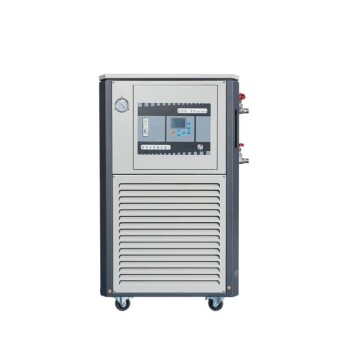
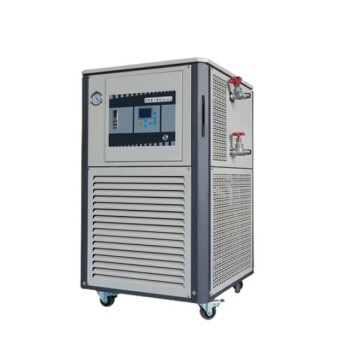
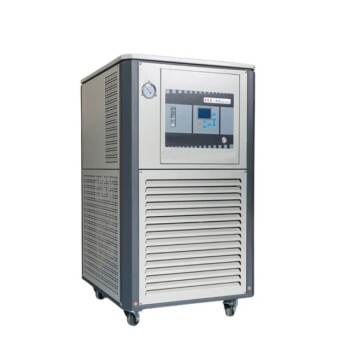
Laboratory high-temperature heating devices combined with Fourier Transform Infrared Spectroscopy (FT-IR) create a comprehensive system for validating lubricant stability. The heating device serves to accelerate the aging process by maintaining temperatures above 60 degrees Celsius, forcing the lubricant to undergo oxidative degradation rapidly. Simultaneously, FT-IR acts as the diagnostic tool, monitoring the chemical evolution of the oil by tracking the emergence of specific carbonyl absorption peaks.
By simulating harsh thermal environments and tracking molecular changes in real-time, this method provides a quantifiable metric for antioxidant performance: the ability to delay the formation of carbonyl groups is the definitive sign of a stable lubricant.
Simulating Operational Stress
To evaluate an antioxidant effectively, you must first create the conditions that cause lubricant failure.
The Role of Accelerated Aging
Under normal conditions, lubricant oxidation can take months or years to occur. Laboratory heating devices compress this timeline by simulating environments above 60 degrees Celsius.
Forcing Oxidative Degradation
This elevated heat provides the activation energy required to initiate chemical breakdown. It forces the lubricant to react with oxygen, replicating the high-stress environment of an internal combustion engine or industrial machinery.
Monitoring Chemical Integrity via FT-IR
Once the oil is under thermal stress, FT-IR is used to "see" the chemical changes occurring at the molecular level.
Identifying the Carbonyl Signature
As lubricant oil oxidizes, its hydrocarbon chains break down and react with oxygen to form new compounds. The most significant marker of this degradation is the appearance of carbonyl characteristic absorption peaks.
The 1731 cm⁻¹ Indicator
FT-IR instrumentation is tuned to monitor a specific region of the infrared spectrum. These critical carbonyl peaks typically manifest at approximately 1731 cm⁻¹. The growth of a peak at this specific wavenumber is a direct quantitative measure of how much the oil has degraded.
The Mechanism of Protection
The data provided by the FT-IR allows researchers to evaluate the specific mechanism of the antioxidant additive.
Capturing Peroxide Radicals
Oxidation is a chain reaction driven by free radicals. An effective antioxidant intervenes by capturing peroxide radicals before they can propagate further damage.
Stabilizing Chemical Properties
By neutralizing these radicals, the antioxidant effectively inhibits the formation of carbonyl peaks. If the FT-IR spectrum remains relatively flat at 1731 cm⁻¹ despite high heat, it proves the antioxidant is successfully stabilizing the lubricant's chemical properties.
Understanding the Trade-offs
While this methodology is robust, it requires careful interpretation to ensure accurate results.
Thermal Specificity
This method focuses heavily on thermal oxidation. It does not necessarily account for other degradation factors, such as mechanical shear stress or contamination by fuel and water, which may occur in real-world scenarios.
Detection Limits
The precision of the evaluation depends on the sensitivity of the FT-IR instrument. Early stages of oxidation may produce subtle spectral changes that are difficult to distinguish from baseline noise without proper calibration.
Making the Right Choice for Your Goal
To maximize the value of this testing methodology, tailor your approach to your specific objectives.
- If your primary focus is formulation comparison: Compare the rate of growth of the peak at 1731 cm⁻¹; the formulation with the slowest peak growth under identical heat is the superior candidate.
- If your primary focus is simulation accuracy: Ensure your heating device is set significantly above 60 degrees Celsius to sufficiently accelerate the reaction, but do not exceed the flash point of the base oil.
The combination of controlled thermal stress and spectral monitoring transforms lubricant testing from a guessing game into a precise, data-driven science.
Summary Table:
| Component | Role in Evaluation | Key Parameter/Indicator |
|---|---|---|
| High-Temp Heating Device | Accelerates aging & simulates thermal stress | Temperatures > 60°C |
| FT-IR Spectroscopy | Monitors chemical molecular changes | Carbonyl peak at ~1731 cm⁻¹ |
| Antioxidants | Inhibits oxidative chain reactions | Captures peroxide radicals |
| Degradation Marker | Quantifies lubricant failure level | Growth of 1731 cm⁻¹ absorption peak |
Elevate Your Lubricant Research with KINTEK Precision
Ensure the accuracy of your antioxidant evaluations with KINTEK’s high-performance laboratory equipment. Whether you need precise high-temperature furnaces, crushing and milling systems for sample prep, or high-temperature high-pressure reactors for simulating extreme environments, we provide the tools necessary for rigorous material analysis.
Our specialized portfolio includes:
- Advanced muffle and tube furnaces for accelerated aging studies.
- High-pressure reactors and autoclaves for lubricant testing.
- High-purity ceramics, crucibles, and PTFE consumables for uncontaminated results.
Don't leave your chemical integrity to chance. Contact KINTEK today to discover how our comprehensive laboratory solutions can streamline your R&D and ensure superior product stability.
References
- Faez S. Al-Shibli, Khansa Abdul Razzaq Alassdi. Synthesis of the Antioxidant Compounds from the Eugenol to the Lubricating Oils. DOI: 10.36329/jkcm/2022/v2.i9.13318
This article is also based on technical information from Kintek Solution Knowledge Base .
Related Products
- High Temperature Constant Temperature Heating Circulator Water Bath Chiller Circulator for Reaction Bath
- Automatic High Temperature Heated Hydraulic Press Machine with Heated Plates for Lab
- Manual High Temperature Heated Hydraulic Press Machine with Heated Plates for Lab
- 10L Heating Chilling Circulator Cooling Water Bath Circulator for High and Low Temperature Constant Temperature Reaction
- 5L Heating Chilling Circulator Cooling Water Bath Circulator for High and Low Temperature Constant Temperature Reaction
People Also Ask
- What is the necessity of a circulating water bath in chlorate production? Optimize Yield & Purity with Precision
- How do constant temperature circulators impact weight-loss immersion tests? Ensure Precision in Corrosion Analysis
- How does a constant temperature circulator support the leaching reaction of gold scrap? Optimize Gold Recovery Results
- Why is a constant temperature water bath used for precursor storage in CVD? Achieve Stable Nanocrystalline SiC Deposition
- Why is a high-precision constant temperature water bath necessary for anaerobic digestion? Ensure Success at 37±0.02°C