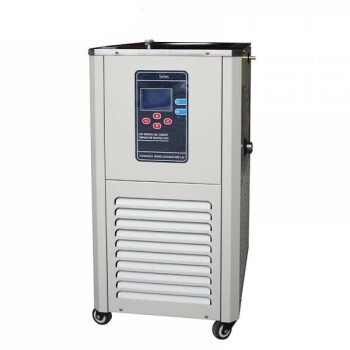
A constant temperature water bath serves as a critical stabilizer for the precursor reaction in green synthesis. By maintaining a specific, moderate temperature—such as 60 degrees Celsius—over an extended period, it ensures the gradual and controlled reduction of metal salts by biological molecules. This precise thermal environment is essential for managing the nucleation process to produce uniform nanostructures.
In green nanotechnology, the quality of the final product is dictated by reaction kinetics. A constant temperature water bath replaces the volatility of rapid heating with a gentle, continuous thermal mode, allowing for the precise consistency needed to form high-quality metal oxide nanoparticles.
The Role of Thermal Stability
Creating a Controlled Environment
The primary function of the water bath is to provide a stable, long-term thermal environment. Unlike open-flame or hot-plate methods which can cause temperature spikes, a water bath envelops the reaction vessel in a consistent heat source.
Supporting Long-Duration Reactions
Green synthesis often requires time for biological molecules to interact effectively with precursors. The water bath facilitates this by maintaining exact temperatures for extended durations, such as the 12-hour cycle mentioned in synthesis protocols.
Facilitating Chemical Transformation
Enabling Gradual Reduction
The interaction between plant extracts and metal salts is a delicate chemical process. A water bath ensures this reduction happens gradually rather than instantaneously.
Preventing Aggressive Reactions
Rapid heating can degrade sensitive biological compounds found in plant extracts. The gentle, continuous heating mode preserves these molecules, ensuring they remain active enough to reduce the metal salts effectively.
Controlling Nanostructure Quality
Regulating Nucleation
Nucleation is the initial step where the first atoms of the crystal form. The constant temperature provided by the water bath helps control this rate, preventing the chaotic formation of particles.
Ensuring Uniformity
To achieve uniform nanostructures, the solution must reach a specific consistency. The steady thermal energy ensures the reaction proceeds evenly throughout the mixture, leading to particles of similar size and shape.
Understanding the Trade-offs
Time Consumption
The process described is inherently slow. Relying on a "gentle and continuous" heating mode for 12 hours requires significantly more time than high-energy methods like combustion synthesis.
Throughput Limitations
While excellent for quality, this method reduces throughput. A constant temperature water bath limits the speed at which you can iterate or mass-produce nanoparticles compared to faster, albeit less controlled, methods.
Optimizing Your Synthesis Protocol
When deciding on the thermal method for your green synthesis project, consider your specific constraints regarding time and quality.
- If your primary focus is Particle Uniformity: Utilize the constant temperature water bath to ensure a controlled nucleation process and consistent nanostructure size.
- If your primary focus is Speed of Production: Recognize that the 12-hour gentle heating cycle may be a bottleneck and consider if rapid variation is acceptable for your specific application.
By prioritizing thermal stability, you transform a volatile chemical mixture into a predictable system capable of yielding high-quality metal oxide nanoparticles.
Summary Table:
| Feature | Role in Green Synthesis | Impact on Nanoparticles |
|---|---|---|
| Thermal Stability | Prevents temperature spikes and volatility | Ensures consistent crystal growth |
| Gentle Heating | Preserves sensitive biological reducing agents | Enables gradual, controlled reduction |
| Long-Duration Support | Maintains heat for 12+ hour cycles | Allows complete precursor transformation |
| Nucleation Control | Regulates the initial crystal formation rate | Produces uniform size and shape |
Elevate Your Nanotechnology Research with KINTEK
Precision is the foundation of successful green synthesis. At KINTEK, we understand that maintaining a stable thermal environment is non-negotiable for producing high-quality metal oxide nanoparticles. Our advanced laboratory solutions are designed to provide the exact consistency your precursor reactions require.
From high-precision water baths and cooling solutions (ULT freezers, freeze dryers) to specialized high-temperature reactors and autoclaves, KINTEK provides the robust equipment needed to control every stage of your synthesis. Whether you are scaling up with our crushing and milling systems or refining materials using our furnaces and hydraulic presses, our portfolio supports the entire lifecycle of material science.
Ready to achieve superior particle uniformity? Contact us today to discover how KINTEK’s laboratory equipment and consumables can optimize your research outcomes.
References
- Eduardo González, P.A. Luque. A Study of the Optical and Structural Properties of SnO2 Nanoparticles Synthesized with Tilia cordata Applied in Methylene Blue Degradation. DOI: 10.3390/sym14112231
This article is also based on technical information from Kintek Solution Knowledge Base .
Related Products
- High Temperature Constant Temperature Heating Circulator Water Bath Chiller Circulator for Reaction Bath
- 50L Chiller Water Bath Cooling Circulator Low Temperature Constant Temperature Reaction Bath
- 10L Chilling Circulator Cooling Water Bath Low Temperature Constant Temperature Reaction Bath
- 30L Chiller Water Bath Cooling Circulator Low Temperature Constant Temperature Reaction Bath
- 40L Chiller Water Bath Cooling Circulator Low Temperature Constant Temperature Reaction Bath
People Also Ask
- What is the necessity of a circulating water bath in chlorate production? Optimize Yield & Purity with Precision
- How do constant temperature circulators impact weight-loss immersion tests? Ensure Precision in Corrosion Analysis
- How does a constant temperature circulator support the leaching reaction of gold scrap? Optimize Gold Recovery Results
- Why is a constant temperature water bath used for precursor storage in CVD? Achieve Stable Nanocrystalline SiC Deposition
- Why is a high-precision constant temperature water bath necessary for anaerobic digestion? Ensure Success at 37±0.02°C