Knowledge How does a heat-collecting constant temperature heating magnetic stirrer contribute to wood delignification?
Author avatar

Tech Team · Kintek Solution

Updated 1 day ago

How does a heat-collecting constant temperature heating magnetic stirrer contribute to wood delignification?


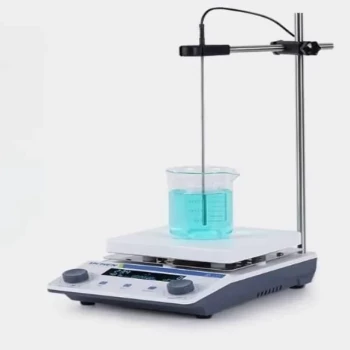
A heat-collecting constant temperature heating magnetic stirrer serves as the critical control unit for efficient wood delignification. By simultaneously maintaining a precise thermal environment of 85°C and ensuring continuous fluid agitation, this device drives the chemical reaction required to strip lignin from wood fibers while preserving the cellulose structure.

The device enables the production of high-purity cellulose templates by creating a stable, high-temperature acidic environment that ensures uniform chemical penetration and accelerated reaction rates, even within thick wood samples.

The Role of Precision Thermal Control

Maintaining Reaction Kinetics

The core challenge in delignification is initiating and sustaining the breakdown of lignin without damaging the cellulose. This specific device maintains a constant temperature of 85°C.

This precise thermal regulation is essential for the acidic sodium chlorite solution to function effectively. Without a stable high temperature, the chemical reaction would slow down significantly, leading to incomplete processing.

The "Heat-Collecting" Advantage

The "heat-collecting" aspect of the device implies an ability to concentrate and retain thermal energy around the reaction vessel.

This ensures that the energy input is efficient and minimizes temperature fluctuations during the extended reaction times required for delignification.

The Necessity of Mechanical Agitation

Achieving Homogeneity

Magnetic stirring provides continuous motion within the chemical bath. This prevents the formation of concentration gradients where the reagents might become depleted near the wood surface.

By keeping the solution in constant motion, fresh sodium chlorite is continually brought into contact with the wood sample.

Penetrating Thick Templates

For thick wood templates, surface-level exposure is insufficient. The combination of heat and stirring ensures that the reagents penetrate deep into the interior of the wood.

This capability is what allows for the removal of lignin throughout the entire volume of the material, rather than just the exterior layers.

Understanding the Operational Trade-offs

The Risk of Static Conditions

If stirring is interrupted or insufficient, the delignification process becomes uneven.

You may end up with a sample that is pure cellulose on the outside but still contains rigid lignin in the core, rendering the template useless for high-purity applications.

Thermal Sensitivity

While 85°C is the target for acceleration, deviating from this constant temperature presents risks.

If the temperature drops, the reaction stalls; if it spikes significantly higher due to poor control, there is a potential risk of degrading the cellulose fibers you aim to preserve. Reliability in the "constant temperature" mechanism is therefore paramount.

Making the Right Choice for Your Goal

To maximize the effectiveness of your delignification process, consider your specific experimental needs:

  • If your primary focus is processing thick samples: Ensure your stirrer is set to a vigorous setting to guarantee deep chemical penetration into the wood interior.
  • If your primary focus is chemical purity: Prioritize the thermal stability of the device to maintain the reaction exactly at 85°C, preventing incomplete reactions or fiber degradation.

Successful delignification relies not just on the chemicals used, but on the rigorous stability of the physical environment provided by your equipment.

Summary Table:

Feature Function in Delignification Benefit to Wood Processing
85°C Thermal Control Sustains acidic sodium chlorite kinetics Ensures complete lignin breakdown without fiber damage
Heat-Collecting Design Concentrates and retains thermal energy Minimizes fluctuations during extended reaction times
Magnetic Stirring Prevents reagent concentration gradients Guarantees fresh chemical contact with wood surfaces
Fluid Agitation Facilitates deep reagent penetration Enables uniform delignification in thick wood templates

Elevate Your Biomaterial Research with KINTEK Precision

Achieving high-purity cellulose templates requires more than just chemicals—it demands the rigorous environmental stability that only professional-grade laboratory equipment can provide. KINTEK specializes in high-performance heating and stirring solutions designed to meet the exacting standards of material science.

From our advanced heat-collecting magnetic stirrers and homogenizers for uniform processing to our high-temperature furnaces and vacuum reactors for complex material transformations, KINTEK offers the comprehensive tools you need to ensure repeatable results and structural integrity.

Ready to optimize your lab's delignification and material processing workflow?

Contact KINTEK Experts Today to find the perfect equipment solution for your specific research goals.

References

  1. Yan Wu, Feng Yang. Comparison of Multilayer Transparent Wood and Single Layer Transparent Wood With the Same Thickness. DOI: 10.3389/fmats.2021.633345

This article is also based on technical information from Kintek Solution Knowledge Base .

Related Products

People Also Ask

Related Products

High Performance Laboratory Stirrers for Diverse Applications

High Performance Laboratory Stirrers for Diverse Applications

Precise laboratory overhead stirrers for high-viscosity mixing. Durable, customizable, and ideal for research. Explore models now!

Custom PTFE Teflon Parts Manufacturer for Magnetic Stirring Bar

Custom PTFE Teflon Parts Manufacturer for Magnetic Stirring Bar

The PTFE magnetic stirring bar, made from high-quality PTFE, offers exceptional resistance to acids, alkalis, and organic solvents, coupled with high-temperature stability and low friction. Ideal for laboratory use, these stirring bars are compatible with standard flask ports, ensuring stability and safety during operations.

Laboratory Vortex Mixer Orbital Shaker Multifunctional Rotation Oscillation Mixer

Laboratory Vortex Mixer Orbital Shaker Multifunctional Rotation Oscillation Mixer

The inching mixer is small in size, mixes quickly and thoroughly, and the liquid is in a vortex shape, which can mix all the test solutions attached to the tube wall.

Custom PTFE Teflon Parts Manufacturer Laboratory High Temperature Mixing Paddle Mixer

Custom PTFE Teflon Parts Manufacturer Laboratory High Temperature Mixing Paddle Mixer

The PTFE mixing paddle mixer is a versatile and robust tool designed for laboratory use, particularly in environments requiring high resistance to chemicals and extreme temperatures. Crafted from high-quality PTFE, this mixer boasts several key features that enhance its functionality and durability.

Laboratory Oscillating Orbital Shaker

Laboratory Oscillating Orbital Shaker

Mixer-OT orbital shaker uses brushless motor, which can run for a long time. It is suitable for vibration tasks of culture dishes, flasks and beakers.

Laboratory Disc Rotary Mixer for Efficient Sample Mixing and Homogenization

Laboratory Disc Rotary Mixer for Efficient Sample Mixing and Homogenization

Efficient Laboratory Disc Rotary Mixer for Precise Sample Mixing, Versatile for Various Applications, DC Motor and Microcomputer Control, Adjustable Speed and Angle.

High Shear Homogenizer for Pharmaceutical and Cosmetic Applications

High Shear Homogenizer for Pharmaceutical and Cosmetic Applications

Enhance lab efficiency with our high-speed Laboratory Emulsifier Homogenizer for precise, stable sample processing. Ideal for pharmaceuticals & cosmetics.

Vacuum Hot Press Furnace Heated Vacuum Press Machine Tube Furnace

Vacuum Hot Press Furnace Heated Vacuum Press Machine Tube Furnace

Reduce forming pressure & shorten sintering time with Vacuum Tube Hot Press Furnace for high-density, fine-grain materials. Ideal for refractory metals.

Vacuum Hot Press Furnace Machine for Lamination and Heating

Vacuum Hot Press Furnace Machine for Lamination and Heating

Experience clean and precise lamination with Vacuum Lamination Press. Perfect for wafer bonding, thin-film transformations, and LCP lamination. Order now!

Twin Screw Extruder Plastic Granulation Machine

Twin Screw Extruder Plastic Granulation Machine

Twin screw extruder plastic granulation machine is designed for the mixing and processing experiments of engineering plastics, modified plastics, waste plastics and masterbatches.

Custom PTFE Teflon Parts Manufacturer for Acid and Alkali Resistant Chemical Powder Material Scoops

Custom PTFE Teflon Parts Manufacturer for Acid and Alkali Resistant Chemical Powder Material Scoops

Known for its excellent thermal stability, chemical resistance and electrical insulating properties, PTFE is a versatile thermoplastic material.

Custom PTFE Teflon Parts Manufacturer for Culture Dish and Evaporation Dish

Custom PTFE Teflon Parts Manufacturer for Culture Dish and Evaporation Dish

The PTFE culture dish evaporating dish is a versatile laboratory tool known for its chemical resistance and high-temperature stability. PTFE, a fluoropolymer, offers exceptional non-stick properties and durability, making it ideal for various applications in research and industry, including filtration, pyrolysis, and membrane technology.

Vertical High Temperature Graphite Vacuum Graphitization Furnace

Vertical High Temperature Graphite Vacuum Graphitization Furnace

Vertical high temperature graphitization furnace for carbonization and graphitization of carbon materials up to 3100℃.Suitable for shaped graphitization of carbon fiber filaments and other materials sintered in a carbon environment.Applications in metallurgy, electronics, and aerospace for producing high-quality graphite products like electrodes and crucibles.

High Precision Diamond Wire Cutting Machine Laboratory Saw Precision Wire EDM Cutting Machine

High Precision Diamond Wire Cutting Machine Laboratory Saw Precision Wire EDM Cutting Machine

The high precision diamond wire cutting machine is a versatile and precise cutting tool designed specifically for material researchers. It utilizes a continuous diamond wire cutting mechanism, enabling precise cutting of brittle materials such as ceramics, crystals, glass, metals, rocks, and various other materials.

High Purity Pure Graphite Crucible for Evaporation

High Purity Pure Graphite Crucible for Evaporation

Vessels for high temperature applications, where materials are kept at extremely high temperatures to evaporate, allowing thin films to be deposited on substrates.

Evaporation Boat for Organic Matter

Evaporation Boat for Organic Matter

The evaporation boat for organic matter is an important tool for precise and uniform heating during the deposition of organic materials.

Ultra-High Temperature Graphite Vacuum Graphitization Furnace

Ultra-High Temperature Graphite Vacuum Graphitization Furnace

The ultra-high temperature graphitization furnace utilizes medium frequency induction heating in a vacuum or inert gas environment. The induction coil generates an alternating magnetic field, inducing eddy currents in the graphite crucible, which heats up and radiates heat to the workpiece, bringing it to the desired temperature. This furnace is primarily used for graphitization and sintering of carbon materials, carbon fiber materials, and other composite materials.

Graphite Vacuum Furnace High Thermal Conductivity Film Graphitization Furnace

Graphite Vacuum Furnace High Thermal Conductivity Film Graphitization Furnace

The high thermal conductivity film graphitization furnace has uniform temperature, low energy consumption and can operate continuously.

Carbon Graphite Boat -Laboratory Tube Furnace with Cover

Carbon Graphite Boat -Laboratory Tube Furnace with Cover

Covered Carbon Graphite Boat Laboratory Tube Furnaces are specialized vessels or vessels made of graphite material designed to withstand extreme high temperatures and chemically aggressive environments.

Molybdenum Tungsten Tantalum Evaporation Boat for High Temperature Applications

Molybdenum Tungsten Tantalum Evaporation Boat for High Temperature Applications

Evaporation boat sources are used in thermal evaporation systems and are suitable for depositing various metals, alloys and materials. Evaporation boat sources are available in different thicknesses of tungsten, tantalum and molybdenum to ensure compatibility with a variety of power sources. As a container, it is used for vacuum evaporation of materials. They can be used for thin film deposition of various materials, or designed to be compatible with techniques such as electron beam fabrication.


Leave Your Message