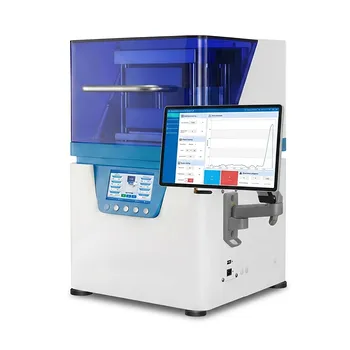
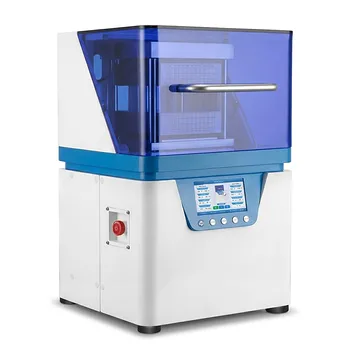
Applying uniform axial pressure via a laboratory hydraulic press is the critical step that transforms loose $x\text{BiScO}_3\text{-(1-x)BaTiO}_3$ powder into a structural "green body." This process utilizes precision-controlled force to rearrange particles, eliminate internal voids, and establish the high green density required for successful high-temperature sintering.
The laboratory hydraulic press provides the mechanical force necessary to overcome inter-particle friction, creating a dense, geometrically stable pellet. By minimizing the distance between powder grains, the press facilitates the solid-state diffusion and chemical reactions essential for producing high-performance piezoelectric ceramics.
The Role of Precision Compaction
Achieving Uniform Green Density
The primary function of the hydraulic press is to apply uniaxial pressure to homogenized powder mixtures contained within steel molds. This pressure forces loose particles to rearrange and pack tightly, significantly increasing the green density of the ceramic body.
High green density is vital because it reduces the volume of air trapped between particles. This ensures that when the material is later heated, the particles are close enough to fuse efficiently without excessive shrinkage.
Defining Geometric Dimensions
Using precision molds in conjunction with the press allows researchers to produce specimens with standardized dimensions. This geometric regularity is essential for accurate downstream measurements, such as high-precision displacement tracking in dilatometry.
A well-pressed green body possesses enough mechanical strength to be handled and transported to a furnace. Without this preliminary structural integrity, the ceramic would remain a fragile powder incapable of maintaining its shape during the firing process.
Enhancing Material Performance Through Pressure
Facilitating Solid-State Reactions
By reducing the physical distance between powder particles, the hydraulic press creates the optimal environment for diffusion-controlled chemical reactions. In $x\text{BiScO}_3\text{-(1-x)BaTiO}_3$ systems, tight particle contact is necessary for the complex ions to migrate and form the desired perovskite structure.
Enhanced contact ensures that the solid-state reaction occurs uniformly throughout the pellet. This leads to a more homogenous final product with consistent dielectric and piezoelectric properties.
Reducing Internal Porosity
The application of high axial pressure, sometimes reaching up to 300 MPa, effectively collapses macro-pores within the powder bed. Minimizing these internal gaps is a prerequisite for achieving high-density ceramics after sintering.
Reducing porosity also prevents structural defects that could lead to failure. A dense green body is less prone to warping, cracking, or deformation when subjected to the thermal stresses of a high-temperature tube furnace.
Understanding the Trade-offs and Constraints
Axial Pressure vs. Density Gradients
While uniaxial pressing is efficient, it can occasionally lead to non-uniform density distributions within the green body. Friction between the powder and the steel mold walls may cause the center of the pellet to be less dense than the surfaces.
To mitigate this, many laboratories use double-action pressing methods or lubricants. Ensuring the pressure is applied steadily and released slowly is critical to preventing "capping" or delamination of the ceramic layers.
Pressure Limits and Material Integrity
Choosing the correct pressure is a delicate balance; for instance, while 10 MPa might suffice for simple prototypes, advanced composites may require much higher forces. However, excessive pressure can lead to stored elastic energy that causes the green body to crack or explode upon removal from the mold.
The specific chemistry of $x\text{BiScO}_3\text{-(1-x)BaTiO}_3$ requires a calibrated approach to pressure. Over-compaction can hinder the release of organic binders during the initial stages of sintering, leading to internal bloating or surface blemishes.
How to Apply This to Your Project
Recommendations for Optimal Pressing
- If your primary focus is Maximum Density: Utilize higher pressures (up to 300 MPa) and consider a double-action mold to ensure a tight particle arrangement and mechanical coupling.
- If your primary focus is Geometric Precision: Use high-grade steel molds and maintain a consistent, lower pressure (e.g., 10–35 MPa) to produce regular specimens for dilatometry.
- If your primary focus is Preventing Structural Defects: Ensure a slow pressure release rate and consider adding a small percentage of binder to improve the green strength of the pellet.
By mastering the precise application of axial force, you ensure that your ceramic green bodies possess the structural and chemical foundation necessary for high-performance applications.
Summary Table:
| Feature | Impact on Ceramic Green Bodies | Key Consideration |
|---|---|---|
| Uniaxial Pressure | Rearranges particles to increase green density | Prevents excessive sintering shrinkage |
| Precision Molds | Produces standardized geometric dimensions | Essential for accurate dilatometry |
| High-Force Compaction | Collapses macro-pores and reduces porosity | Pressures up to 300 MPa for high-density |
| Particle Contact | Facilitates solid-state chemical reactions | Critical for homogenous perovskite structures |
| Controlled Release | Maintains structural integrity | Prevents delamination and "capping" effects |
Elevate Your Ceramic Research with KINTEK Precision
Achieving the perfect green body is the foundation of high-performance piezoelectric ceramics. KINTEK specializes in advanced laboratory equipment designed to meet the rigorous demands of material science. Whether you are synthesizing $x\text{BiScO}_3\text{-(1-x)BaTiO}_3$ or developing new composites, we provide the tools necessary for excellence:
- Precision Pressing: A full range of hydraulic presses (pellet, hot, and isostatic) to ensure uniform density and structural integrity.
- Sintering Solutions: High-temperature furnaces (muffle, tube, vacuum, and atmosphere) to transform green bodies into dense ceramics.
- Material Preparation: Crushing and milling systems, sieving equipment, and essential consumables like ceramics and crucibles.
- Advanced Research Tools: From high-temperature high-pressure reactors and autoclaves to electrolytic cells and battery research consumables.
Ready to optimize your laboratory workflow? Contact our technical experts today to discover how KINTEK’s comprehensive portfolio can enhance your material performance and research efficiency.
References
- Jincymol Joseph, Shujun Zhang. Low temperature sintering lead‐free dielectric <scp><i>x</i>BiScO<sub>3</sub></scp>‐(1‐<i>x</i>)<scp>BaTiO<sub>3</sub></scp> for energy storage applications. DOI: 10.1002/eom2.12331
This article is also based on technical information from Kintek Solution Knowledge Base .
Related Products
- Fully Automatic Heated Hydraulic Lab Press for Materials Sintering and Sample Preparation
- Ball Press Mold for Lab
- Automatic Hydraulic Hot Press with 500x500mm Heating Plates and Multi Stage PLC Control for Material Sintering
- 30T 40T Split Automatic Heated Hydraulic Press Machine with Heated Plates for Laboratory Hot Press
- Automatic High Temperature Heated Hydraulic Press Machine with Heated Plates for Lab
People Also Ask
- How is a laboratory hydraulic press used in the preparation of modified biochar samples for FTIR analysis? Expert Guide
- How does a laboratory heating hydraulic press contribute to the preparation of recycled graphite green bodies? - Optimize Density.
- How does the laboratory hydraulic press contribute to the preparation of solid targets for laser ablation?
- What role does a laboratory hydraulic press play in perovskite-MOF glass fabrication? Master Material Densification
- Why use a laboratory hydraulic press for Fe2O3-CoP conductivity? Achieve Precise Material Characterization