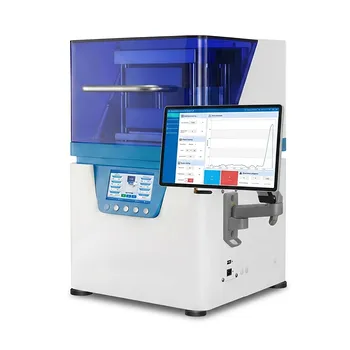
The laboratory hydraulic press is the critical tool for enabling solid-state diffusion. By compressing raw material powders into dense cylindrical pellets, the press minimizes the distance between particles and maximizes their contact area, which is essential for the chemical transformation of $GaGe_2Te$ during high-temperature annealing.
Core Takeaway: A laboratory hydraulic press transforms loose powder into a cohesive "green body," providing the physical proximity required for atoms to migrate across grain boundaries. This compaction is the primary driver for achieving a fast reaction rate and a chemically homogeneous final product.
The Role of Physical Proximity in Chemical Synthesis
Maximizing Particle Contact Area
In a solid-state reaction, the chemical transformation occurs at the interfaces where different particles touch. Laboratory hydraulic presses apply uniform vertical pressure to eliminate the air gaps inherent in loose powder mixtures. By forcing these particles into intimate contact, the press creates a high-density network that serves as the "highway" for the reaction to proceed.
Accelerating Solid-State Diffusion
Solid-state reactions are primarily limited by the speed at which atoms can move through a solid medium. The primary reference indicates that physical compaction significantly shortens the diffusion distance that elements must travel to interact. Without this compression, the reaction would be sluggish, likely resulting in unreacted raw materials or an incomplete phase transition.
Impact on Product Quality and Reproducibility
Achieving Homogeneity in $GaGe_2Te$
The homogeneity of $GaGe_2Te$—the uniform distribution of Gallium, Germanium, and Tellurium—depends on a consistent reaction environment. A hydraulic press ensures that the internal density of the pellet is uniform throughout its volume. This uniformity prevents localized "pockets" of unreacted material, leading to a high-purity final crystalline structure.
Controlling Reaction Kinetics
In complex syntheses, controlling the surface area and geometric dimensions is vital for reproducible results. Using a press allows researchers to standardize the pellet size, which ensures that heat distribution during the annealing process is consistent across different batches. As noted in supplementary contexts, this level of control is a prerequisite for quantitative studies and reliable material characterization.
Understanding the Technical Trade-offs
Pressure Thresholds and Material Integrity
While high pressure is necessary for densification, exceeding the material's structural limits can lead to delamination or "capping." If the pressure is too high, internal stresses can cause the pellet to crack or shatter upon release from the die. Conversely, insufficient pressure (under-compaction) leaves excessive porosity, which increases grain boundary resistance and slows the reaction.
The Risk of Contamination
The use of steel dies and high pressure introduces a small risk of surface contamination from the tooling. In high-purity $GaGe_2Te$ synthesis, researchers must balance the need for high compaction pressure with the potential for die-wall friction to introduce impurities. Selecting the appropriate pressure—often ranging from 30 MPa to several hundred MPa depending on the material—is a delicate calibration.
How to Optimize Pressing for Your Synthesis Goal
Applying This to Your Project
To achieve the best results when preparing $GaGe_2Te$ or similar ternary compounds, the pressing stage must be treated with the same precision as the thermal annealing stage.
- If your primary focus is Phase Purity: Use higher pressures to eliminate voids, ensuring that every particle of Ga and Ge is in direct contact with Te to prevent secondary phase formation.
- If your primary focus is Experimental Reproducibility: Document and maintain a constant "dwell time" (how long the pressure is held) to ensure every pellet reaches the same level of preliminary densification.
- If your primary focus is Structural Integrity: Increase pressure gradually and use a lubricant or specialized die coating to prevent the pellet from sticking or cracking during ejection.
Proper use of a laboratory hydraulic press bridges the gap between a simple mixture of powders and a sophisticated, high-performance solid-state material.
Summary Table:
| Feature | Impact on GaGe2Te Synthesis |
|---|---|
| Powder Compaction | Minimizes diffusion distance and maximizes particle contact area. |
| Homogeneity | Ensures uniform distribution of Gallium, Germanium, and Tellurium. |
| Standardization | Creates consistent pellet sizes for reproducible heat distribution. |
| Pressure Control | Balances densification with structural integrity to prevent cracking. |
| Reaction Kinetics | Accelerates the chemical transformation by facilitating atomic migration. |
Elevate Your Material Research with KINTEK Precision
Achieving high-purity GaGe2Te requires more than just high temperatures; it demands the physical precision of professional-grade lab equipment. KINTEK specializes in high-performance laboratory hydraulic presses (pellet, hot, isostatic) and high-temperature furnaces (muffle, vacuum, CVD) designed to optimize your solid-state reactions.
Beyond compaction, our portfolio includes crushing and milling systems, high-pressure reactors, and essential ceramic and PTFE consumables to streamline your entire workflow.
Ready to ensure consistent, high-density results in every batch? Contact us today to find the perfect equipment solution tailored to your research goals!
References
- Tobias Juhlke, Oliver Oeckler. Layered GaGe<sub>2</sub>Te: structure and chemical bonding. DOI: 10.1002/zaac.202300107
This article is also based on technical information from Kintek Solution Knowledge Base .
Related Products
- Laboratory Hydraulic Press Split Electric Lab Pellet Press
- Laboratory Hydraulic Press Lab Pellet Press Machine for Glove Box
- Laboratory Hydraulic Press Lab Pellet Press for Button Battery
- Fully Automatic Heated Hydraulic Lab Press for Materials Sintering and Sample Preparation
- Automatic Laboratory Hydraulic Pellet Press Machine for Lab Use
People Also Ask
- What role does a laboratory hydraulic press play in platinum recovery research? Enhancing Sample Precision
- What are the specific applications of a lab hydraulic press in biochar evaluation? Optimize density and data accuracy.
- What are the roles of a laboratory hydraulic press and stainless steel molds in the preparation of graphite samples?
- What is the role of a laboratory hydraulic press in electrode prep? Maximize Energy Density & Sealing Precision
- Why must a laboratory hydraulic press equipped with cylindrical molds be used when preparing BZY green bodies? High Density