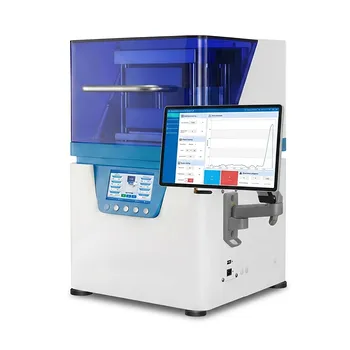
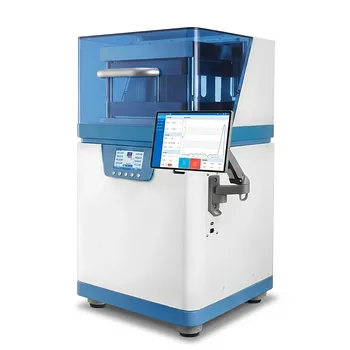
The laboratory hydraulic press is the primary tool for overcoming the inherent challenges of solid-solid contact in All-Solid-State Lithium Batteries (ASLIB).
By applying high-tonnage, precise pressure to loose electrolyte and electrode powders, the press compresses these materials into dense, low-porosity membranes. This mechanical densification is essential for eliminating interface gaps and reducing interfacial impedance, which allows for efficient lithium-ion transport across the solid-phase boundaries.
The laboratory hydraulic press transforms discrete powder particles into a cohesive electrochemical system through mechanical densification. By eliminating voids and ensuring intimate physical contact, it creates the low-resistance pathways necessary for high-performance solid-state energy storage.
Overcoming Interfacial Impedance through Densification
Eliminating Voids and Porosity
Sulfide-based solid electrolytes possess a low elastic modulus, making them highly compressible at room temperature. The hydraulic press applies pressures—often ranging from 320 MPa to 480 MPa—to eliminate the gaps between powder particles that would otherwise stall ion movement.
Reducing Grain Boundary Resistance
High-pressure compaction forces particles into close proximity, significantly lowering grain boundary resistance. This densification is fundamental to ensuring that lithium ions can move seamlessly between the active materials and the electrolyte layer.
Structural Integrity and Advanced Molding
Pelletization of Electrolyte Powders
The press is used for the cold-press molding of powders into stable, low-porosity solid electrolyte membranes. This process ensures the structural integrity of the battery components, preventing the fragile layers from crumbling during assembly or testing.
Multi-layer Co-pressing
Researchers use the hydraulic press to create double-layer or triple-layer pellets by compressing cathode, electrolyte, and anode materials simultaneously. This technique establishes a robust, integrated interface between different functional layers, which is critical for the overall efficiency of the battery.
Accurate Material Characterization
By compressing dry-coated composite powders into dense pellets, the press allows for the accurate measurement of material resistivity. This data is vital for evaluating the integrity of conductive networks and the quality of electrode coatings.
Dynamic Stability and Dendrite Inhibition
Offsetting Volume Changes
During battery cycling, materials often expand and contract; the use of constant-pressure test systems or high-precision fixtures helps manage these fluctuations. Maintaining continuous physical contact offsets volume changes, preventing the formation of performance-degrading voids.
Suppressing Lithium Dendrites
High-precision pressure is critical for maintaining the interface between the lithium metal anode and the solid electrolyte. This pressure inhibits the growth of lithium dendrites, which can cause internal short circuits and premature battery failure.
Understanding the Trade-offs
Mechanical Stress vs. Material Degradation
While high pressure is necessary for densification, excessive force can lead to the mechanical fracture of active material particles. Finding the "sweet spot" of pressure is essential to ensure contact without compromising the structural health of the materials.
Pressure Distribution Uniformity
Inconsistent pressure application can create non-uniform density across the pellet, leading to localized areas of high resistance. This can result in uneven current distribution and accelerated degradation during battery operation.
Scalability Limitations
Laboratory hydraulic presses are ideal for pellet-type cells and fundamental research, but the high pressures required are difficult to replicate in large-scale roll-to-roll manufacturing. Transitioning from batch pressing to continuous production remains a significant engineering hurdle.
Applying Pressure Parameters to Your Research
Effective interface engineering requires tailoring the pressure application to the specific chemistry and architecture of your battery.
- If your primary focus is reducing interfacial resistance: Utilize high-tonnage cold-pressing (up to 480 MPa) to maximize particle-to-particle contact and eliminate internal porosity.
- If your primary focus is long-term cycling stability: Implement constant-pressure fixtures to maintain a steady stack pressure, which offsets volume changes and inhibits dendrite growth.
- If your primary focus is material characterization: Use standardized pressure settings (e.g., 360 MPa) to ensure reproducible resistivity measurements when evaluating conductive networks.
Precision pressure application is the bridge between loose powders and a high-functioning, integrated solid-state electrochemical system.
Summary Table:
| Key Role | Impact on Battery Performance | Typical Pressure/Parameters |
|---|---|---|
| Densification | Eliminates voids & lowers interfacial impedance | 320 MPa to 480 MPa |
| Pelletization | Creates stable, low-porosity electrolyte membranes | High-tonnage cold-pressing |
| Multi-layer Co-pressing | Establishes robust interfaces between active layers | Simultaneous material integration |
| Dendrite Inhibition | Maintains anode/electrolyte contact to prevent shorts | High-precision constant pressure |
| Characterization | Ensures accurate material resistivity measurements | Standardized settings (e.g., 360 MPa) |
Elevate Your Battery Research with KINTEK Precision
Achieving the perfect interface in All-Solid-State Lithium Batteries (ASLIB) requires uncompromising precision. KINTEK specializes in advanced laboratory equipment designed to help researchers overcome interfacial impedance and material degradation.
Whether you need high-tonnage hydraulic presses (pellet, hot, or isostatic) for dense membrane fabrication, or high-temperature furnaces (vacuum, tube, or atmosphere) for material synthesis, our portfolio is engineered for excellence. We also provide a full range of battery research tools, including:
- Crushing and milling systems for powder preparation.
- High-temperature high-pressure reactors and autoclaves.
- Essential consumables like PTFE products, ceramics, and crucibles.
Don't let voids or dendrites stall your innovation. Let our experts provide the tools you need for reliable, scalable battery performance.
Contact KINTEK Today to Optimize Your Lab Setup
References
- Tongjie Liu, Jitendra Kumar. Thermal, Electrical, and Environmental Safeties of Sulfide Electrolyte-Based All-Solid-State Li-Ion Batteries. DOI: 10.1021/acsomega.3c00261
This article is also based on technical information from Kintek Solution Knowledge Base .
Related Products
- Laboratory Hydraulic Press Split Electric Lab Pellet Press
- Laboratory Hydraulic Press Lab Pellet Press Machine for Glove Box
- Laboratory Hydraulic Press Lab Pellet Press for Button Battery
- Automatic Laboratory Hydraulic Pellet Press Machine for Lab Use
- Fully Automatic Heated Hydraulic Lab Press for Materials Sintering and Sample Preparation
People Also Ask
- What role does a laboratory hydraulic press play in platinum recovery research? Enhancing Sample Precision
- What are the specific applications of a lab hydraulic press in biochar evaluation? Optimize density and data accuracy.
- What are the roles of a laboratory hydraulic press and stainless steel molds in the preparation of graphite samples?
- What is the role of a laboratory hydraulic press in electrode prep? Maximize Energy Density & Sealing Precision
- Why must a laboratory hydraulic press equipped with cylindrical molds be used when preparing BZY green bodies? High Density